

Positive signals from the US-Iran negotiations led to a cooling of energy markets last week, as investors eased concerns about potential supply disruptions in the Middle East. While energy stocks faced widespread selling pressure, some agricultural commodities maintained their recovery momentum, resulting in a clear divergence in the global commodity market during the trading week of May 19-23. At the close of the week, the MXV-Index fell 1.5%, to 2,904 points.
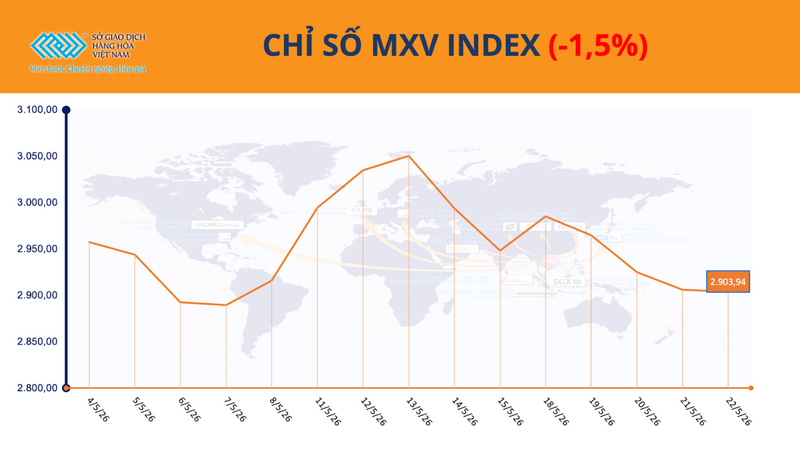
MXV-Index. Source: MXV
Oil market cools amid prospects of reopening the Hormuz.
According to the Vietnam Commodity Exchange (MXV), the global energy market experienced a volatile week as oil prices reversed course amid news related to US-Iran relations and the prospect of resuming energy flows through the Strait of Hormuz. At the close of the week, all five energy commodities were in the red. The MXV-Index for this group led the overall market decline, plummeting nearly 5% to 4,409 points.
Selling pressure emerged early in the week as the market began to mitigate the geopolitical risks that had been reflected in oil prices during the preceding period of escalating tensions. This stemmed from statements by US President Donald Trump indicating that Washington had temporarily halted new military interventions against Iran, and that the two countries had a "very good chance" of reaching an agreement regarding Tehran's nuclear program.
These signals helped ease concerns about potential supply disruptions in the Middle East, while also raising expectations that energy transport through the Strait of Hormuz could soon stabilize. As a result, oil prices fell by about 2% on Tuesday (May 19) and maintained a downward trend for most of the rest of the week.
However, the decline was not continuous, as the market saw renewed buying activity amid a tougher stance from Iran and signals indicating shrinking fuel supplies in the US. Nevertheless, positive news regarding the ongoing negotiations between Washington and Tehran continued to dominate trading sentiment this past week.
At the close of the trading week, WTI crude oil prices fell nearly 4.4%, to $96.6 per barrel. Meanwhile, Brent crude lost more than 5.2%, ending the week at $103.54 per barrel.
According to MXV, the energy market will remain volatile in the coming period. This means that the risk of disruption to shipping through the Strait of Hormuz has not been completely eliminated from the market.
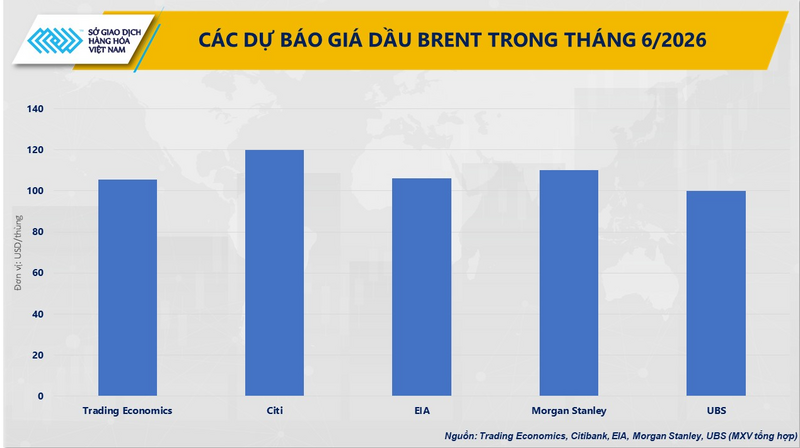
Brent crude oil price forecasts for June 2026. Source: MXV
Corn prices regained upward momentum thanks to demand and biofuels.
In the agricultural commodities sector, the corn market saw a recovery after a volatile trading week. At the end of the week, July corn futures on the CBOT rose 1.43%, closing at $182 per ton.
According to MXV, the corn market's performance last week was simultaneously influenced by US-China trade tensions, planting progress in the US, and actual international market demand.
The biggest highlight of the week came from the White House announcement that China has committed to purchasing at least an additional $17 billion worth of US agricultural products annually until 2028. This information immediately triggered short-term buying activity from hedge funds and short-term investors on the CBOT, thereby supporting a sharp surge in corn prices in the early sessions of the week.
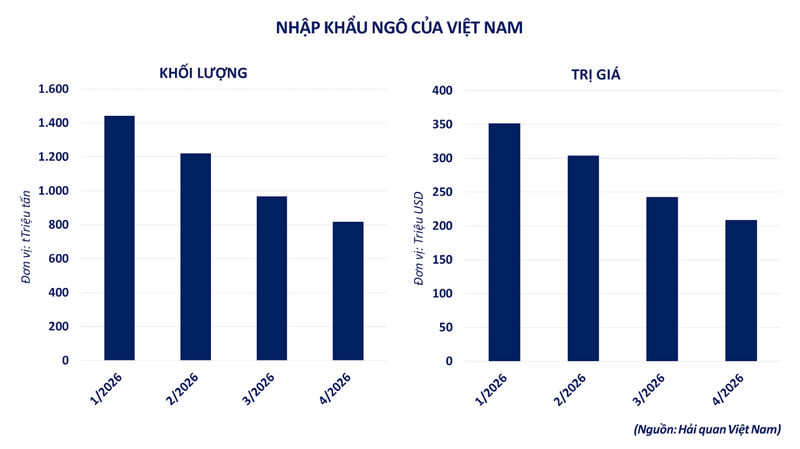
Vietnam's corn imports. Source: MXV
However, the rapid increase stalled when the Chinese Ministry of Commerce only confirmed the goal of expanding bilateral agricultural trade without mentioning the specific scale of purchases as announced by the US.
The lack of new purchase contracts, coupled with China's continued import tariffs on US agricultural products, has led to a return to a cautious market. Short-term profit-taking has resumed after the strong gains earlier in the week.
Nevertheless, the market still received significant support from actual consumption demand. The USDA's weekly export report showed sales of old-crop corn reached 2.12 million tons, far exceeding market expectations.
Of that total, Japan led with nearly 787,400 tons. In addition, steady demand from Mexico continues to bolster the consumption outlook for US corn.
In addition to the animal feed sector, the market is also receiving support from biofuels as the US House of Representatives passed a bill allowing the year-round sale of E15 gasoline nationwide. According to the International Energy Agency (IEA), ethanol production recovered last week to an average of 1.11 million barrels per day, thereby supporting the long-term outlook for corn consumption.
Domestically, import activity continues to be vibrant as supplies from India begin to return after a long period of disruption. It is expected that corn imports in May will reach nearly 1 million tons.
According to businesses, this figure could increase to nearly 1.4 million tons in June, with approximately 140,000 tons coming from India. Amidst abundant imported supplies and recovering blending demand at animal feed factories, the domestic corn market is expected to remain stable in the near future.
Source: https://congthuong.vn/gia-dau-the-gioi-giam-gan-5-458083.html
![[Image] Hanoi's urban life under the challenge of a "scorching hot" environment](https://vphoto.vietnam.vn/thumb/1200x675/vietnam/resource/IMAGE/2026/05/25/1779706979265_nang-nong-t5-2026-minh-duy-7-4636-jpg.webp)



![[Image] Close-up view of the interchange connecting the two expressways and Long Thanh Airport.](https://vphoto.vietnam.vn/thumb/1200x675/vietnam/resource/IMAGE/2026/05/25/1779703378210_ndo_br_z7863716673926-224453a31600126cce10622af6290afd-4549-jpg.webp)































































































Comment (0)