

The Standing Committee of the Gia Lai Provincial Party Committee has just issued Action Program No. 12-CTr/TU dated April 21, 2026, to implement Resolution No. 80-NQ/TW dated January 7, 2026, of the Politburo on the development of Vietnamese culture.
The program's highlight is not only affirming the role of culture, but also placing culture in its proper position in development: on par with politics, economics , and society; linking preservation with promotion; and connecting heritage with tourism, cultural industries, digital transformation, and integration.
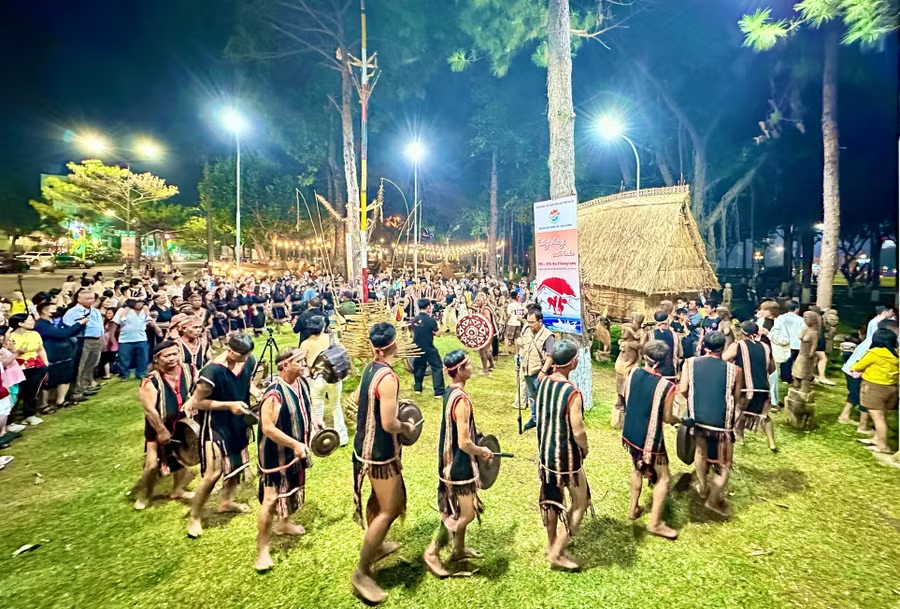
After the merger, Gia Lai possesses a vast, multi-layered, and rich cultural space. It is a blend of Central Highlands and Central Coastal cultures; of gong music, epics, and community festivals with traditional opera, folk singing, and martial arts; and of Cham cultural heritage and the Tay Son influence with the cultural life of the Kinh, Jrai, Bahnar, H'rê, and Cham ethnic groups.
It is this synergy that creates Gia Lai's unique advantage: it possesses both historical depth and the potential for new development.
Awakening cultural heritage
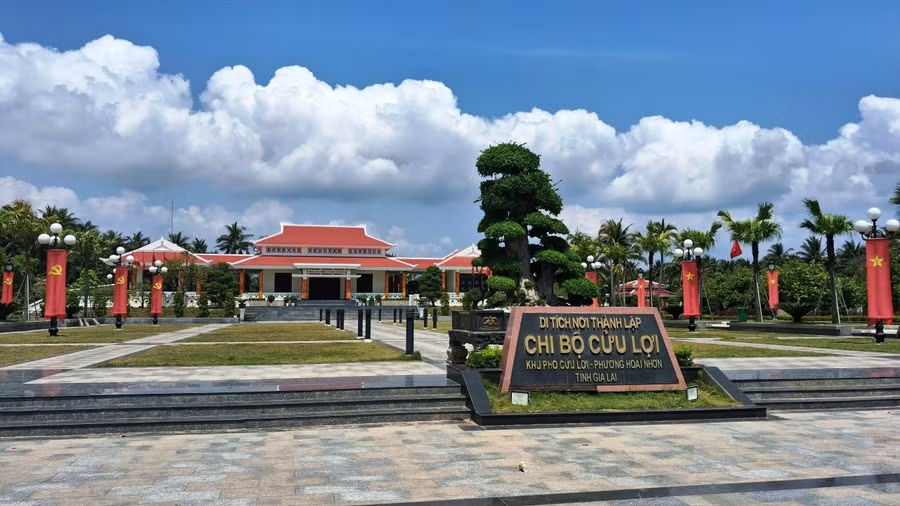
Gia Lai currently has 200 classified historical sites, including 4 special national historical sites, 44 national historical sites, and 152 provincial-level historical sites; 13 national treasures with 40 artifacts; 2 cultural heritage sites inscribed by UNESCO; and 9 heritage sites included in the National List of Intangible Cultural Heritage.
The province has 21 People's Artists, 64 Meritorious Artists, 7 People's Artisans, and 67 Meritorious Artisans; over 500 gong ensembles with more than 16,000 gong artisans; and approximately 40 groups practicing the Bài Chòi folk art form with about 300 artisans and practitioners of various art forms.
In reality, Gia Lai does not lack cultural resources. The challenge lies in transforming these resources into assets, turning identity into advantages, and transforming heritage into products that have vitality in contemporary life. This is also the overarching spirit of Action Program No. 12-CTr/TU.
The specific goals set are that by 2030, Gia Lai province strives to ensure that 100% of local governments at both levels and the armed forces have cultural institutions; and 90% of grassroots cultural institutions operate regularly and effectively. Specifically for 2026, the province aims to complete the digitization of 100% of cultural heritage sites that have been classified as national or special national heritage sites; and by 2030, 80% of provincial-level cultural heritage sites will be digitized.
In addition, plans for restoration, preservation, and promotion of the value of 100% of special national monuments, 70% of national monuments, and 40% of provincial-level monuments have been developed. 100% of students and trainees have regular access to and participation in art and cultural heritage education activities. 100% of communes and wards have been invested in with grassroots communication systems applying information and telecommunication technology.
The program requires that at least 2% of the total annual budget be allocated to culture, with this amount gradually increasing as practical needs arise. This is a new message and approach, not just general statements or slogans, but quantified by goals, targets, a roadmap, and the responsibilities of the implementing organizations.
A highlight of the Action Program is the identification of three key cultural industry brands that need to be focused on and implemented: Binh Dinh traditional martial arts, Gia Lai gong culture space, and cultural tourism. These brands have both historical roots and the potential to create products, markets, and attractions for domestic and international tourists.
Gia Lai province also aims to develop service, tourism, entertainment, and bio-tourism centers in Ghenh Rang, De Gi, Bien Ho - Chu Dang Ya Volcano, and Kon Ha Nung plateau; develop two live performance art shows into cultural industry products; organize the International Vietnamese Traditional Martial Arts Festival and the International Gong Festival in Gia Lai every two years; and strive for Binh Dinh Traditional Martial Arts to be inscribed by UNESCO as a representative intangible cultural heritage of humanity.
This approach demonstrates that cultural heritage should not only be preserved, but also digitized, retold, performed, and connected to tourism, education, media, and the creative economy. Cultural identity should not only be preserved within festivals or community spaces, but must become a valuable product with a market and widespread appeal.
Creating momentum for rapid and sustainable development.
To realize the aforementioned goals, Gia Lai province has set forth seven main groups of tasks and solutions. The focus is on: reforming thinking, unifying understanding and action; perfecting institutions and policies; building a comprehensively developed Gia Lai population; reforming cultural management towards a constructive and service-oriented approach; promoting science and technology, innovation, and digital transformation; developing the cultural industry in conjunction with tourism; mobilizing resources and improving the quality of human resources; and expanding cultural cooperation and integration.
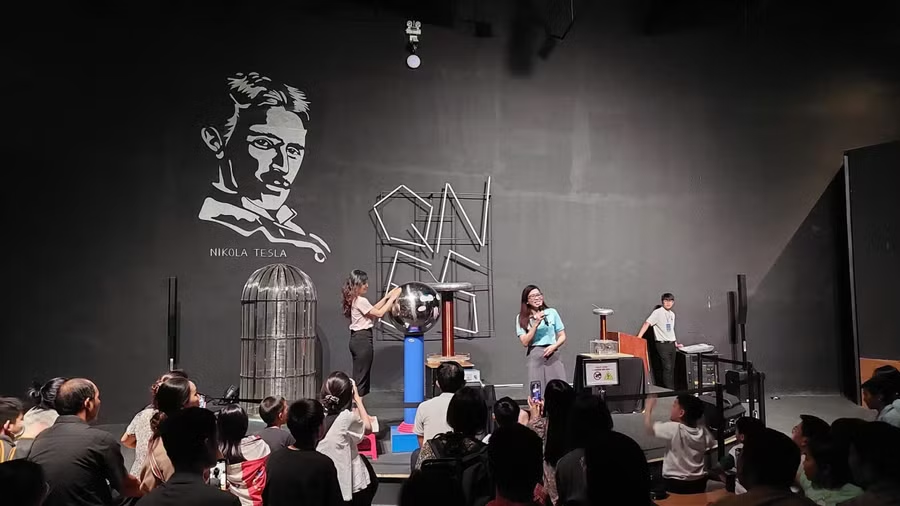
In this context, the commune and ward levels are identified as the crucial core of community cultural life at the grassroots level; this is closely aligned with the practical realities of the two-tiered local government model. Culture, to truly permeate life, must begin at the grassroots. Cultural institutions, to be effective, must be closely connected to the people, villages, hamlets, and neighborhoods. For digital transformation in culture to be truly meaningful, it must help people more easily access digital libraries, digital museums, cultural heritage data, online performing arts, and new cultural services.
The program also emphasizes the role of artists, intellectuals, folk artisans, influential figures, religious leaders, businesspeople, and the community in creating, preserving, and disseminating positive cultural values. These are the forces that ensure culture not only exists in written form, but also lives within each community, each family, and each social space.
Gia Lai province is facing new development demands. To move quickly, resources are needed. To move sustainably, a solid foundation is essential. Culture is that foundation. When heritage is revived, when people are placed at the center, when identity becomes a brand, and when cultural industries are linked to tourism and digital transformation, Gia Lai province will have a strong impetus for rapid and sustainable development.
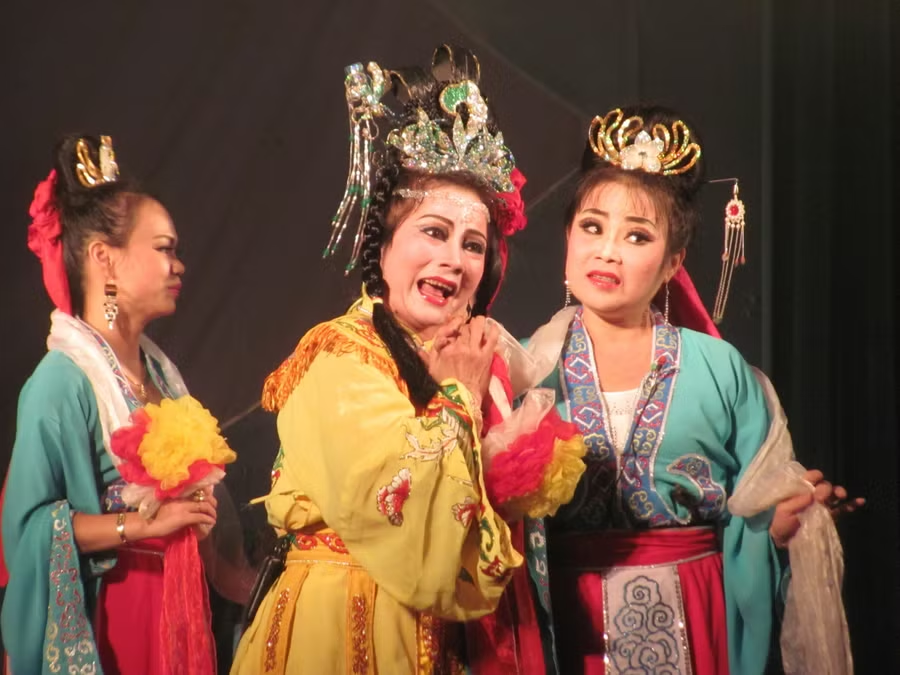
Therefore, Action Program No. 12-CTr/TU is not just a document implementing a Central Committee resolution. It is also the basis for action at all levels and sectors of Gia Lai province; cultural development does not lag behind socio-economic development, but rather goes hand in hand with it, deeply permeates it, and creates a driving force for development. From forests to seas, from gongs to folk singing and traditional theater; from traditional martial arts to cultural tourism..., Gia Lai province has the potential and opportunity to transform its cultural treasures into a driving force for development in the new era.
Source: https://baogialai.com.vn/gia-lai-danh-thuc-nguon-luc-van-hoa-cho-phat-trien-post585808.html
![[Image] Hanoi's urban life under the challenge of a "scorching hot" environment](https://vphoto.vietnam.vn/thumb/1200x675/vietnam/resource/IMAGE/2026/05/25/1779706979265_nang-nong-t5-2026-minh-duy-7-4636-jpg.webp)
![[Image] Close-up view of the interchange connecting the two expressways and Long Thanh Airport.](https://vphoto.vietnam.vn/thumb/1200x675/vietnam/resource/IMAGE/2026/05/25/1779703378210_ndo_br_z7863716673926-224453a31600126cce10622af6290afd-4549-jpg.webp)


































































Comment (0)