

According to the Ministry of Information and Communications , the website at the address "vietgcv[.]cc", which impersonates the Ministry's portal, is one of 20 fraudulent websites that the National Cybersecurity Monitoring Center - NCSC under the Information Security Department (Ministry of Information and Communications) has recommended people be vigilant about, avoiding accessing and following instructions from malicious actors.
Just before that, in early April, the Cybersecurity Department warned about a case where fraudsters set up a website at the domain name "policeonline[.]club", impersonating the website of the Cybersecurity Monitoring Center to post 'advertisements offering support in recovering money lost in scams with a 99.9% success rate', causing many people to be scammed and have their assets stolen once again.
According to statistics, in just the first three weeks of April 2024, the Information Security Department's online safety system (canhbao.khonggianmang.vn) received nearly 630 user reports about online scams. Through investigation and analysis, experts from the Information Security Department found that many scams involved impersonating major agencies, organizations, businesses, and service providers such as government ministries, social networks, banks, email services, and public services.
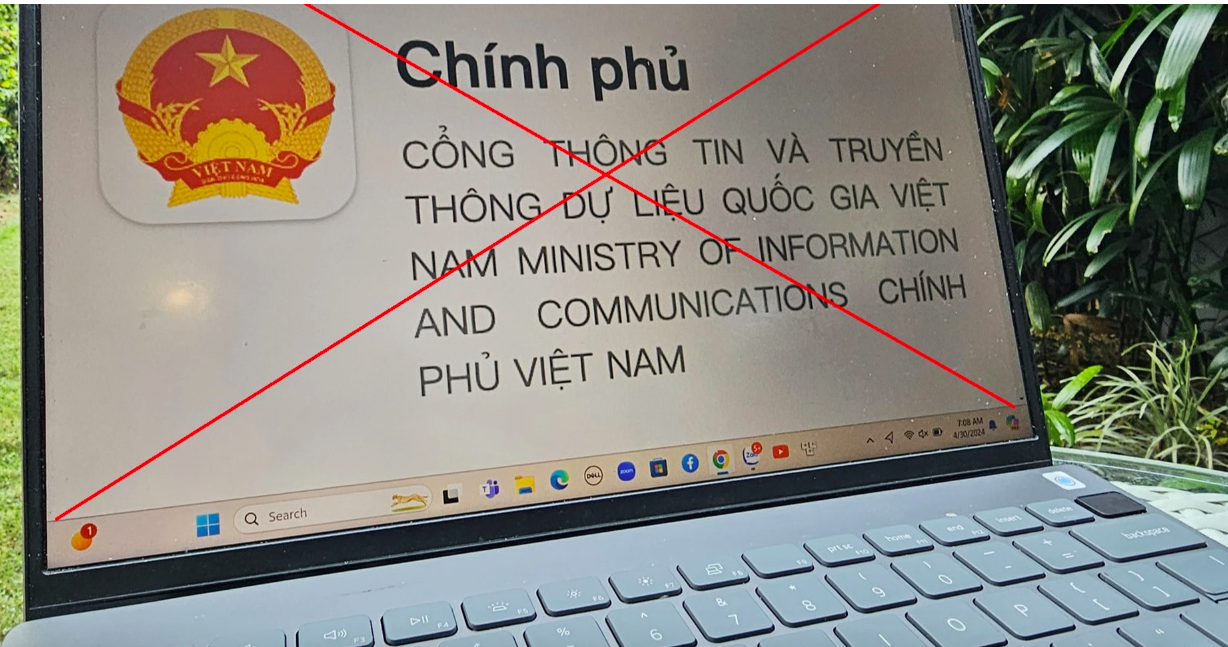
The website interface mimics the official portal of the Ministry of Information and Communications.
Based on user feedback and the results of scanning and monitoring Vietnam's cyberspace over the past month, the Information Security Department has specifically advised people to be vigilant and avoid accessing 44 fraudulent and fake websites. The number of fraudulent and fake websites that the agency warned online users about in March 2024 was over 100.
Notably, in the past two months, scammers have continued to create fake websites impersonating national public services with various domain names, all of which are international domains, specifically: Dichvucong[.]cvgov[.]com; Dichvucong[.]xgovvn[.]net; Dichvucong[.]dulieuqucogia[.]com...
Thus, as of April 21st, the national online fraud prevention database has updated over 124,600 fake websites related to online fraud. This database is now directly connected to the Cốc Cốc browser and the Zalo and SafeGate systems to automatically protect domestic internet users from online fraud websites.
As of the first quarter of 2024, the technical system of the Ministry of Information and Communications, specifically the Cybersecurity Department, had proactively blocked more than 10,000 malicious domains, including over 2,700 online phishing domains.
As a result, it has protected over 10.1 million people, equivalent to more than 13.1% of Vietnamese internet users, from online phishing attacks and violations of the law in cyberspace.
In parallel with regularly or unexpectedly issuing warnings about fake and fraudulent websites, as well as providing guidance on identifying and preventing common forms of fraud, the Information Security Department has been providing many free technological tools to help people detect malware in network systems, check for information leaks, or independently verify suspected fraudulent or fake websites.
In addition to warning users, experts from the Information Security Department also recommend that agencies, organizations, and businesses proactively scan to detect fraudulent websites and those impersonating their entities early, and provide early warnings to users.
This, in turn, helps prevent online fraud, ensures information security for users, and protects the organization's brand .
Source

![[Photo] Prime Minister Pham Minh Chinh presides over a meeting on private sector economic development.](/_next/image?url=https%3A%2F%2Fvphoto.vietnam.vn%2Fthumb%2F1200x675%2Fvietnam%2Fresource%2FIMAGE%2F2025%2F12%2F20%2F1766237501876_thiet-ke-chua-co-ten-40-png.webp&w=3840&q=75)

![[Photo] Prime Minister Pham Minh Chinh presides over the conference announcing the establishment of the International Finance Centre in Vietnam.](/_next/image?url=https%3A%2F%2Fvphoto.vietnam.vn%2Fthumb%2F1200x675%2Fvietnam%2Fresource%2FIMAGE%2F2025%2F12%2F21%2F1766309817714_ndo_br_dsc-3400-jpg.webp&w=3840&q=75)





























































































Comment (0)