

 |
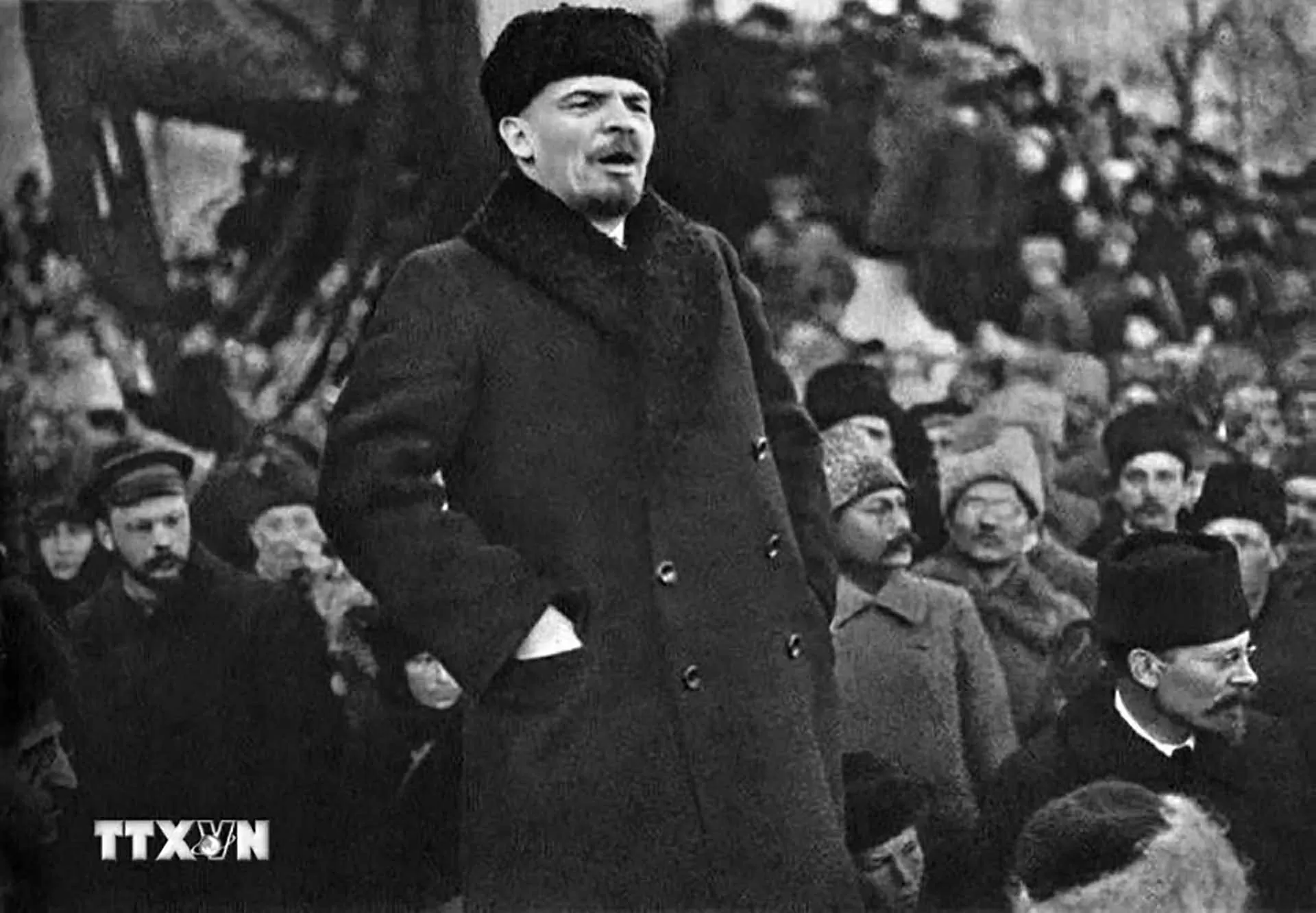
| Vladimir Ilyich Lenin – the great leader of the world proletariat, founder of the Communist International; and leader of the Russian people in the October Revolution, establishing the first workers' and peasants' state in the world led by the party of the proletariat. (Source: VNA) |
As a great thinker and outstanding political theorist, Vladimir Ilyich Lenin made immense contributions throughout his revolutionary life to the liberation of working people worldwide, the struggle against imperialism, and the fight for peace, independence, and freedom of nations.
Lenin was born on April 22, 1870, 155 years ago.
The great lighthouse of the working people
Lenin, whose real name was Vladimir Ilyich Ulyanov, was born on April 22, 1870, into a progressive intellectual family in the city of Simbirsk, Russia (now Ulyanovsk). From a young age, through his family and relatives, Lenin absorbed progressive ideas and hated the autocratic regime of the Russian Tsar.
At the age of 18, he studied the works of Karl Marx, Friedrich Engels, Georghi Valentinovitr Plekhanov, and began participating in the revolution, propagating Marxist ideology.
In 1891, Lenin graduated in Law from St. Petersburg University and, from 1893, became the leader of the Marxist group in Saint Petersburg. In 1894, Lenin joined the Russian Social Democratic Party. From there, he was one of the organizers and leaders of the Russian Revolution.
Lenin's revolutionary activities were incredibly rich. He was the first to creatively apply the principles of Marxism to the practical realities of Russia; he prepared politically, ideologically, and organizationally for the establishment of the Russian Social Democratic Workers' Party – the predecessor of the Bolshevik Communist Party of Russia, a new type of proletarian party that led the working class and people of Russia to the Great October Revolution and the construction of socialism in the Soviet Union; he was the one who transformed Marxism from theory into reality.
Following the October Revolution (1917), Lenin led the Bolsheviks and the Russian working people in a victorious struggle against internal and external enemies, firmly defending the achievements of the revolution and successfully protecting the existence of the world's first workers' and peasants' state. Lenin was the chief architect of the directions and plans for building socialism in the Soviet Union, especially the New Economic Policy (NEP).
Lenin was also an active advocate for proletarian internationalism, founding the Communist International (Third International) to lead the international communist and workers' movement, uniting all revolutionary forces in the struggle against imperialism. He creatively applied the principles of Marxism to resolving the relationship between national and international elements in the revolutionary struggle of the proletariat.
At the same time, it developed the Marxist national question into the national and colonial question in the imperialist era; put forward programmatic principles of the proletariat on the national question; considered the national liberation movement as a part of the world proletarian revolution; and criticized narrow nationalism as well as great-power chauvinism.
Marx's slogan "Workers of the world unite!" was developed by Lenin into "Workers of the world and oppressed peoples unite!"
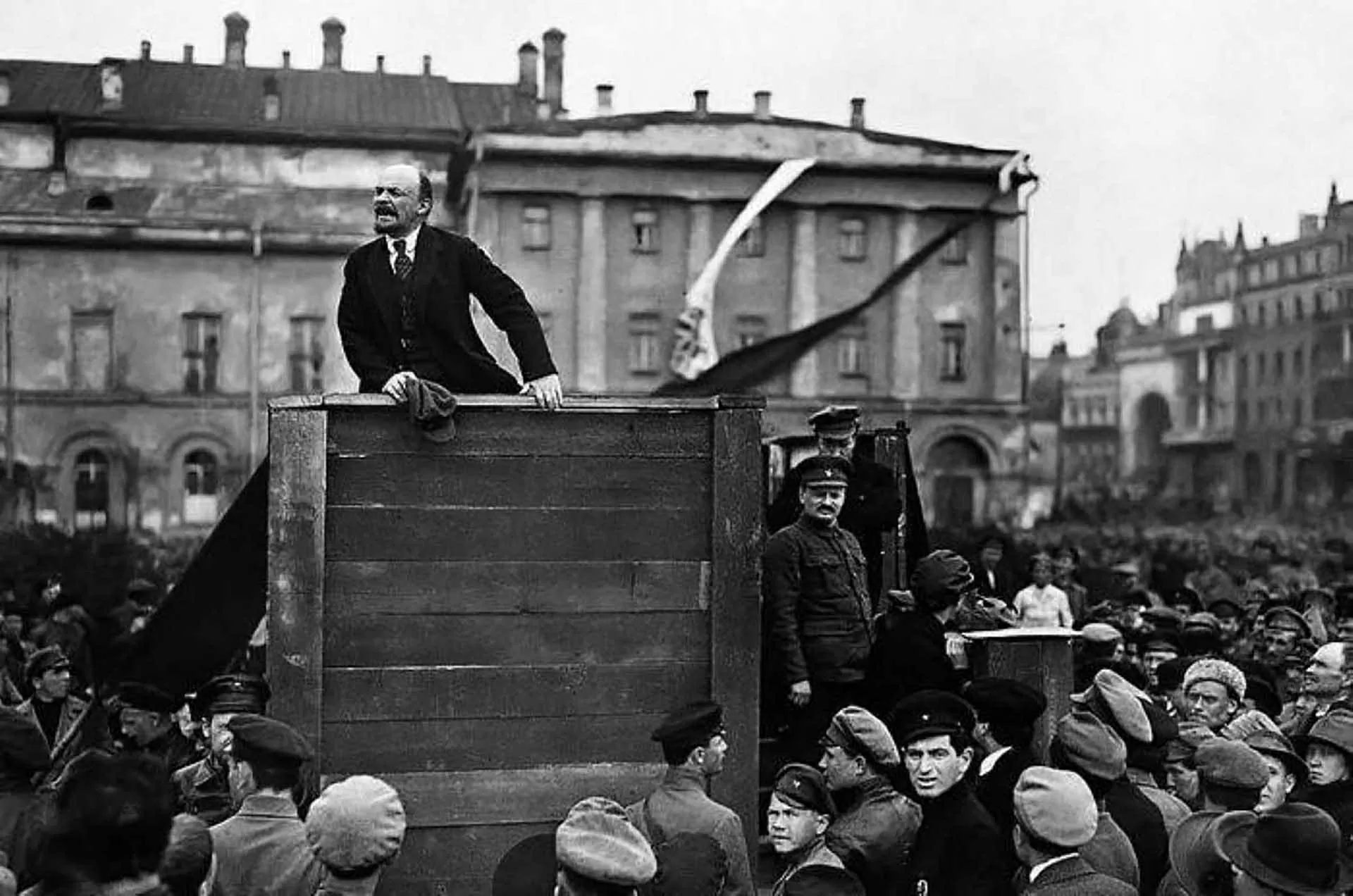 |
| VI Lenin delivering a speech in Red Square in Moscow during the celebration of the first anniversary of the Great October Russian Revolution, November 7, 1918. (Source: VNA) |
Under Lenin's banner, the Union of Soviet Socialist Republics and the world socialist system were formed; fascism was destroyed; oppressed peoples rose up for national independence, causing the colonial system of imperialism to disintegrate. Immediately after the Russian October Revolution, other revolutions took place in Austria, Hungary, Germany, Turkey, and China. The Bavarian Soviet Republic, the Hungarian Soviet Republic, the Bremen Soviet Republic, and the Slovak Soviet Republic were proclaimed. Soviet councils were established in Ireland as well as in northern Italy…
Lenin's name has been associated with the greatest revolutionary transformations in human society from the beginning of the 20th century to the present day. As President Ho Chi Minh wrote: "Lenin was the one who implemented and developed Marxism. He was the father of the proletarian revolution and the national liberation revolution. He was the teacher who created revolutionary fighters throughout the world, not only with the most scientific revolutionary theory, but also with the noblest revolutionary ethics."
Throughout his revolutionary life, Lenin was repeatedly arrested, imprisoned, exiled, and targeted for assassination. Yet, Lenin always shone as a shining example of unwavering revolutionary spirit, of a resolute will to liberate the working class and the working people, of lofty revolutionary moral qualities, and of a simple, pure, and people-friendly lifestyle. Lenin died on January 21, 1924, in the village of Gorki, Moscow. His remains are interred in the mausoleum in Red Square.
Great contributions to humanity
Like Marx and Friedrich Engels in the 19th century, V.I. Lenin emerged in the 20th century as one of the greatest scientists in the revolution and one of the greatest revolutionaries in science. He was not only a faithful successor to the scientific and revolutionary doctrines of Marx and Friedrich Engels, but also comprehensively developed and expanded Marxist theory, elevating it to new heights, transforming theory into socialist revolutionary practice; making Marxism truly the dominant ideology in the international communist and workers' movement; and helping the proletariat worldwide and oppressed peoples unite in a single front against their common enemy—reactionary capitalism—to defend their legitimate human rights.
Throughout his life, dedicated to the revolutionary cause of the working class, the working people, and the oppressed nations worldwide, Lenin left behind a vast legacy. This includes a precious intellectual and theoretical heritage; and a exemplary moral character, a model of a true communist who devoted his life to the struggle for national liberation, class liberation, and the liberation of humanity from oppression and enslavement.
It can be said that, throughout his revolutionary career, Lenin contributed many great achievements to humanity, both in theory and practice.
Theoretically, Lenin synthesized the entirety of Marxism in a scientific, systematic, and fundamental way. While defending Marxism against distortions by populists, Machists, opportunists, revisionists, and the counter-revolutionary rhetoric of many other bourgeois thinkers, Lenin added many enduring truths to all three constituent parts of Marxism, including:
In philosophy, these include topics such as the dialectical materialist worldview and the dialectical materialist method, the theory of knowledge, the subjective factor in social revolution, the role of the masses and individuals in history, the relationship between social existence and social consciousness, the state, and the dictatorship of the proletariat…
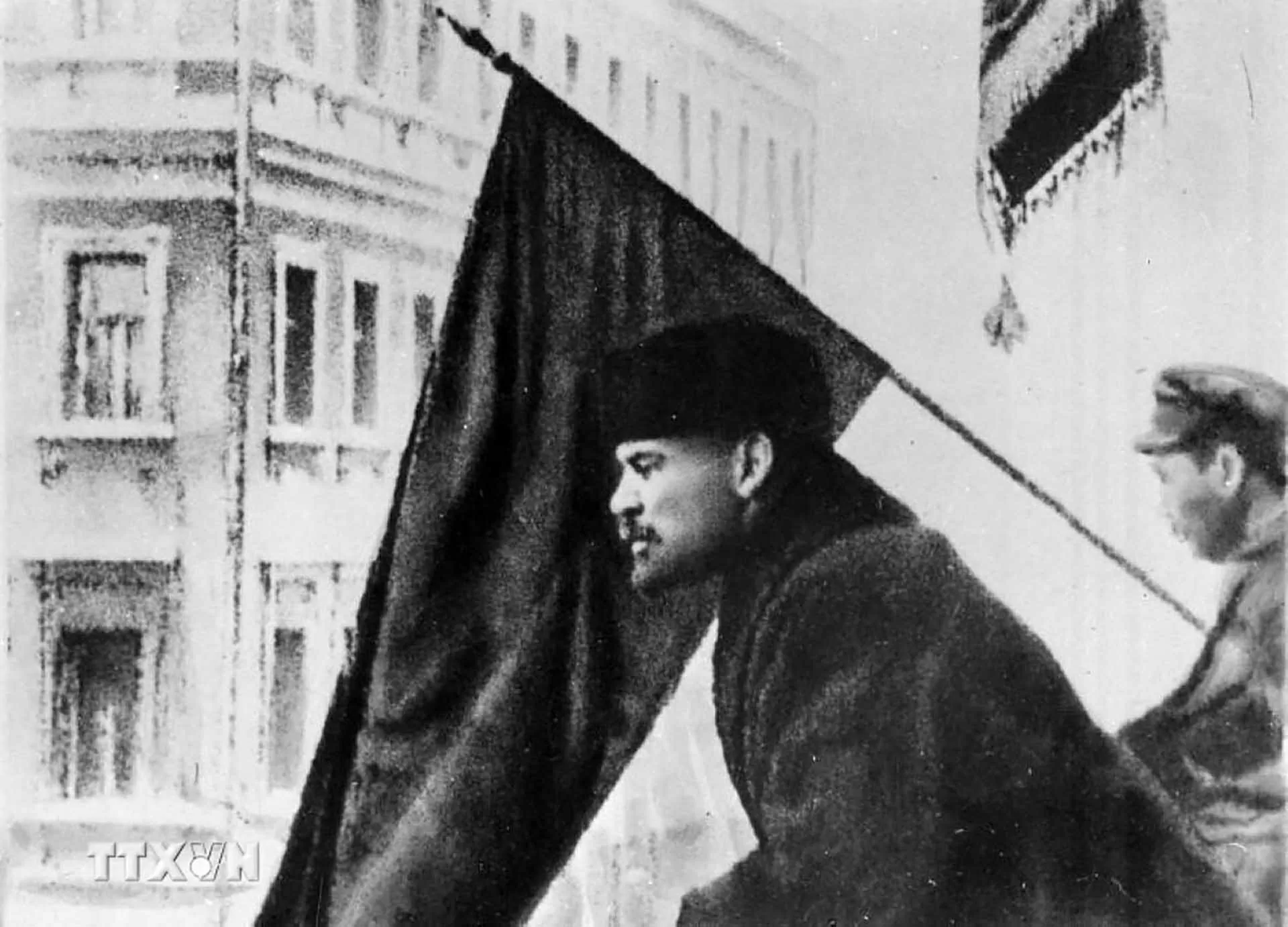 |
| From Soviet headquarters (Moscow), Vladimir Ilyich Lenin speaks to the Red Army before they depart for battle (October 16, 1919). (Source: VNA) |
In political economy, Lenin was the first to propose a plan for advancing towards socialism in a country where the proletariat had seized power but the economic and cultural prerequisites for socialism were incomplete. This was the New Economic Policy (NEP), a multi-sector economic system whose goal was to develop production to liberate workers on the basis of advanced technology and the ownership of the working people under the management of the proletarian dictatorship.
Lenin also identified the fundamental socio-economic tasks of decisive importance throughout the transitional period to socialism as the practical implementation of the socialization of production, with the basic tasks of industrialization, gradually transforming small-scale production into large-scale production through collectivization, while simultaneously carrying out a cultural revolution, constantly raising the political awareness, educational level, and scientific and technical skills of the people, resolutely fighting to eliminate old ideas and customs, and strongly promoting the revolutionary enthusiasm and creative spirit of the people…
In scientific socialism, Lenin enriched it with theories about the possibility of the proletarian revolution's victory first in some countries, or even in a single country; about the characteristics of capitalism in the imperialist stage; about the transitional period with its transitional forms, "transitional steps," the fundamental contradictions of the transitional period; the characteristics and essence of the transitional period…
Thanks to Lenin's contributions, Marxism developed into Marxism-Leninism – a doctrine that fully embodies the unity of scientific, revolutionary, and humanistic values of its founders, defenders, and developers.
In practice, under Lenin's leadership, the victory of the 1917 October Socialist Revolution in Russia transformed socialism from theory into reality. Unlike previous revolutions, the October Socialist Revolution in Russia did not replace one form of exploitation with another; instead, it established the dictatorship of the proletariat, eliminating all forms of exploitation. This created a fundamental turning point in history, ushering in a new era for humanity – the era of transition from capitalism to socialism on a global scale.
As the leader of the working class, the working people, and the oppressed nations worldwide, Lenin was not only concerned with the fate of Russia, but also deeply concerned with the fate of colonial peoples. Through the creative application of Marxist principles and the summation of the practical experience of the Russian Revolution, Lenin correctly and scientifically identified the relationship between the national question and the colonial question in the imperialist era, between the national and international elements in the revolutionary struggle of the proletariat; and at the same time, outlined the fundamental issues facing the proletariat in its struggle for national liberation.
Lenin's ideas on the solidarity of the working class in all countries; the fact that oppressed peoples are subjects in the revolutionary process; and the unity of the world's proletariat and oppressed peoples… also served as strategic guidance, driving the struggles for independence on a global scale and fueling movements for freedom and democracy in capitalist countries.
Vietnam remains steadfast in its adherence to Marxism-Leninism and Ho Chi Minh Thought.
The burning desire for independence and freedom for the people and the country motivated Nguyen Ai Quoc - President Ho Chi Minh - to embark on a journey to find a way to save the nation. He read V.I. Lenin's "First Draft on the National and Colonial Question." Upon reading Lenin's "Draft Theses," he was deeply moved: "Sitting alone in my room, I spoke aloud as if addressing a large crowd: 'Oh, my suffering and oppressed compatriots! This is what we need, this is the path to our liberation!'"
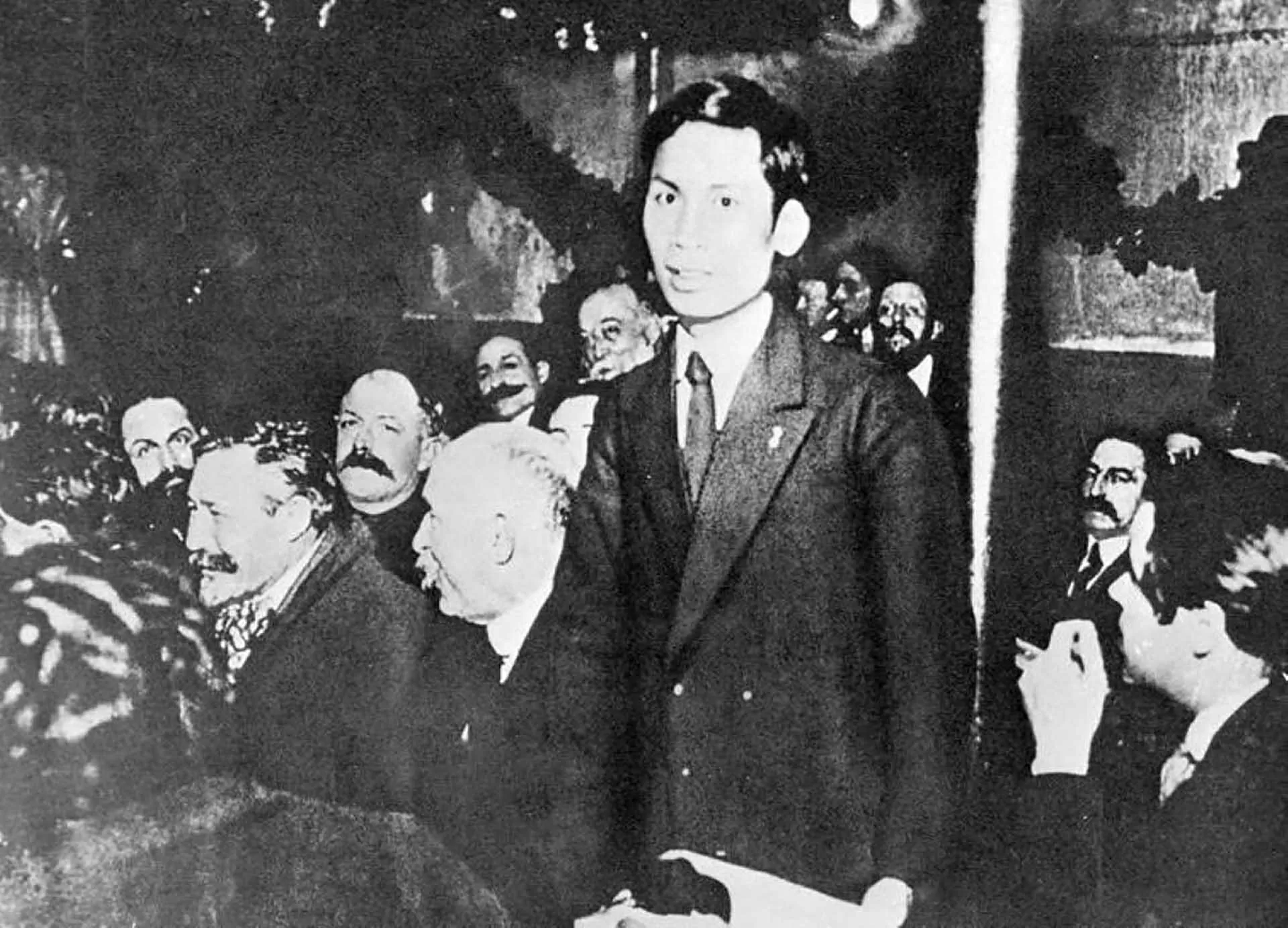 |
| In December 1920, the patriotic young man Nguyen Ai Quoc (the name of President Ho Chi Minh during his revolutionary activities in France) attended the 18th Congress of the French Socialist Party in Tours as a delegate to Indochina. Nguyen Ai Quoc supported Lenin's Thesis on the National and Colonial Question; he endorsed the establishment of the French Communist Party and became one of its founders, as well as the first Vietnamese Communist. (Source: VNA) |
It is clear that Lenin's "First Draft of the Theses on the National and Colonial Questions" marked a fundamental qualitative turning point in the development of Nguyen Ai Quoc-Ho Chi Minh's awareness, ideology, and political stance in his search for a path to national salvation. From this point, the correct direction for the national liberation cause was determined, ending the long and profound crisis regarding the revolutionary path of Vietnam.
President Ho Chi Minh regarded Lenin's ideas and the lessons of the Russian October Revolution as a "magical handbook," but he did not simply copy them. Instead, he absorbed their spirit and creatively applied them to the practical conditions of the Vietnamese revolution. He founded and nurtured the Communist Party of Vietnam, transforming it into the vanguard of the working class, possessing the prestige and capacity to lead the Vietnamese people through countless difficulties and challenges to achieve national independence, unify the country, and advance the entire nation towards socialism.
It can be affirmed that, from the first time President Ho Chi Minh read Lenin's "First Draft of the Theses on the National and Colonial Questions," to the present day, Lenin's theory in particular, and Marxism-Leninism in general, have always accompanied and guided the Vietnamese nation in achieving great victories in the national democratic revolution, the socialist revolution, and in the cause of renovation, construction, and defense of the Fatherland.
The great victories and historically significant achievements on the Vietnamese revolutionary path over the past 95 years have left the Party and the people with invaluable lessons. One of the major lessons is the lesson of independence and self-reliance in accurately assessing the situation, in creatively applying the theory and methodology of Marxism-Leninism to the specific circumstances of our country, and in learning from the experiences of other countries.
This lesson stems from Lenin's dialectical and creative thinking. In any period of the revolution, if we know how to apply Marxism-Leninism creatively, we will achieve victory; conversely, if we deviate from dialectical thinking and adhere to dogmatic rigidity, we will inevitably make mistakes and suffer losses.
Amidst a global and domestic situation fraught with both opportunities and challenges, the Party and the people of Vietnam remain steadfast on the revolutionary path: national independence linked with socialism; taking Marxism-Leninism and Ho Chi Minh Thought as the ideological foundation and guiding principle for all actions.
Therefore, even though time has passed and the world has undergone tremendous changes, V.I. Lenin's ideas remain a guiding light for the struggle for peace, national independence, democracy, people's livelihoods, progress, and social justice throughout the world.
Every year, commemorations of Lenin's birth and death anniversaries provide an opportunity for generations of Russians, as well as people around the world, to remember Lenin's immense contributions and affirm that the legacy he left for humanity remains relevant today.
Source: https://baoquocte.vn/gia-tri-vung-ben-trong-tu-tuong-cua-vilenin-311938.html
![[Image] Hanoi Police officially crowned champions of V-League 2025/2026](https://vphoto.vietnam.vn/thumb/1200x675/vietnam/resource/IMAGE/2026/05/31/1780244769054_ndo_br_039d561b692be875b13a-jpg.webp)










![[Photo] The General Secretary, President and his wife begin their state visit to the Philippines.](https://vphoto.vietnam.vn/thumb/1200x675/vietnam/resource/IMAGE/2026/05/31/1780230559452_anh-man-hinh-2026-05-31-luc-19-28-11.png)



















































Comment (0)