

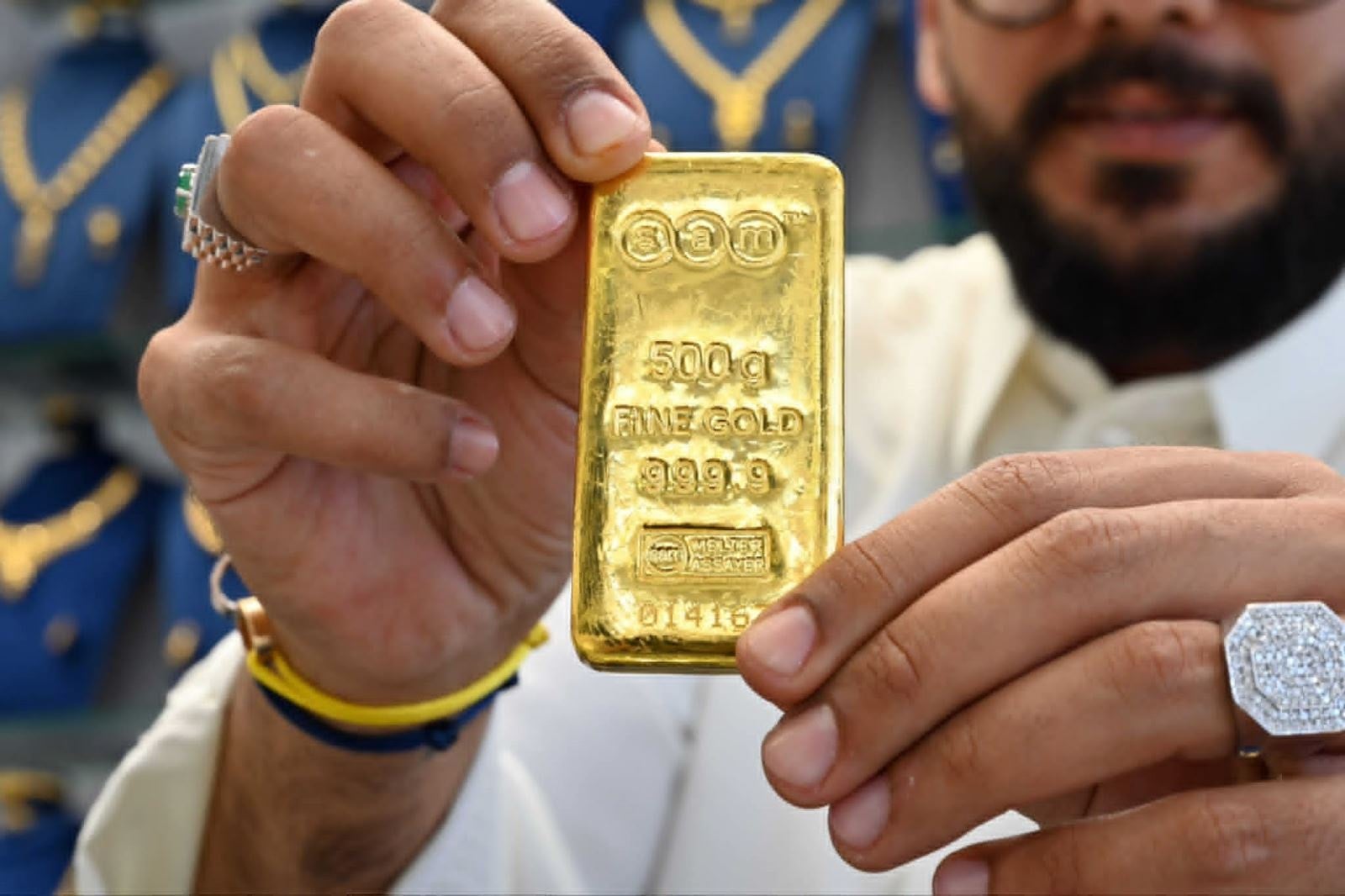
World gold prices fluctuate sharply.
The international gold market started the new week in a state of intense tug-of-war between safe-haven demand and monetary policy pressure. On May 18, 2026, the spot gold price opened at $4,539.09 per ounce. This is a relatively high price level after a period of strong gold price increases driven by geopolitical concerns and global inflation hedging needs.
In the first two trading sessions of the week, risk aversion in the Middle East helped gold prices surge quite strongly. By May 19th, world gold prices briefly jumped to $4,588.64 per ounce – the highest level of the week. However, the upward momentum did not last long. As the US dollar recovered and US bond yields rose, the market quickly entered a period of strong profit-taking.
Selling pressure intensified significantly on May 20th as investors collectively adjusted their expectations regarding the US Federal Reserve's interest rate policy. Spot gold prices fell to a weekly low of around $4,453 per ounce before recovering slightly in the final sessions of the week.
At the close of trading on the morning of May 24th, world gold prices stood around $4,523.20 per ounce, about $16 per ounce lower than at the beginning of the week, marking the second consecutive week of decline.
This development reflects growing caution in international financial markets. Minutes from the FOMC meeting released this week showed the Fed maintaining a hawkish stance, not yet ready to ease monetary policy as US inflation continues to remain high. Fed Governor Christopher Waller emphasized that inflation risks remain, particularly in the context of volatile energy prices due to geopolitical instability.
The Fed's signal that it will maintain high interest rates for an extended period has driven up US Treasury yields sharply. The 30-year yield is currently above 5%, while the 10-year yield is around 4.5-4.6%. This is seen as significant pressure on gold and silver because the opportunity cost of holding non-yielding assets is increasing. Consequently, the US dollar continues to strengthen, causing speculative capital to move away from the precious metals market.
Furthermore, weakening US consumer confidence data coupled with rising inflation expectations is adding pressure to the market. Investors are now losing confidence in the Fed's ability to cut interest rates soon this year. According to many experts, a prolonged high-interest rate environment will make it difficult for gold to return to the strong upward trend seen earlier in the year.
Notably, pressure on gold is currently coming not only from monetary policy but also from changes in the behavior of investment funds and central banks. Some international experts believe that the gold market is entering a "revaluation" phase after a prolonged period of excessive price increases lasting for many months. Liquidity on futures exchanges has decreased significantly, reflecting the cautious sentiment of speculators regarding the risk of further deep price corrections.
Marc Chandler, CEO of Bannockburn Global Forex, believes that gold cannot confirm a new uptrend until it surpasses the $4,600/ounce mark. He warns that the risk of a further decline remains, especially if the US dollar continues to strengthen and US bond yields remain high. According to him, if tensions in the Middle East persist, some countries like Turkey or the Gulf states may have to sell off their gold reserves to support their economies , thereby adding further downward pressure on the precious metals market.
Meanwhile, Adrian Day, President of Adrian Day Asset Management, believes that gold may continue to fluctuate sharply but is leaning towards a slight upward trend due to the fact that safe-haven demand has not completely disappeared.
Conversely, Rich Checkan, President of Asset Strategies International, assesses the risk of the Fed continuing to maintain high interest rates or even raising them again as a major negative factor for gold. According to him, recent US CPI and PPI data have both risen more sharply than expected, causing the market to increasingly narrow expectations of monetary easing this year.
Kitco News' weekly survey shows that Wall Street analysts remain bearish in the short term. Of the 13 experts surveyed, only 15% predicted a rise in gold prices next week, while 62% believed gold would continue to fall and 23% expected prices to remain stable. Meanwhile, individual investors maintained a positive sentiment, with 56% expecting a rebound in gold prices.
Analysts believe that next week will be a particularly important period for the gold market as a series of US economic data releases are announced, including first-quarter GDP, PCE inflation index, jobless claims, and new home sales. These will be key indicators for the market to better determine the Fed's policy path in the second half of 2026.
Domestic gold prices have fallen sharply, and there are signs of a shift in capital flows.
Domestically, gold prices last week were even more negative than in the international market. At the beginning of the week on May 18th, SJC gold bars were trading around 160.5 million VND/ounce for buying and 163.5 million VND/ounce for selling. By the morning of May 24th, the price had fallen to approximately 159 million VND/ounce for buying and 162.03 million VND/ounce for selling. Thus, in just one week, each ounce of SJC gold decreased by about 1.5-2 million VND.
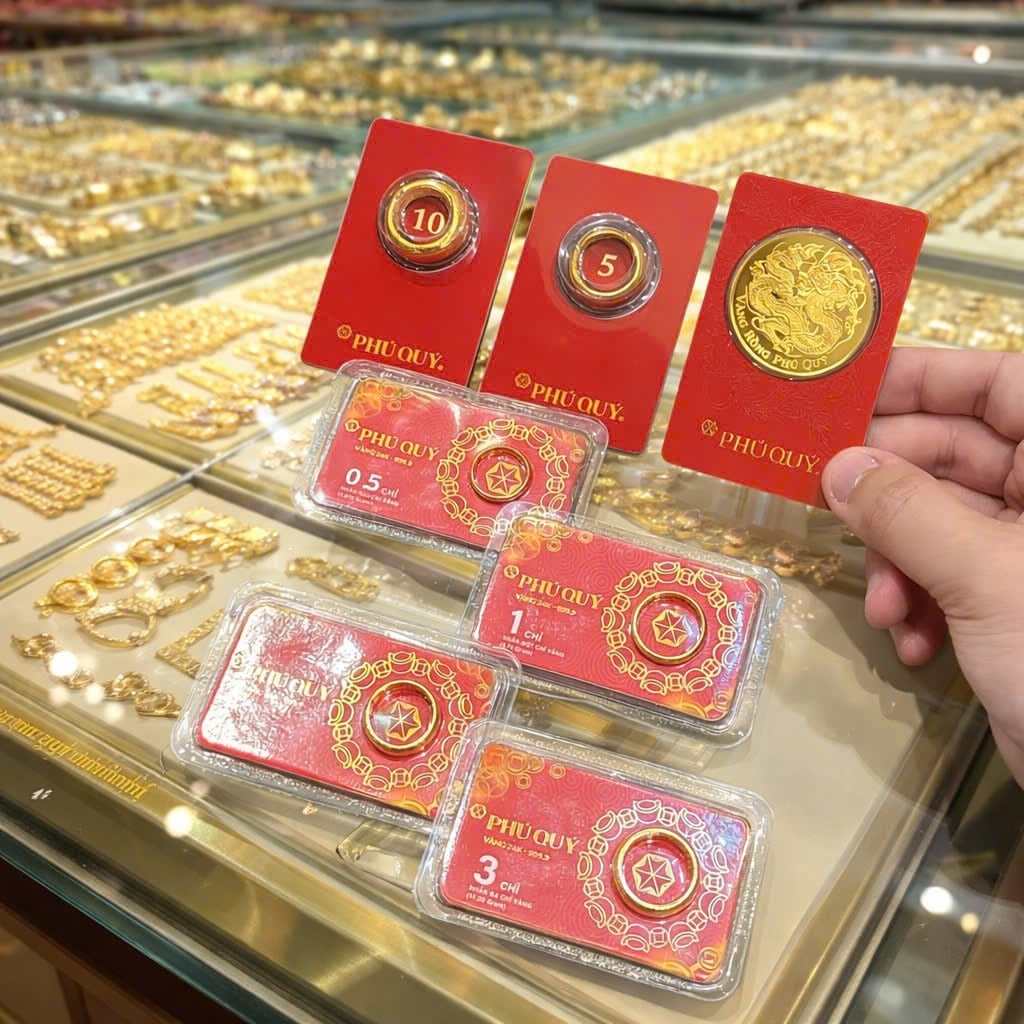
Notably, the downward trend occurred almost continuously throughout each trading session. The May 21st session was considered the sharpest drop of the week, with the price of gold bars losing more than 1 million VND/ounce in just one day. On the morning of May 22nd, businesses continued to adjust prices down by another 400,000 VND/ounce. By the May 23rd session, domestic gold prices had further "evaporated" by 900,000 VND to 1.1 million VND/ounce at many major trading systems.
Not only gold bars, but also gold rings and gold jewelry are plummeting in line with the general trend. SJC 99.99 gold rings are currently trading around 158.5 - 161.6 million VND/ounce, down about 2.3 million VND compared to the end of last week. Brands like DOJI, PNJ, Phu Quy, and Bao Tin Minh Chau are all listing prices around 158.5 - 161.5 million VND/ounce.
Despite the sharp decline, the domestic gold market maintains a very large gap compared to world prices. Converted at the current exchange rate, world gold is equivalent to approximately 145.1 million VND/ounce, nearly 16.9 million VND/ounce lower than SJC gold. This large difference continues to reflect the limited supply and the persistent imbalance in the domestic gold market.
Another notable feature this past week was the continued widening of the buy-sell spread. Most listed businesses showed a difference of around 3-3.1 million VND/ounce, with some places even seeing a difference of nearly 9 million VND/ounce for gold jewelry. This significantly increases short-term investment risks, especially for speculative investors.
Compared to its historical peak set in early March 2026 – approximately 190.9 million VND/ounce – the price of SJC gold has now fallen by nearly 29 million VND/ounce. This prolonged sharp decline is strongly impacting market sentiment. Many investors who bought gold at high prices are starting to sell at a loss or reduce their holdings to protect their capital.
The reality at gold shops in Hanoi and Ho Chi Minh City shows that transactions are no longer as active as they were at the beginning of the year. The "buy high" mentality has made many people more cautious, while new investors are mostly observing from the sidelines.
Simultaneously, there are signs of money flowing back into the banking system. With deposit interest rates rising again, many people consider saving money in a bank safer than holding gold during this period of significant volatility. Some banks are currently offering interest rates of 7.5-8.5% per year for 6-12 month terms, and in some cases even close to 9% per year under specific conditions.
Besides market factors, investors are also interested in information regarding the Ministry of Finance's research into a mechanism for taxing gold bullion transactions. According to the draft revised Personal Income Tax Law, the proposed tax rate could be 0.1% on the total value of each transaction, aiming to increase transparency in the gold market.
Although not immediately implemented, this move is seen as a signal that the regulatory authorities are aiming to tighten control over speculation and improve the legal framework for managing the gold market in the near future.
Experts believe the gold market is entering a correction and rebalancing phase after an overheated rally earlier this year. In the short term, gold prices may continue to fluctuate sharply in response to developments in US monetary policy and global geopolitical situations. Investors are advised to limit the use of financial leverage and consider a rational asset allocation rather than chasing short-term market ups and downs.
Source: https://baohaiphong.vn/gia-vang-mat-moc-162-trieu-dan-o-at-gui-tiet-kiem-543678.html

![[Image] Hanoi's urban life under the challenge of a "scorching hot" environment](https://vphoto.vietnam.vn/thumb/1200x675/vietnam/resource/IMAGE/2026/05/25/1779706979265_nang-nong-t5-2026-minh-duy-7-4636-jpg.webp)


![[Image] Close-up view of the interchange connecting the two expressways and Long Thanh Airport.](https://vphoto.vietnam.vn/thumb/1200x675/vietnam/resource/IMAGE/2026/05/25/1779703378210_ndo_br_z7863716673926-224453a31600126cce10622af6290afd-4549-jpg.webp)
































































































Comment (0)