

In addition to addressing the problem of overcrowded schools due to increasing population, the city also aims to increase the ratio of classrooms to 300 per 10,000 people by 2030, gradually improving the quality of education and ensuring sufficient school places for students.
Adding new schools will reduce overcrowding.
These days, in many areas of Ho Chi Minh City, new school buildings are gradually taking on a modern look. From unfinished concrete structures to completed classroom blocks, the face of education in the city is changing every day. In the eager eyes of students, teachers, and parents is the anticipation of more spacious and modern schools, where children can study closer to home in better conditions.
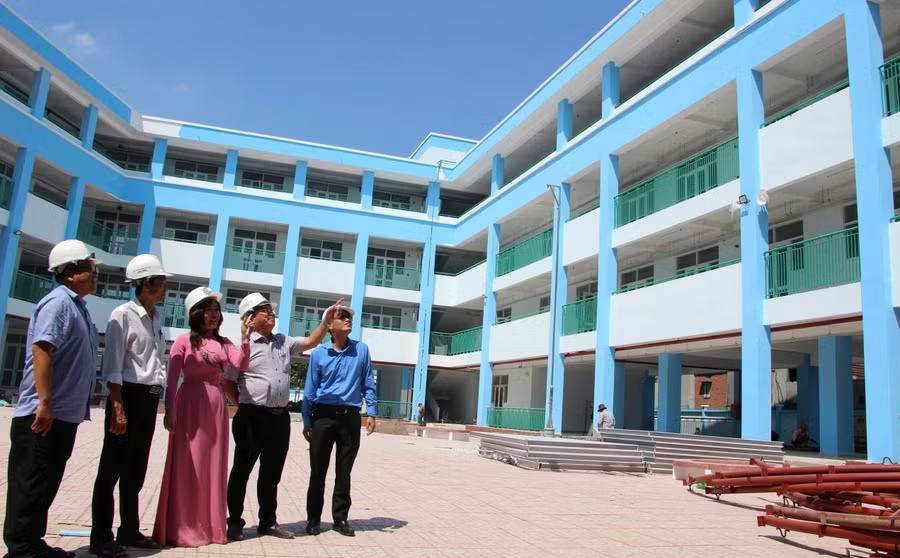
Amidst this changing landscape, Tran Dai Nghia Primary School stands out as a significant landmark. Built on land formerly belonging to the Binh Hung Hoa Cemetery, the school is considered a symbol of the urban transformation from cemetery land to educational infrastructure serving a densely populated community.
The building has a total floor area of nearly 10,000 square meters, comprising one ground floor and three upper floors. The classrooms are equipped with modern facilities, from 65-inch interactive whiteboards to AI-powered teaching support systems. In addition, there are numerous functional rooms such as those for foreign languages, computer science, STEM, music and art, a multi-purpose room, a school counseling center, and a boarding area, creating a comprehensive learning environment for students.
Ms. Van Minh Tan, the school principal, said: “For the 2026-2027 school year, the school plans to enroll 10 first-grade classes and accept additional students in grades 2, 3, and 4 to alleviate the burden on neighboring schools. With the new facilities, 100% of students will be able to attend school for two sessions per day with boarding facilities.”
The school's opening not only meets the growing educational needs of the local community but also provides students with access to a more modern, safe, and convenient educational environment. The school also hopes that this will be a space that helps children develop comprehensively in terms of academics, skills, and physical abilities during their early years.”
Not only at the primary school level, but many large-scale projects at the high school level are also being accelerated. A notable example is the project to build a new Hung Vuong Specialized High School in Hoa Loi ward, with a total investment of over 750 billion VND.
The school is built on a plot of land nearly 58,000 m², comprising 45 classrooms for approximately 1,575 students, along with an auditorium, dormitories, and indoor and outdoor sports facilities. The highlight of the project is its "holistic educational ecosystem" model, combining learning, research, physical training, and skill development spaces in a green, modern environment.
According to Ms. Nguyen Thi Thanh Phuong, the school's principal, the project not only expands the scale of training but also contributes to improving the quality of advanced education, preparing high-quality human resources for the city in the future. Upon completion, the school is expected to become a destination for talented students not only in the region but also in neighboring localities.
According to the Ho Chi Minh City Department of Education and Training, in the 2026-2027 school year, the city will have 5 new public high schools in operation, including 2 completely new schools and 3 schools converted from old premises.
Simultaneously, in line with the campaign to complete 1,000 classrooms before the new school year as directed by the Chairman of the Ho Chi Minh City People's Committee, the Education sector is accelerating the implementation of 22 projects with a scale of 907 classrooms, expected to be put into use at the beginning of the 2026-2027 school year.
Gradually reaching the target of 300 classrooms per 10,000 people.
With nearly 2.6 million students and approximately 180,000 teachers and staff at 3,428 educational institutions, Ho Chi Minh City currently has the largest education system in the country. However, this scale also brings increasing pressure on school infrastructure in the context of rapid urbanization and a continuously growing migrant population.
On average, Ho Chi Minh City sees an increase of approximately 50,000-60,000 students each year, with about 24% being non-residents. This population growth, concentrated mainly in industrial zones, export processing zones, and new urban areas, has led to overcrowding in schools in many localities. Many areas have to maintain student numbers exceeding the standard, hindering the goal of organizing two-session schooling per day and increasing the percentage of schools meeting national standards.
According to the Ho Chi Minh City Department of Education and Training, the average number of classrooms per 10,000 people citywide is currently 277. While this figure shows significant improvement in recent years, the actual distribution of educational infrastructure across different areas remains highly uneven.
Area 1 (formerly Ho Chi Minh City) has approached the standard with 297 classrooms per 10,000 inhabitants. However, pressure remains concentrated in areas with rapid population growth such as District 12, Go Vap, and the districts of Hoc Mon and Binh Chanh before the merger. Meanwhile, Area 2 (formerly Binh Duong) currently only has about 200 classrooms per 10,000 inhabitants.
This area is considered to be under significant pressure regarding school facilities due to the concentration of industrial zones and export processing zones with a large number of migrant workers. The high rate of population growth due to migration has led to a faster increase in educational demand than the capacity of the educational infrastructure. Conversely, Area 3 (formerly Ba Ria - Vung Tau) has exceeded the standard with 316 classrooms per 10,000 inhabitants, with only localized shortages in some wards and communes.
Over the past period, Ho Chi Minh City has reviewed and adjusted the planning of the school network to suit the population changes in each area, while implementing a rational enrollment zoning to reduce localized pressure. Many projects for building new schools, renovating and expanding existing ones have also been included in the medium-term public investment plan.
Along with building infrastructure, the city's education sector is also increasing investment in teaching equipment, gradually modernizing schools; and simultaneously supplementing the teaching staff to reduce the number of students per class according to the roadmap of the Ministry of Education and Training. A series of new school buildings in densely populated residential areas are gradually taking shape, contributing to changing the face of urban education and meeting the growing learning needs of the people.
According to Nguyen Van Hieu, Director of the Ho Chi Minh City Department of Education and Training, the city plans to put into use approximately 1,200 more classrooms from now until the end of 2026; and an additional 1,500 classrooms will be added in 2027 alone.
With this progress, Ho Chi Minh City expects to basically meet the demand for school places by the end of 2027, creating a foundation to gradually realize the goal of achieving a ratio of 300 classrooms per 10,000 people of school age by 2030.
According to Nguyen Van Hieu, Director of the Ho Chi Minh City Department of Education and Training: “After the merger, Ho Chi Minh City has become the locality with the largest scale of education and training in the country. This is both an important advantage and poses many challenges in terms of management, developing the workforce, investing in infrastructure, and perfecting education policies to suit the new reality.”
The city's Education sector recognizes that its pioneering role in implementing groundbreaking educational projects and programs is not only a key task but also an opportunity to affirm Ho Chi Minh City's position in the comprehensive reform of education and training. This reality demands that the Education sector act decisively, creatively, and effectively to successfully achieve the key goals and tasks set by the city.”
Source: https://giaoducthoidai.vn/giai-con-khat-phong-hoc-o-tphcm-post778259.html

![[Photo] General Secretary and President To Lam presides over a working session with the Central Policy and Strategy Committee on the development of the materials industry.](https://vphoto.vietnam.vn/thumb/1200x675/vietnam/resource/IMAGE/2026/05/21/1779359935432_a3-bnd-3129-1412-jpg.webp)
![[Photo] National Assembly Chairman Tran Thanh Man working with the Standing Committee of the Law and Justice Committee](https://vphoto.vietnam.vn/thumb/1200x675/vietnam/resource/IMAGE/2026/05/21/1779378929214_ndo_br_1-4610-jpg.webp)

































































Comment (0)