

To realize the aspiration for national development by 2045, education - especially higher education - must become a center for generating new knowledge, training high-quality human resources, and creating momentum for innovation.
Vanguard
At the ceremony commemorating the 120th anniversary of Hanoi National University, General Secretary and President To Lam emphasized: The Party has repeatedly warned that backwardness is an overarching threat to the nation's destiny and future. This backwardness in development stems from backwardness in science , technology, innovation, and the knowledge content in production, services, and national governance.
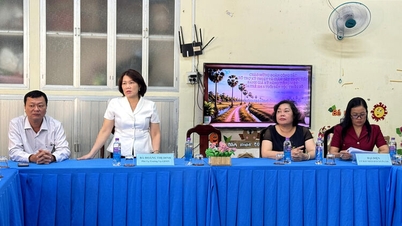
According to Ms. Phan Thi Le Thu, Deputy Principal of Vien Dong College, the speech by General Secretary and President To Lam is not only a warning about the risk of falling behind, but also a strategic message placing great responsibility on education and training in the new era. Today, education and training is not simply about imparting knowledge, but must become the central driving force to enhance national competitiveness, develop high-quality human resources, and promote innovation.
Ms. Phan Thi Le Thu, M.Sc., argues that while in the past a nation's advantage might have relied on resources or cheap labor, today national strength is determined by the quality of its human resources, technological level, and creativity. Therefore, education must take a step ahead, playing the role of "unlocking intellect," shaping a generation of citizens with global capabilities, digital thinking, modern professional skills, and the ability to adapt to the rapidly changing world.
Regarding vocational education, Ms. Phan Thi Le Thu recognizes that this sector is the pioneering force directly creating high-quality practical human resources for the economy. A nation that wants rapid and sustainable development cannot do without a team of high-quality practical engineers, technology experts, nurses, technicians, and service personnel meeting international standards. This is also why colleges need to shift strongly from the mindset of "training what they have" to "training what businesses and society need."
Professor Ngo Thi Phuong Lan, Rector of the University of Social Sciences and Humanities, Vietnam National University Ho Chi Minh City, also emphasized the mission of education, especially higher education, in the journey to making Vietnam a developed nation by 2045. That mission is to build and continuously improve a modern, open, flexible, interconnected national education system strong enough to fulfill four strategic functions: discovering and nurturing talent, generating new knowledge, promoting innovation, and enhancing the learning capacity of the entire society. This is the foundation that determines the quality of human resources, national competitiveness, scientific and technological level, and the country's ability to develop independently.
In that system, different levels and types of education do not exist in isolation but are interconnected within an organic, integrated structure. General education forms the foundation of knowledge, character, and basic competencies. Vocational and college education trains highly skilled technicians and practical personnel.
Continuing education creates opportunities for lifelong learning and enhances the skills of all citizens. Higher education plays a central role in training highly skilled human resources, conducting scientific research, and fostering innovation. Each component fulfills a distinct function but simultaneously complements and supports the others, forming a unified educational ecosystem that ensures all citizens have the opportunity to learn, adapt their skills, and develop continuously throughout their lives.
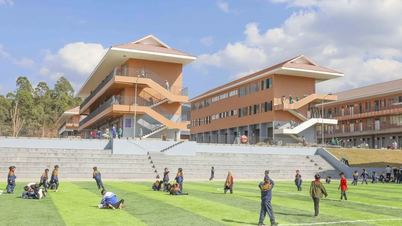
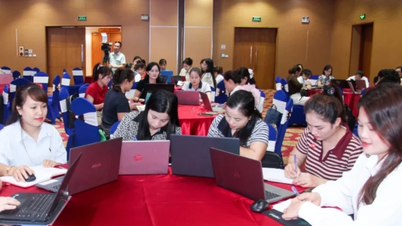
 Students of the University of Education, Vietnam National University, Hanoi. Photo: NTCC
Education should be used to create the impetus for realizing the aspirations of 2045.
To ensure that education and training fulfill their mission effectively, Professor Ngo Thi Phuong Lan believes that Vietnam first needs to continue fundamentally and comprehensively reforming its education system towards a modern, open, flexible, and lifelong learning approach.
The education system must shift dramatically from knowledge transmission to competency development, from training to meet immediate needs to preparing for long-term challenges, and from administrative management to quality management and innovation. Education should not only equip students with knowledge but also foster independent thinking, creativity, adaptability, and a sense of responsibility in citizens in the digital age.
In particular, higher education plays a central role in the national knowledge system. Universities must become centers for training experts, scientists, entrepreneurs, and leaders with the capacity for lifelong learning, the ability to master new technologies, and a global mindset. At the same time, they must be centers for generating new knowledge through scientific research, international cooperation, and close connection with the country's development practices. On this foundation, research and innovation results from universities need to spread throughout the entire education system, contributing to improving the quality of vocational training, continuing education, college education, and skills development programs for society.
Higher education simultaneously needs to play a pivotal role in the national innovation ecosystem, connecting the State, businesses, the scientific community, and the wider community to transform knowledge into technology, policies, products, and services that serve socio-economic development. A nation can only rise strongly when it not only receives but also proactively creates knowledge, technology, and development models that are appropriate to its own historical, cultural, and social conditions. Higher education will help create "make in Vietnam" knowledge, affirming its contribution to global knowledge and leading development.
“In other words, if science, technology, and innovation are the driving forces of growth in the new era, then education – especially higher education – is where that driving force is created. Building and continuously improving an integrated education system, in which vocational education, continuing education, colleges, and universities are organically linked, is not only the task of the Ministry of Education but also a core development strategy for Vietnam to enhance its competitiveness, consolidate its intellectual sovereignty, and realize its aspiration to become a developed, high-income country by 2045,” emphasized Professor Ngo Thi Phuong Lan.
Ms. Phan Thi Le Thu shared that for Vietnam to become an advanced developed country by 2045, education and training must truly become a "leading national policy." In this context, higher education and vocational education institutions need to be pioneers in innovating training models, creating an open training ecosystem that prioritizes the quality of human resources, and is guided by the development needs of society and businesses; while simultaneously nurturing the aspiration for innovation and creativity in the modern Vietnamese youth, fostering practical learning, practical skills, and genuine talent.
"With our responsibility, we not only train students to find employment, but also aim to cultivate a generation of citizens who are internationally competitive, aspire to contribute, and are capable of accompanying the country's development in the new era," Ms. Phan Thi Le Thu expressed.
Dr. Cu Ngoc Phuong, Head of the Department of Political Theory at Nguyen Tat Thanh University, believes that to realize the aspiration for national development by 2045, education needs to be reformed not only in curriculum and methods, but more profoundly in the concept of human development goals. A truly effective education must aim to unleash creative potential, cultivate scientific thinking skills, and foster the cultural character of Vietnamese people in the new era.
"Only when education truly becomes the foundation of innovation and intellectual development of the nation will knowledge transform into intrinsic strength, enabling the country to escape the risk of falling behind and rise to the group of advanced developed nations." - Dr. Cu Ngoc Phuong
Source: https://giaoducthoidai.vn/giao-duc-tao-suc-manh-noi-sinh-dua-dat-nuoc-but-pha-post779366.html


![[Photo] Standing Committee member of the Party Central Committee Tran Cam Tu working with the Central Inspection Committee](https://vphoto.vietnam.vn/thumb/1200x675/vietnam/resource/IMAGE/2026/05/28/1779969579668_ndo_br_bnd-2495-jpg.webp)





































































Comment (0)