

Recently, an increasing number of public schools in Ho Chi Minh City have started offering IELTS courses to students at affordable costs, in the context of foreign languages no longer being a compulsory subject in the high school graduation exam from 2025, and universities increasingly using international certificates as admission criteria. For this program to be truly effective, according to experts, teachers are a key factor.
PROPER TRAINING IS NECESSARY.
As an internationally certified TESOL (English as a Second Language) instructor, Ms. Nguyen Le Tuyet Ngoc, National IELTS Training Director of the MTS testing agency (UK), believes that to teach IELTS classes effectively, teachers need to be trained in academics and pedagogical skills, rather than simply having high scores automatically indicating excellent teaching abilities. While the IELTS exam can assess a teacher's language proficiency, it doesn't fully reflect their ability to prepare students for the exam.

A session to support trainee teachers in designing teaching activities.
"Overall, the teacher training program for certification includes content such as in-depth knowledge of exam structure, how to set goals for the teaching process, design lesson plans and classroom activities, as well as problem-solving methods for both students and teachers. And with this knowledge and skills, teachers can flexibly apply them to any other certification such as TOEFL, PTE, FCE, CAE...", Ms. Ngoc commented.
To ensure effective training, experts emphasize that the most important thing is to motivate teachers, especially those with many years of experience, to learn. In addition, when teaching IELTS preparation, teachers need to know how to inspire learning, avoiding rote memorization and pressure. "You shouldn't teach IELTS by constantly giving students practice tests and correcting their work, but rather focus on building foundational skills in all four skills: listening, speaking, reading, and writing. Then, guide them towards the actual exam," Ms. Ngoc advised.
"Besides organizing or facilitating teachers' participation in IELTS training courses, school administrators also need to support teachers in other areas such as assessing language proficiency and grouping students according to ability, listening to feedback, and finding ways to 'resolve' difficulties for teachers. Good coordination between the school and teachers will be the 'key' to the success of supplementary IELTS teaching in public schools," Ms. Ngoc concluded.
"Currently, there are many methods for teacher training around the world . One of the most common forms is training based on the English language teaching framework, and then branching out into smaller areas such as teaching exam preparation for certifications, or teaching specialized programs like business English. Graduating from teacher training colleges or having relevant certifications will give teachers a good foundation to participate in IELTS teaching courses," Ms. Ngoc added.
NATIVE-SPEAKING TEACHERS ARE ALSO A PROBLEM
Although offering IELTS courses in public schools is in line with the trend of internationalizing education in Vietnam, experts believe that many challenges remain.
"That's because teachers are trained over four years at university to master linguistic knowledge and pedagogical skills to teach general English well, not to prepare for professional exams. Furthermore, the current high school environment cannot provide teachers with the same conditions and tools as language centers," explained Dr. Do Huu Nguyen Loc, President of the Ho Chi Minh City Association for English Language Research and Teaching.
According to Mr. Loc, public school teachers can absolutely help students achieve high IELTS scores; the important thing is to have the necessary resources. Accordingly, teachers must receive training to thoroughly understand the exam, how to approach it, and be supported in developing all four skills.
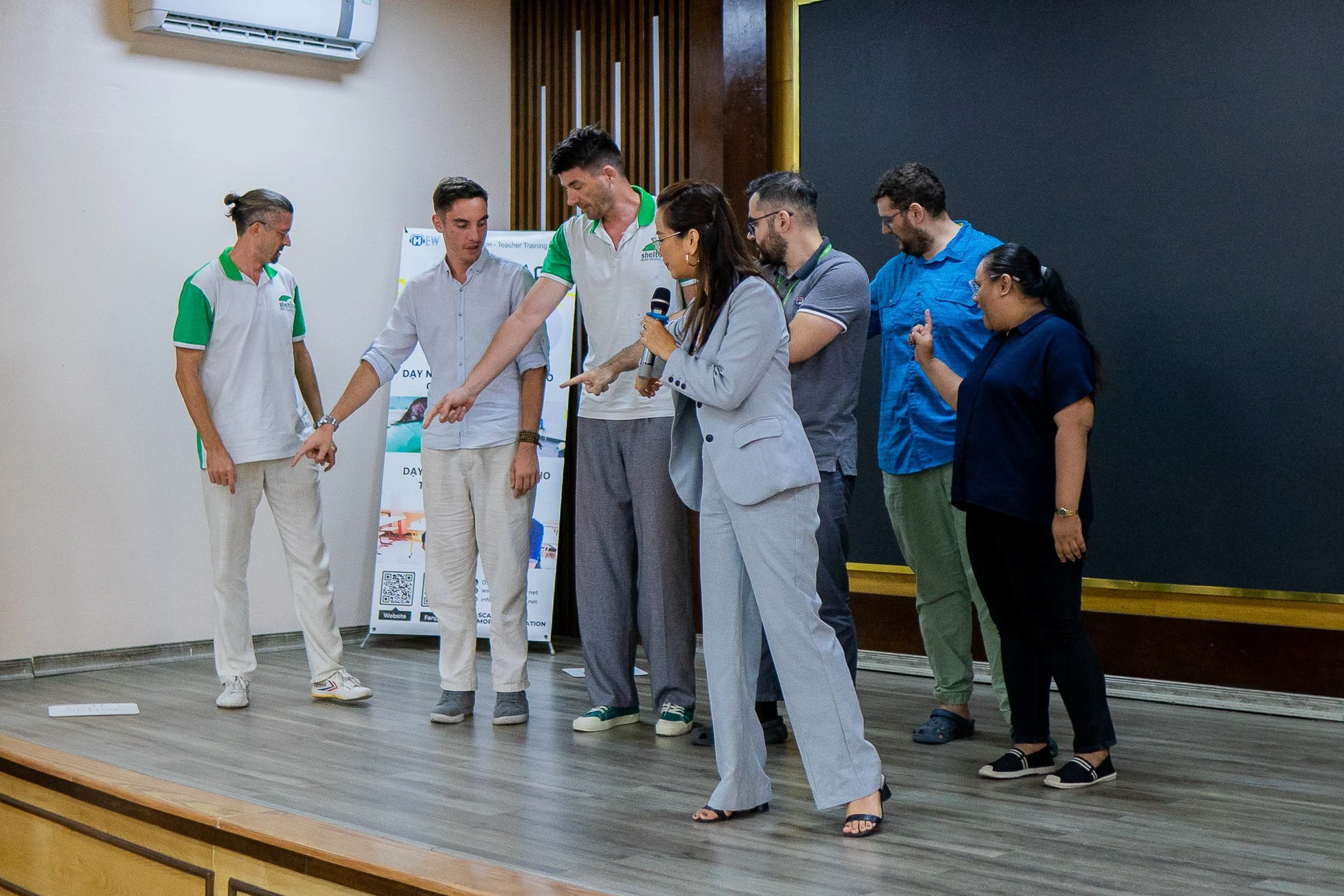
Training trainee teachers to teach grammar to children using a new method.
According to Ms. Lu Thi Hong Nham, Director of Duc Anh Study Abroad and Translation Consulting Company, to avoid the distortion of IELTS tutoring in public schools, teachers must "meet the standards" in terms of knowledge and pedagogical skills to teach IELTS. Otherwise, the lessons will only revolve around tricks and tips for answering questions, causing both teachers and students to waste time and effort.
Native English-speaking teachers are also a factor to consider. Many foreigners come to Vietnam to teach without relevant teaching qualifications, instead "coping" by enrolling in courses and taking English teaching certification exams like TELF, which only last a few weeks. "The quality of native English-speaking IELTS teachers is also a big question," Ms. Nham raised.
Paving the way for international integration.
According to Ms. Hong Nham, international language certificates like IELTS are also a criterion for admission to universities, but they are only the last factor in the admission and scholarship selection process in popular study abroad destinations such as the US, UK, or Australia. "The first and most crucial factor is academic ability, demonstrated through GPA and standardized test scores (such as SAT, ACT); second is the applicant's outstanding qualities, based on leadership skills and contributions to the community," Ms. Nham noted.
Andy Pham, Senior Mekong Region Manager at the Australian National University, believes that popularizing IELTS instruction in schools gives students an advantage not only in terms of entrance requirements. "In an international environment, English is key to understanding and communicating lecture content with classmates and professors. Providing opportunities for public school students to be exposed to IELTS early on can help them integrate more quickly," Andy shared.
Dr. Nguyen Vinh Quang, Director of Mr.Q International Vocational Education Organization, stated that IELTS is an English proficiency test that assesses skills across various topics. "Therefore, the goal of schools offering IELTS courses is not only to meet enrollment requirements, but more broadly to enhance students' ability to integrate into the globalized world, rather than simply studying for the sake of passing exams as in the past," Dr. Quang explained.
AVOID INCREASING THE BURDEN ON STUDENTS INSTEAD OF REDUCING IT.
Furthermore, the director also expressed concerns about the organization of IELTS tutoring programs in public schools, especially when some schools delegate IELTS teaching to affiliated centers. The content and number of lessons must be arranged scientifically to avoid "overburdening" students instead of reducing the workload as directed by the Ministry of Education and Training. "And after the course ends, a comparison should be made between schools offering IELTS tutoring and schools that do not implement this program for a comprehensive evaluation," Ms. Nham stated.
However, according to Ms. Nham, the school's positive efforts to popularize IELTS among students, helping disadvantaged students access useful resources, cannot be denied. "Improving the quality of teachers and organizational work, and not forcing students to participate in this program, are what need to be done to make IELTS teaching and learning in high schools truly effective," Ms. Nham suggested.
A pedagogical lesson
Surveys show that not all schools offer IELTS instruction in the classroom. So, what can teachers do to help students better understand the test if they need it? Dr. Phung Thuy Linh, founder of Eduling International and Director of the English Program at Chatham University (USA), acknowledges this is also a problem she faces when teaching English to international students.
"In the classroom, we also incorporate some content about exams for those who need to prepare for certifications. However, students can easily get bored if the learning materials only focus on exam preparation. Another point worth noting is that the skills required by the exams don't really reflect real language use, nor do they help develop other competencies such as cross-cultural communication," Ms. Linh said.
Furthermore, according to Dr. Linh, teachers also need support when juggling different programs to clarify teaching objectives; at the same time, teachers need training to understand the IELTS exam and other types of exams, as well as to have teaching skills, so that they can develop English proficiency and help students prepare for the exam.
Source link








![[Image] Checking the security conditions at the exam site, ready for the 10th grade exam.](https://vphoto.vietnam.vn/thumb/402x226/vietnam/resource/IMAGE/2026/05/28/1779943458889_z7872507660648-d764421a26e8cd7b61d70d142a48a685-jpg.webp)


























![[Photo] Reception to welcome General Secretary and President To Lam and his wife on their State visit to the Philippines](https://vphoto.vietnam.vn/thumb/1200x675/vietnam/resource/IMAGE/2026/06/01/1780295488620_vna-potal-chieu-dai-chao-mung-tong-bi-thu-chu-tich-nuoc-to-lam-va-phu-nhan-tham-cap-nha-nuoc-toi-philippines-8798060-7855-jpg.webp)


































































Comment (0)