

 |
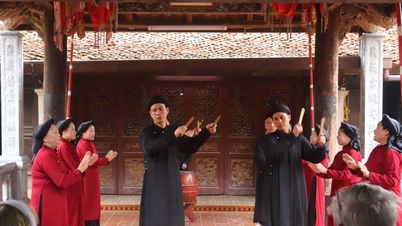
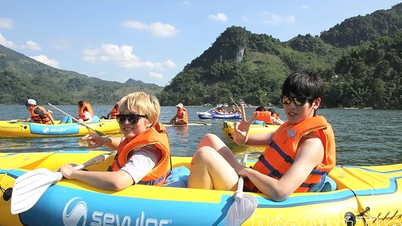
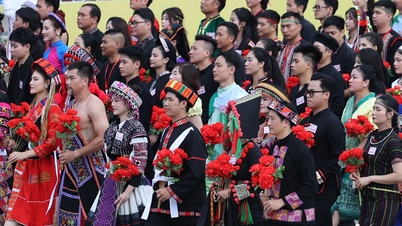
| Many rituals are performed by artisans from Thai Nguyen province for tourists at the Vietnam Ethnic Groups Cultural and Tourism Village. |
Currently, the province has 754 intangible cultural heritage items being preserved, passed down, and promoted by the local people, including 45 nationally recognized heritage items. Notably, the Then ritual of the Tay, Nung, and Thai people has been inscribed by UNESCO on the list of Representative Intangible Cultural Heritage of Humanity.
This is a testament to the enduring vitality of traditional culture. To date, the province has had 3 people honored by the State as People's Artisans and 19 people honored as Distinguished Artisans. These artisans have made important contributions to the preservation, safeguarding, and transmission of heritage.
Many of the artisans are elderly, but they serve as a bridge between the past, present, and future. They are the keepers of cultural memory and directly pass it on to the younger generation. For example, Mrs. Mieu Thi Nguyen, a San Diu ethnic woman from Na Quan hamlet, Nam Hoa commune, has collected and handwritten over 5,000 Soong Co songs and taught them to people in the area. Mr. Ma Dinh Duoc, a Tay ethnic man from Hoang Ha hamlet, Phu Dinh commune, has made over 1,000 Tinh lutes in nearly 30 years. Then there is People's Artisan Hoang Thi Bich Hong, who, as the head of the Provincial Then Singing Club, has taught Then singing and Tinh lute playing to hundreds of younger generations.
In the ethnic communities of Thai Nguyen, there are always those who are quietly preserving and passing on the intangible cultural heritage of their people to future generations. They do this work as a survival instinct of their ethnic community, and also as a personal responsibility, without burdening them with time or money .
With particular attention and support from the State, many beautiful intangible cultural features among the people have been revived. And thanks to funding from the State and social contributions, many scientific projects on intangible cultural heritage have been implemented, yielding practical results.
Research and preservation activities related to folk music, the restoration of festivals and rituals, etc., not only focus on "preserving" but also aim to "bring the heritage to life" in modern life. After each restoration, people's awareness of preserving and transmitting heritage is significantly raised.
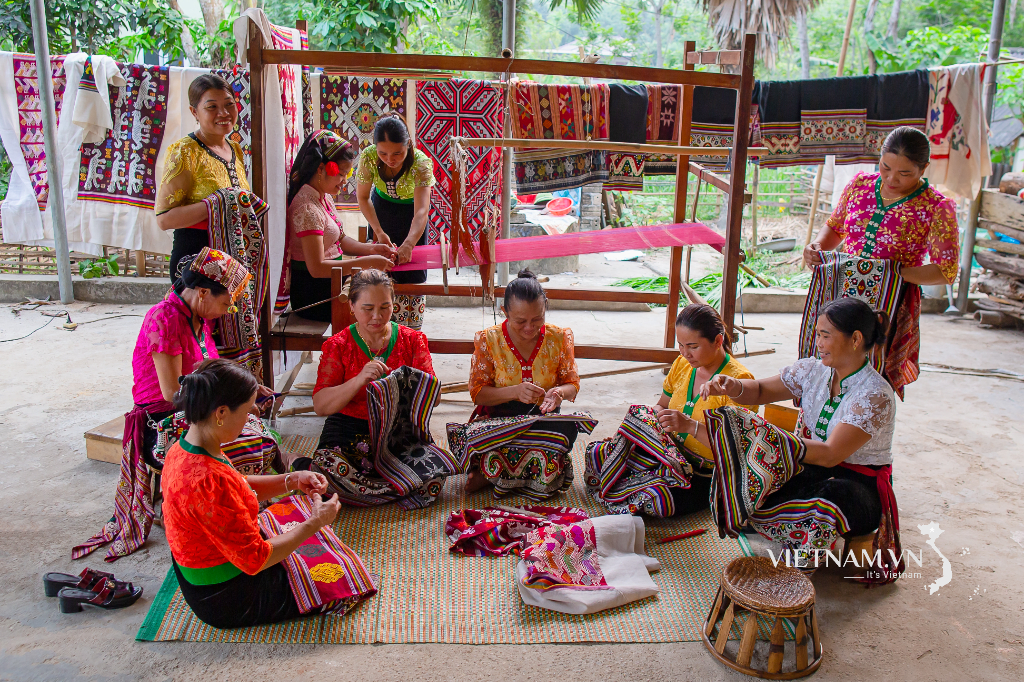
In recent years, notable achievements include the reenactment of the Tay wedding ceremony in Lam Vy commune; the harvest prayer ceremony of the San Diu people in Vo Tranh commune; and the coming-of-age ceremony of the Nung Phan Sinh people in Nam Hoa commune. Alongside these are projects to preserve and promote the Then, Luon Coi, and Luon Sluong folk songs of the Tay people. Through these efforts, the rituals of the ethnic groups are recreated, helping the community better understand the cultural values of their people and thereby raising awareness of their preservation.
Traditional festivals, which are revived and maintained annually, also play an important role in preserving heritage. Festivals such as the Xuan Duong Love Market, Long Tong, and Mu La, organized annually, partly meet the cultural needs of ethnic communities, while also creating a space for them to interact and connect with each other.
In the context of integration and development, intangible cultural heritage faces many challenges. However, with the involvement of relevant levels and sectors, and directly the people of ethnic minorities, intangible cultural heritage continues to be restored in its original form, passed on, preserved, and its value promoted.
Source: https://baothainguyen.vn/van-hoa/202603/gin-giu-hon-cot-van-hoa-thai-nguyen-df22a3f/















































Comment (0)