

Many countries allow international students to work 20 hours per week during the semester, and violations can result in deportation.
Below are the number of part-time working hours for international students in several countries.
Canada
Ms. Hai Anh Vu, Senior Regional Manager for Southeast Asia at Algonquin College in Ottawa, stated that international students enrolled in full-time programs are allowed to work 20 hours per week during the academic year. Students can work on campus (unlimited hours), off campus (with time restrictions), or both, depending on their abilities. During holidays, they are allowed to work full-time.
According to Ms. Hai Anh, this is a government regulation that helps international students balance their study and work time, and earn extra income to cover expenses.
"This also helps Canada address its labor shortage," she said.
For local students, the government does not limit the number of hours they can work part-time. However, employers usually hire students who are 15 years old or older if they can ensure they can manage their study time.
When working, students must provide their Social Security number (SIN) to their employer. All wages, social insurance contributions, unemployment insurance, personal income tax, etc., are referenced to this SIN number. Working overtime violates immigration regulations, affecting the renewal of study or work permits after graduation, and can even lead to deportation or a ban on re-entry into Canada for 1-5 years.
The minimum wage in Canada is approximately 14-17 CAD (250,000-310,000 VND) per hour, depending on the province.
Singapore
International students in Singapore are allowed to work part-time if they are 14 years of age or older, as part of a full-time program at a school licensed by the Singapore Ministry of Manpower (MOM).
International students are allowed to work a maximum of 16 hours per week during the academic year and there are no limits during holidays. Local students are not subject to this regulation.
According to Mr. Dinh Hoang Ha, Regional Director of SSTC Academy Singapore, students who violate the rules may be fined SGD 20,000 (over VND 368 million) or sentenced to up to two years in prison and may be permanently banned from entering Singapore.
If employers hire international students without work permits, they may face fines ranging from S$5,000 to S$30,000 (approximately VND 92-550 million), or imprisonment for up to 12 months. In many cases, both penalties apply.
"Singapore's laws are strict, so employers must manage themselves and be accountable under the law. They will check student visas before hiring students," Mr. Ha said.
The average hourly wage for part-time work in Singapore is 9 SGD (approximately 165,000 VND).
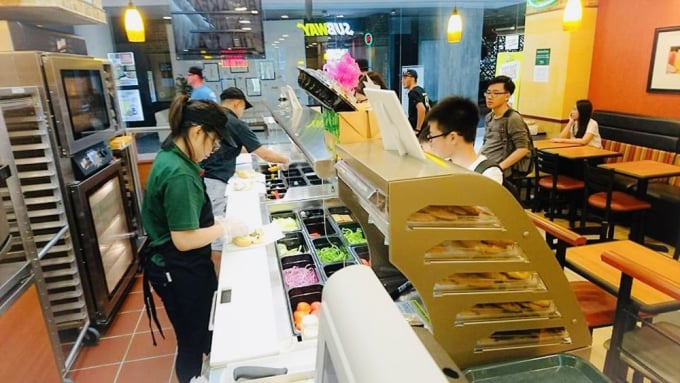
Vietnamese students work part-time at a bakery in Singapore. Photo: Dinh Hoang Ha
America
In the US, international students are allowed to work a maximum of 20 hours per week on campus (serving in the cafeteria, office work, dorm reception, tutoring, teaching assistant, etc.). During the summer, this limit is increased to 40 hours per week. American students are not subject to any restrictions on part-time work hours, both on and off campus.
Each week, international students must record their hours worked in a school monitoring system. Part-time wages in the US range from approximately $7.25 to $18 USD (174,000-450,000 VND) per hour, depending on the school and job position. This is usually equal to or slightly higher than the state minimum wage. For example, the minimum wage in Minnesota is $8.85 USD/hour, and in Indiana it is $7.25 USD/hour.
"If caught working illegally, international students can be arrested and deported," warned Nguyen Ngoc Khuong, an independent study abroad consultant in Minneapolis, Minnesota.
Japan
Previously, international students in Japan were allowed to work no more than 28 hours per week, but this regulation has changed. Currently, the total number of part-time hours for international students over 7 consecutive days must not exceed this limit. The reason is that many international students work too much part-time, leaving insufficient time for studying.
This regulation does not apply to Japanese students. However, they usually do not work more than 14-15 hours per week due to tax-related reasons.
Companies, restaurants, and shops all have systems to monitor working hours. Whenever the 28-hour limit is almost reached, the system will send an email alert to the international student. International students can work 2-3 part-time jobs, but must submit proof of income when renewing their visa. If the figures are too high, the student may be subject to an audit.
According to Mr. Nguyen Duy, Director of CBE, a Japanese study abroad consulting company, if they violate the rules, they will not be allowed to extend their stay or change their residency status to work in Japan after graduation.
During holidays, overtime hours are extended to 40 hours per week. Minimum overtime pay in Tokyo is usually the highest, around 1,110 JPY (over 180,000 VND) per hour for convenience store jobs, and up to 3,500-5,500 JPY (570,000-900,000 VND) per hour for translation work. In other cities, pay is about 15% lower.
Australia
In Australia, international students are allowed to work 48 hours every two weeks while studying and there are no limits on hours during holidays. The minimum wage for international students is AUD 21.38 (approximately VND 350,000) per hour.
The Australian government mandates that all employees pay income tax. International students must obtain and receive their tax identification number from the Australian Tax Office before starting work. Most companies pay salaries via bank transfer, so the number of hours worked is automatically updated.
If international students violate regulations regarding working hours or work illegally, depending on the severity and nature of the work, they may be warned, fined, or even deported.
Like many other countries, limits on overtime work do not apply to Australian students.
Dawn
Source link


![[Photo] Prime Minister Pham Minh Chinh attends the Conference on the Implementation of Tasks for 2026 of the Industry and Trade Sector](/_next/image?url=https%3A%2F%2Fvphoto.vietnam.vn%2Fthumb%2F1200x675%2Fvietnam%2Fresource%2FIMAGE%2F2025%2F12%2F19%2F1766159500458_ndo_br_shared31-jpg.webp&w=3840&q=75)






















































































Comment (0)