

Overcoming difficulties to stay in the profession.
In Thanh Lieu residential area (Tan Hung ward), young artisan Nguyen Cong Dat has spent many years researching and restoring the local woodblock printing craft. This is a traditional craft with a history of nearly 600 years, but it had once been in decline. Besides researching historical documents, he also directly learned techniques from the craftsmen who were still involved in the trade.
From selecting the wood and surface treatment to each carving stroke on the print, he persistently practiced to master the technique, because even a small mistake could ruin the entire print. In the process of reviving the craft, he and several artisans in the village gradually restored ancient woodblock prints, while also experimenting with carving new content.
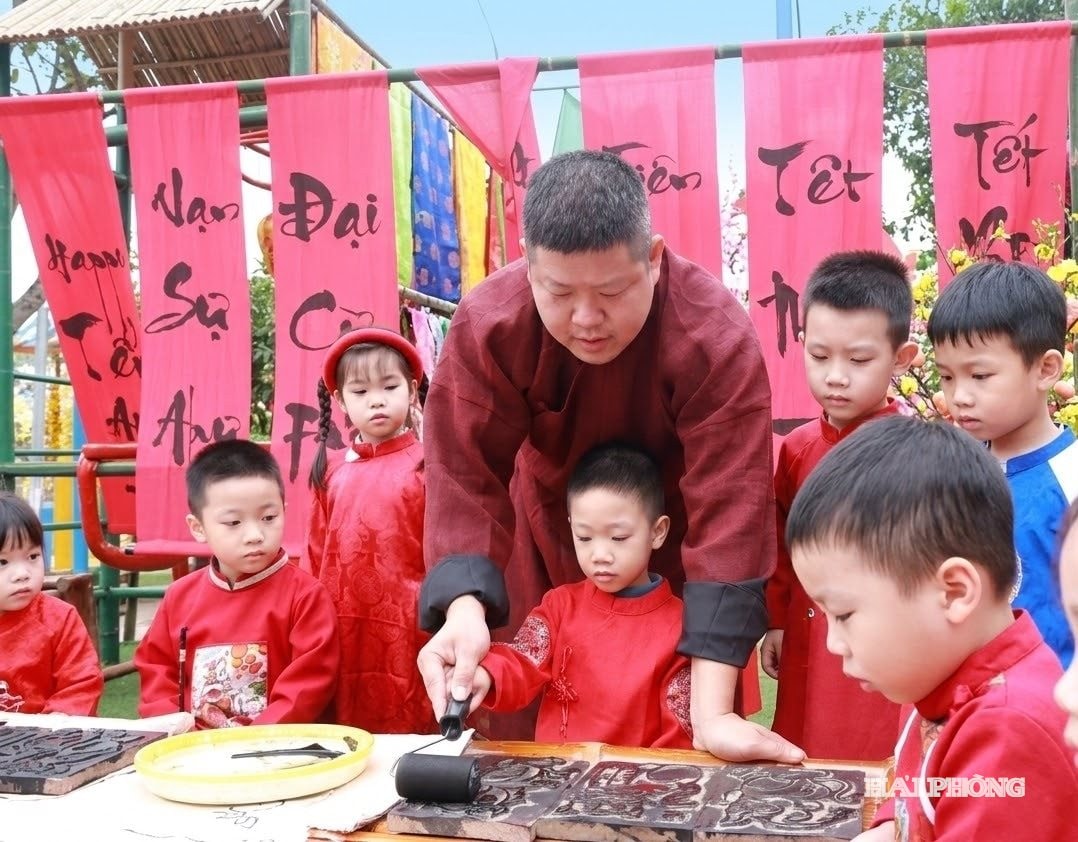
Besides his work, Mr. Dat actively participates in activities introducing and providing hands-on experience in woodblock printing at cultural events and schools. Through these experiences, many students have the opportunity to directly observe and try woodblock printing for the first time, thereby gaining a better understanding of the value of this long-standing traditional craft.
Also choosing to stick with his family's traditional craft, Mr. Nguyen Ngoc Huan from Dong Giao carpentry village (Cam Giang commune) persistently pursues the art of fine woodworking. Growing up in the village's woodworking workshops, he quickly became familiar with the work and gradually learned the stages from selecting wood, carving, sculpting to finishing the product.
Huấn's journey in the craft hasn't always been smooth sailing. There have been times when the market for wooden products faced difficulties, with orders decreasing while raw material prices soared. Some workshops had to scale back production, many workers switched to other jobs to find more stable income, and not a few young people left the village to work elsewhere.
Nevertheless, Mr. Huan decided to stay with the craft. Starting with simple tasks, he persistently learned from experienced craftsmen in the village, gradually honing his skills and mastering carving techniques to perfect his products. He also proactively researched the market and improved designs to better suit customer needs. According to Mr. Huan, to preserve a traditional craft, practitioners need to be flexible and adaptable, maintaining the unique characteristics of the craft while meeting new tastes.
The Dong Giao carpentry village currently has about 6,000 inhabitants, of which approximately 90% are engaged in carpentry. This is one of the villages that attracts a large number of young workers in the locality.
Continuing and innovating the profession.

Not only is he dedicated to his woodblock printing work, but young artist Nguyen Cong Dat is also proactively seeking ways to bring woodblock printing closer to the community. He regularly participates in exhibitions and product presentations at cultural events, and collaborates with several schools to organize woodblock printing experience activities for students.
Through these hands-on experiences, many children had the opportunity to directly observe the woodblock carving and printing process for the first time and try their hand at simple steps of the craft. For Mr. Dat, introducing the craft not only helps people understand the value of woodblock printing but also contributes to sparking the interest of the younger generation in a long-standing traditional craft.
Mr. Dat shared: "Preserving the craft is not just about preserving the techniques of crafting, but also about preserving the cultural values and historical memories preserved in each carving." According to him, when more people understand and appreciate those values, the traditional craft will have more opportunities to continue to be preserved and developed.
Currently, Hai Phong city has 78 active craft villages with various trades such as agricultural product processing, fine art woodworking, embroidery, pottery, etc. According to Ms. Nguyen Thi Dung, Deputy Head of the Rural Development Sub-Department (Department of Agriculture and Environment), there are currently no specific statistics on the number of young workers in these craft villages because the workforce depends on the specifics of the trade and the scale of production in each locality.
Many traditional craft villages are gradually recovering thanks to the participation of young workers. They are not only continuing their family's trades, but many young people are also boldly innovating production methods, improving designs, and expanding their markets. The application of technology, leveraging online sales channels, and participating in product promotion activities are helping some craft villages find suitable development directions.
According to Ms. Nguyen Thi Dung, for traditional craft villages to develop sustainably, it is necessary to continue having policies supporting vocational training, market connections, and product promotion. When traditional crafts have stable development conditions, young people will have more motivation to return and commit to them, contributing to preserving and continuing the long-standing values of these craft villages.
TRAN HIENSource: https://baohaiphong.vn/giu-nghe-xua-bang-suc-tre-537613.html










































































































Comment (0)