

Echoes from the memories of the village
In the misty weather, I returned to Nâm Nung commune to attend the first Party Congress of the commune. In the middle of the assembly hall, the sound of gongs emanating from the artisans spread gently like morning mist, just enough to make people pause, just enough to stir their hearts. That gong sound will forever remain in my memory, as if awakening long-dormant memories, memories of vibrant festivals, of nights with blazing bonfires in the vast forest, where the sound of gongs blended with the songs and laughter of the villages.
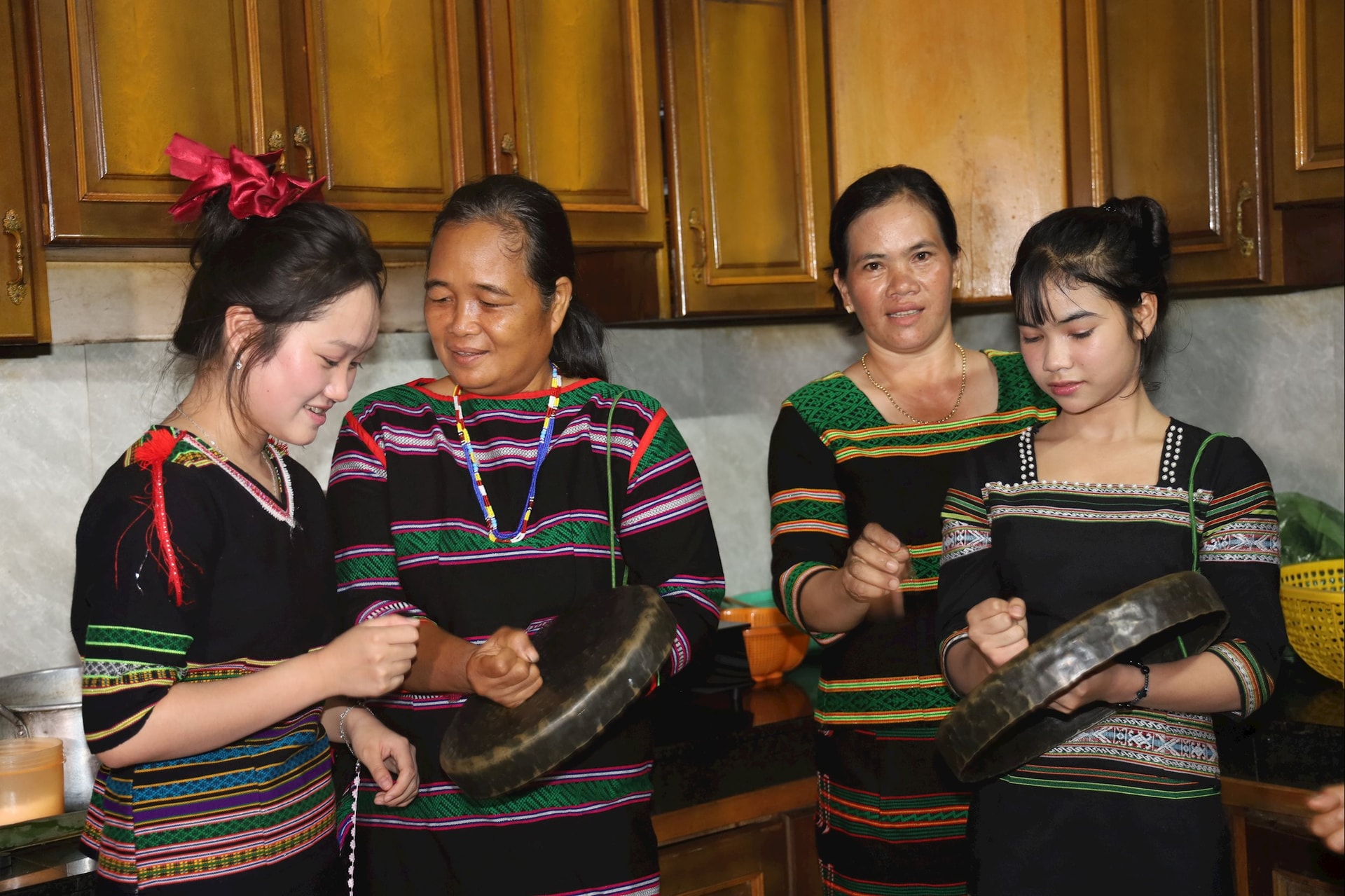
In the past, gongs were present in every aspect of M'nong life, from the New Rice Festival, weddings, and water-blessing ceremonies to the celebrations of longhouses. Each gong sound was a narrative rhythm. People said that gongs were the soul of the village, the voice of heaven and earth. When the gongs sounded, the entire mountain forest seemed to listen.
Ms. Thi Hang, a M'nong woman from Dien Du hamlet (Quang Tan commune), is considered one of the best gong players in the region. Yet, in the eyes of this artisan, there is sometimes a hint of sadness. She worries that the sound of the gong, once the soul of the village, is gradually fading from life. She confided: “In many villages, the sound of gongs now only resonates during festivals or cultural events. On the communal house grounds, the elderly hands still carefully hold each gong, ensuring the sound remains in tune, while the children stand outside, holding their phones, their eyes both curious and distant. Between these two worlds – the rustic sound of the gongs from the mountains and the vibrant melodies of modern life – lies a vast silence.” The silence that Ms. Thi Hang spoke of suddenly weighed heavily on her heart, as if she feared that one day, the sound of the gongs would only echo in old films, in the distant memories of the mountains and forests.
I still remember the words of old K'Prek in Sa Nar village (Quang Son commune), who once said: "When the gongs are silent, the village is very sad." The words sound simple, yet they are poignant. Because gongs are not just musical instruments; they are the breath of the land, the rhythm of life for the people. Whenever the gongs fall silent, a part of the soul of the mountains and forests also falls silent.
Keeping the gong rhythm alive amidst the new rhythm of life.
Not wanting the sound of gongs to become just a memory, Lam Dong province has made many efforts to "awaken" the gong heritage in contemporary life. The province has been implementing the project "Preservation and Promotion of Gong Culture Heritage" for the period 2023-2026, with a vision to 2035, aiming to restore, preserve, and spread the unique cultural values of the Central Highlands people.
In ethnic minority districts such as Tuy Duc, Quang Son, Dam Rong, and Di Linh, many gong-playing classes are opened for young people. Elderly artisans enthusiastically guide them on how to maintain rhythm, adjust the pitch, and feel the nuances of each gong sound. Cultural festivals, national unity celebrations, and community tourism programs all provide spaces for gong music to resonate.
Some villages have linked the preservation of gongs with experiential tourism. However, that is still not enough, because the sound of the gongs only truly "lives" when it is played from the voluntary spirit and joy of the villagers, not just through stage lights or the introductions of tour guides. Many elderly artisans worry that, without a successor generation, without genuine festivals, the gongs will eventually become lost in the age of technology.
Preserving the gong heritage is therefore not just about safeguarding the physical object, but also about awakening emotions. More policies are needed to support artisans, encourage young people to learn and perform gong music, and ensure that the sound of gongs resonates in every community gathering and every small village festival, so that this sound returns to its rightful place of origin – between the land and the people.
As evening fell over Nâm Nung, I left the village as the last rays of sunlight streamed across the mountaintops. From afar, the sound of the gongs echoed, deep and warm, gentle yet profound. I heard that sound blending with the rhythm of my own heart, soft yet persistent. Perhaps, as long as there are people who remember, people who love, the flame of the gongs will never die out.
Source: https://baolamdong.vn/giu-nhip-chieng-cua-nui-rung-401706.html






























































































Comment (0)