And how can we preserve the essence, emotion, and very "human" aspect of music in the digital age?
Anyone can become a musician.
With just a few lines of code, a song can be created in seconds. A diary entry, a social media status update, or a few short descriptions can be transformed by artificial intelligence into a song complete with melody, harmony, arrangement, and vocals. What was once considered a job requiring specialized knowledge and a lengthy artistic process is changing at a dizzying pace.
The emergence of AI is not simply about providing another tool to assist professionals. In many cases, the technology has begun to directly participate in the creative process. The question, therefore, is no longer what AI can do, but rather what role humans will play in a world where creating music is becoming increasingly easy?
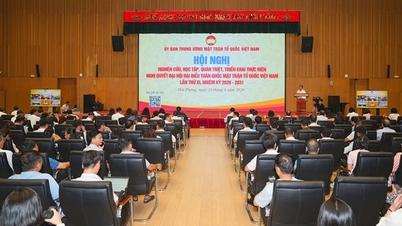
At the seminar "Preserving Integrity in Performing Arts; the Responsibility of Creators in the Digital Age," chaired by the Vietnam Union of Literature and Arts Associations , in coordination with the Vietnam Musicians Association and the Vietnam Theatre Artists Association, and implemented according to the conclusions of the Central Propaganda and Mass Mobilization Committee at the first quarter 2026 meeting on cultural and artistic work, many experts, artists, and managers acknowledged the profound changes that AI is creating in the musical landscape.
According to music researcher and critic Nguyen Quang Long, AI has moved beyond its role as a technical support tool to directly participate in the songwriting process. In a short time, the technology can create melodies, harmonies, arrangements, and even simulate the voices of famous artists with increasing accuracy. Even more remarkably, current AI systems are capable of transforming texts unrelated to music into complete songs with just a few clicks.
This convenience opens up opportunities for many people to access and participate in the world of music. But along with the opportunities come increasingly clear concerns. As creating a song has become easier than ever, the digital space is also seeing an increasing number of products created using AI but lacking personal touch and artistic depth. In an environment where speed of content production is prioritized, short, easily shareable songs often have an advantage over works that are invested in terms of ideas, emotions, and aesthetic value.



Singer-songwriter Giáng Son stated that AI has become quite prevalent in songwriting. She recounted her surprise at judging a competition and receiving 24 songs created using AI tools. She believes technology can be a useful resource, assisting artists in finding ideas or developing creative material. However, using AI-generated products as if they were personal creations is a different matter entirely. “AI can suggest lyrics and melodies. But using those exact products in competitions or for public release is unacceptable,” she shared.
Composer Cát Vận also believes that AI possesses advantages that humans find difficult to compete with in terms of data processing speed or the ability to generate multiple harmony and arrangement options in a short time. However, according to him, the important thing now is not how far the technology can go, but how people use the technology. AI can become a useful assistant in the creative process, but the line between support and replacement is a problem that the music industry must confront.
The development of digital platforms and content distribution algorithms has made the situation even more complex. In the competition for public attention, speed is often prioritized over depth, and virality sometimes becomes a greater advantage than artistic value. At that point, what worries professionals is not only the emergence of AI, but also the risk of human creativity being lost amidst the countless products created every day. And perhaps, this is the biggest question facing music in the AI era: When creating a song becomes increasingly easy, what will define the unique value of an artist?
The rest is up to the artist.
Each technological revolution changes the way people create, perform, and appreciate art. The emergence of AI can be considered one of the biggest turning points in musical life since the advent of recording technology. However, along with new opportunities, many artists have also expressed concerns about the risk of becoming dependent on technology.
People's Artist Vuong Duy Bien, Chairman of the Vietnam Cultural Industry Association, frankly stated: "AI is originally just a supporting tool, a helper. But sometimes it becomes the main labor force, and artists become its helpers." According to him, this is a thought-provoking warning about the risk of human creative capacity being eroded if we become too dependent on technology.
From another perspective, musician Duc Trinh believes that professionals cannot stand outside the flow of the digital age. Understanding and applying AI is an essential requirement in the current context. However, what determines the value of a work is still the personal imprint and unique emotions of the artist. "AI can be very helpful, but the work presented to the public must be creative, reflecting the artist's own emotions to resonate with people's hearts," he emphasized.
Behind the debates about technology, what concerns many artists most remains the place of humans in artistic creation. A piece of music can be completely constructed by AI in terms of structure, harmony, and rhythm. But art has never been merely the arrangement of technical elements. What gives life to a work of art are the experiences, memories, joys, aspirations, and spiritual world that the artist imbues within it.
According to Mr. Nguyen Quang Long, the rapid development of AI tools can create countless "musicians" overnight, but at the same time, it also makes the public appreciate works that possess creative individuality and genuine emotion more. Although AI can synthesize millions of musical pieces to create a new melody, what audiences seek in art is not just sound; they seek empathy, shared experiences, and a feeling of connection with another soul behind the work.



Besides its impact on creative activities, AI also poses an increasing challenge to intellectual property rights. As artificial intelligence systems exploit massive amounts of data to learn, mimic vocals, or recreate artistic styles, many legal questions become urgent: Who is the true author of an AI-assisted work? Who is responsible when artists' rights are infringed? Where is the line between learning, referencing, and copying? These are issues that the Vietnamese music industry, as well as many countries around the world, are trying to address.
In the not-too-distant future, AI may help humans create more musical products than ever before. But the history of art is never written by an abundance of works, but by the unique voices preserved in the minds of generations. Technology may shorten the distance from idea to product, but it cannot replace human beings living a life with something significant to contribute to art.
AI is significantly expanding the creative boundaries of music. But in an era where everything can be created with just a few lines of code, the value of genuine emotion, lived experience, and personal touch becomes increasingly apparent. This is also what distinguishes a product created by an algorithm from a work that can endure in the public memory.
Source: https://baovanhoa.vn/nghe-thuat/giu-phan-nguoi-trong-am-nhac-thoi-ai-239029.html



![[Photo] Prime Minister Le Minh Hung presides over the thematic session on promoting science and technology development and innovation.](https://vphoto.vietnam.vn/thumb/1200x675/vietnam/resource/IMAGE/2026/06/23/1782207872934_ndo_br_dsc-1724-jpg.webp)