

 |
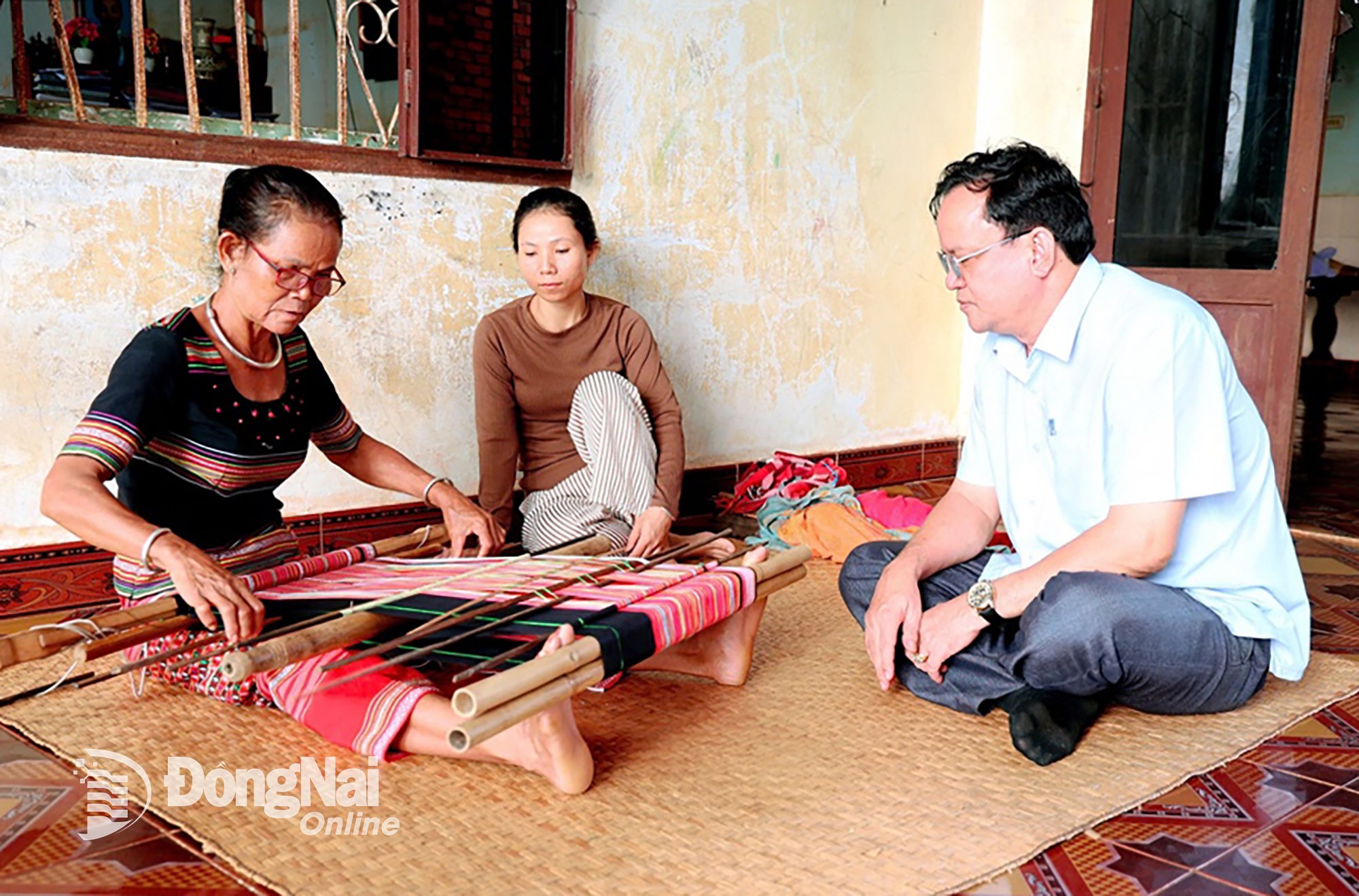
| Deputy Chairman of Tan Hung Commune People's Committee Le Viet Truyen visits and encourages the family of artisan Thi Muong (residing in Bu Dinh village) to preserve and promote the traditional brocade weaving craft. Photo: Quy Son |
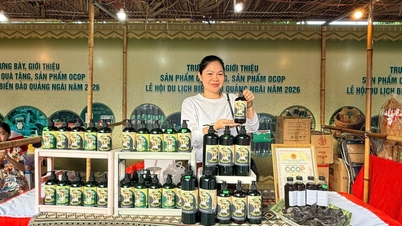
Today, that joy is multiplied as the brocade products of the Bu Dinh Village Weaving Group, Tan Hung Commune, Dong Nai Province, have for the first time received the OCOP (One Commune One Product) 3-star certification, an unprecedented achievement for the traditional brocade weaving craft of this area.
Preserving the "national spirit" in every thread of fabric.
In Phu Thuan village, Phu Rieng commune, Dong Nai province, the sight of a woman sitting on her porch with a loom is no longer unfamiliar to the local people.
Ms. Dieu Thi Hong believes that while brocade weaving isn't physically demanding, it requires a lot of time, perseverance, meticulousness, and especially skill and creativity. Over time, brocade weaving has gradually declined, with fewer and fewer women knowing how to weave. Women now only weave brocade in their free time or when they receive orders to supplement their income. Most brocade weaving is primarily for family use during holidays, Tet (Lunar New Year), or important family events like weddings.
The art of brocade weaving demands a high degree of skill and creativity. Skill is demonstrated through the arrangement of patterns: simple patterns (diamonds, squares) in pale colors are the mark of beginners; complex, flowing patterns with harmonious colors are the hallmark of a talented weaver.
Ms. Thi Phuong, a S'tieng woman (residing in Tranh 3 hamlet, Tan Quan commune, Dong Nai province) who has been involved with weaving since childhood, shared: “For nearly 30 years, weaving brocade is not just about making a piece of cloth. It's a way for me to tell the story of the mountains, the fields, and the rice grains that our ancestors left behind. The patterns are the words I want to speak. Even if I add colors and new images to make it beautiful, the soul, the rice grains of our ancestors, must remain. I have to weave with all my heart and love for the product to have soul. Weaving is also a way to never forget who I am.”
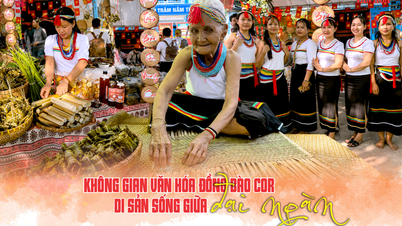
Dong Nai is a land where many ethnic groups converge, a place where cultures intertwine while still preserving their unique characteristics. The S'tieng and M'nong people live together, sharing fields and even the colors of their traditional clothing. The traditional clothing of S'tieng men is basically similar to that of M'nong men. The clothing of S'tieng and M'nong women also shares many similarities, most noticeably in the skirt. Even to the naked eye, one can easily recognize the colorful and intricately patterned skirts of S'tieng women. Over time, the artisans of brocade weaving have skillfully "localized" and enriched their traditional patterns with refined adaptations, such as the pattern of shimmering golden rice grains interspersed with vibrant green rice leaves, which has become a distinctive feature of modern S'tieng.
S'tieng women believe that each piece of brocade is a story told by calloused hands and a heart that tirelessly cherishes its heritage. Not only the patterns, but also the weaving technique is precious, passed down through generations. The women weave and stitch threads directly on the loom, creating diamond, triangular, and delicate zigzag patterns. These skills are not taught in books; only mothers guide their daughters, and grandmothers teach their granddaughters with patience and love.
A journey to awaken identity
Previously, the brocade weaving craft of the S'tieng and M'nong people was honored as a National Intangible Cultural Heritage, affirming the historical and cultural value of this traditional craft. Recently, the brocade products of the Bu Dinh Village Weaving Group in Tan Hung Commune received OCOP 3-star certification, a significant milestone and a sweet reward after many persistent efforts. Achieving OCOP 3-star certification has opened a new door, allowing traditional brocade to transcend the village boundaries and become a branded economic product in the future.
The achievement of achieving OCOP 3-star standard for brocade products in Bu Dinh village, Tan Hung commune, is proof that preservation does not mean maintaining the status quo, but rather making the heritage alive and thriving, capable of sustaining the livelihoods of those who create it. This recognition encourages the younger generation of S'tieng and M'nong people to be proud and return to the looms of their ancestors, and also helps brocade products to be present in future supply chains for tourism, fashion , and handicrafts, thereby increasing their value and expanding their market.
To integrate brocade weaving into modern life, the leaders of Tan Hung commune recently visited the homes of artisans to encourage their families to work together with the local community to preserve and promote the value of brocade weaving, while also honoring those who safeguard the cultural essence of the product. Ensuring the sustainable development of brocade weaving is not the responsibility of any one individual, but requires everyone to work together to promote the cultural values of the nation.
Amidst the noise of machinery in the 4.0 era, the rhythmic clicking of the looms continues. That clicking sound not only weaves fabric but also weaves faith, pride, and a future for a heritage that has been intertwined with the mountains and forests of Dong Nai for generations. And tomorrow will ignite the dream of brocade fabrics from Bu Dinh (Tan Hung), Tranh 3 (Tan Quan), Phu Thuan (Phu Rieng)... continuing to reach the world, carrying the colors of the mountains and forests, and the resilient, simple, and proud heart of the S'tieng people.
Phuong Dung
Source: https://baodongnai.com.vn/dong-nai-cuoi-tuan/202511/giu-van-hoa-tu-doi-tay-kheo-leo-2e02cb6/
![[Image] A brilliant symphony and explosive power in the skies of Da Nang.](https://vphoto.vietnam.vn/thumb/1200x675/vietnam/resource/IMAGE/2026/05/31/1780196945787_anh-man-hinh-2026-05-31-luc-10-08-51.png)




![[Megastory] The journey of young doctors in challenging lands](https://vphoto.vietnam.vn/thumb/402x226/vietnam/resource/IMAGE/2026/03/26/1774537751919_megastory_thay_thuoc_tre_thumbnail_20260326214103.jpeg)



![[Photo Gallery] Spring Volunteer Program - Working Together for the Community](https://vphoto.vietnam.vn/thumb/402x226/vietnam/resource/IMAGE/2026/01/31/1769810662260_5t_20260130154816.jpeg)








![[Video] Sunset at Lap An Lagoon – Where the sun sets over the fishing nets](https://vphoto.vietnam.vn/thumb/340x192/vietnam/resource/IMAGE/2026/05/31/1780192137701_beach-landscape-sea-water-nature-grass-745871-pxhere-com.jpeg)


























































Comment (0)