

Vietnam's shrimp industry could reach $4 billion in exports this year. Vietnamese shrimp also has the opportunity to increase exports to the US.
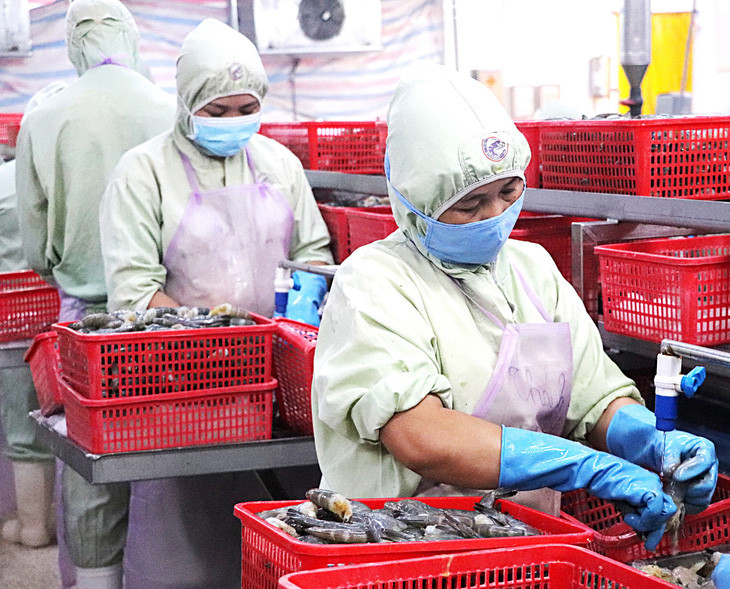
However shrimp industry Vietnam still has many "bottlenecks" that need to be addressed.
Awaiting the decision on December 5th.
The entire industry is excited as export turnover has continuously increased over the past 10 months, and is preparing for new orders. This year, the Vietnamese shrimp industry could reach approximately 4 billion USD. As of the end of October 2024, it had already reached over 3.2 billion USD.
The opportunities for Vietnam's shrimp industry to expand are significant, not only in the US. This is due to its advantages. With numerous FTAs signed by the government, combined with advanced processing techniques, Vietnamese shrimp has penetrated high-end, large-scale distribution and consumption systems in key global markets.
Another piece of good news is that the US Department of Commerce (DOC) has just announced anti-dumping (AD) and countervailing (CVD) duties on shrimp imported from various countries. The duty rate for our shrimp entering this market is 2.84% - lower than the 5.77% from India or 3.78% from Ecuador.
Regarding the overall impact on the shrimp industry, a topical issue right now is the new US president's policy on import tariffs, especially for countries with a trade surplus with this sector.
It should be noted that this policy may, in the short term, affect the US International Trade Commission's (ITC) decision on December 5, 2024, regarding CVD tariffs on Vietnamese shrimp. Vietnamese shrimp will continue to have favorable access to this market with the current tariff rate of 2.84%.
The ITC's decision on December 5th will be implemented from mid-December and is important for the Vietnamese shrimp industry. However, the Vietnamese shrimp industry itself also has "bottlenecks" that need to be addressed.
Challenges include shrimp mortality and a shortage of raw materials.
The biggest challenge for the shrimp industry is contaminated broodstock and increasingly unfavorable water conditions, leading to high mortality rates. No one takes responsibility. The broodstock seller says his broodstock is good. The farmers say, "What's so good about it? They only released it about a month ago, and they're all dying from disease." Then they argue back and forth.
Actually, the problem can still be separated. For example, it is estimated that if the damage is due to poor pond management or water treatment, it will only occur about a month and a half or more after stocking the shrimp fry. If it occurs before a month, the shrimp fry were already infected. Currently, some shrimp farming areas are experiencing damage about a month after stocking.
But now no one is admitting their mistake. The parties are discussing it back and forth without giving exact figures, only saying that now, the disease affecting the fry is quite common, at least 30-40%, meaning that out of 100 ponds, 30-40 are affected.
During the period of 2010-2015, shrimp farmers purchased insurance, but then suffered from acute hepatopancreatic necrosis syndrome (AHPNS), causing continuous shrimp deaths, and the insurance companies stopped selling insurance.
One thing leads to another. This situation has resulted in a shortage of commercial shrimp recently, and prices are very high. Relatively speaking, the cost of farming shrimp in Vietnam is still higher than that of Indian and Ecuadorian shrimp, by almost 1 and 1.5 USD/kg respectively. Meanwhile, the area of shrimp farms meeting ASC standards and having a registered farm system in Vietnam is still very low, below 10%, while ASC-certified shrimp from Ecuador is over 30%.
We need open policies.
We have an advantage over many countries in terms of tariffs due to our participation in numerous free trade agreements. However, it's important to remember that these factors are also subject to fluctuations in politics , diplomacy, and the economy.
It's also not easy to take advantage of tariff preferences from FTAs. For example... Vietnam-EU Free Trade Agreement Although an agreement has been signed, farmed shrimp must meet EU standards.
But there are solutions to the problem.
Firstly, it is necessary to form shrimp farming cooperatives with a scale of approximately 100 hectares. Secondly, policies are needed to encourage investment in agriculture in general, and shrimp farming in particular; to encourage land consolidation and concentration to form new farms, according to regulations and other requirements. Thirdly, a "Greening the Shrimp Industry" program should be implemented to meet global trends as soon as possible.
The most important factor in improving the current bottleneck is having an open policy that encourages land consolidation and concentration, attracting investors to participate in the shrimp farming sector, and forming large-scale farms like its competitor Ecuador.
Source
![[Photo] Standing Committee member of the Party Central Committee Tran Cam Tu working with the Central Inspection Committee](https://vphoto.vietnam.vn/thumb/1200x675/vietnam/resource/IMAGE/2026/05/28/1779969579668_ndo_br_bnd-2495-jpg.webp)




























































































Comment (0)