

Initiating the "one-stop shop" mechanism.
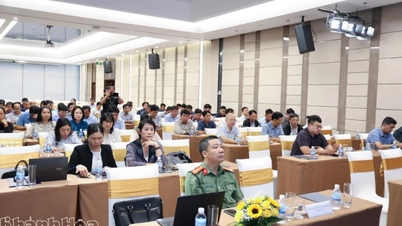
At the opening session of the forum, a representative from the Ministry of Industry and Trade emphasized that Cambodia is an important trading partner of Vietnam in the Mekong region, playing a crucial role as a transit gateway for goods from Vietnam to the ASEAN market and vice versa. The land border between the two countries is over 1,137 km long, passing through 8 provinces of Vietnam and 9 provinces of Cambodia, with a system of border gates distributed along the entire border, playing a key role in the flow of goods.
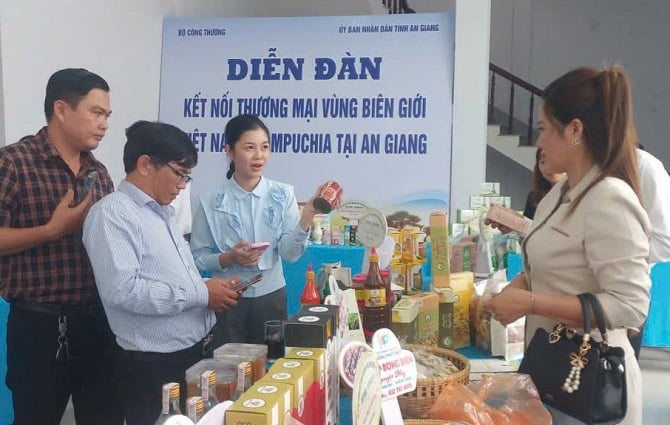
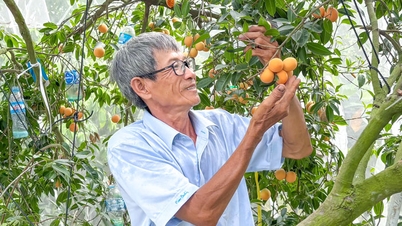
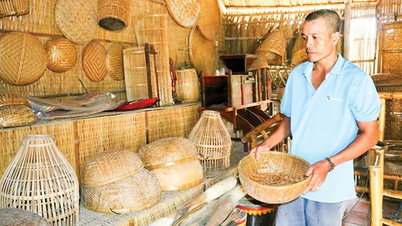
Products from An Giang province that meet OCOP standards of 3 stars or higher are on display at the event.
According to the plan approved by the Prime Minister, by 2030 Vietnam will have established a system of border gate areas with integrated development of trade, logistics, services, and tourism. The goal is to effectively exploit the economic potential of the border region while ensuring national defense and security requirements.
Customs data shows that in the first nine months of 2025, import and export turnover through Vietnam-Cambodia border gates reached over US$5.9 billion, an increase of over 15% compared to the same period. Vietnam's exports continued to grow in key product groups such as textiles, steel, construction materials, processed seafood, and consumer goods. Conversely, Vietnam mainly imported rubber, cashew nuts, agricultural products, and some minerals. The structure of trade demonstrates a clear complementarity between the two economies, but also carries the risk of seasonal trade deficits, especially in the agricultural sector.
In the context of deep integration with the WTO, RCEP, and ATIGA, border trade infrastructure plays a crucial role. Warehouse systems, logistics, border markets, and trade centers not only serve import and export activities but also create momentum for economic development in border regions, increasing employment and income for local people.
At the forum, the most discussed issue was the implementation of a "one-stop shop" mechanism at international border gates between Vietnam and Cambodia. This model is expected to shorten customs clearance time and reduce logistics costs for businesses. Many localities have also included logistics centers, bonded warehouses, supermarkets, and shopping malls in their planning to expand opportunities for investment.
An Giang province, in particular, is considered an important transit point from the Southwest region of Vietnam to Cambodia and the Mekong sub-region. Logistics and agricultural/aquatic product export businesses expect that the synchronized border gate and warehousing infrastructure will help reduce transportation costs (currently accounting for 20-25% of the cost), thereby enhancing the competitiveness of Vietnamese goods in Cambodia and ASEAN.
Aiming to reduce costs by 15%
According to Nguyen Duy Linh Thao, Deputy Director of the Department of Industry and Trade of An Giang province, to develop border trade, An Giang province will focus on improving border gate infrastructure and logistics. Specifically, the province will accelerate investment in infrastructure for the Tinh Bien, Khanh Binh, and Ha Tien border economic zones. This includes building inland ports, bonded warehouses, and large-scale cold storage facilities, while also developing a transportation system connecting border gates with national highways, expressways within and outside the province, and industrial zones.
“The province is focusing on promoting digital transformation in border trade, supporting businesses in expanding into the Cambodian market. We are developing border trade and services and upgrading border markets. At the same time, we are developing new types of trade such as duty-free shopping centers, logistics services, and international transportation. We are also strengthening bilateral cooperation with Kandal and Takeo provinces,” Ms. Thao outlined.

Nguyen Duy Linh Thao, Deputy Director of the Department of Industry and Trade of An Giang province, provided information on the border trade infrastructure between Vietnam and Cambodia.
According to Ms. Thao, despite the great opportunities, the Vietnam-Cambodia border trade infrastructure still has many limitations. Investment capital for border gates, warehouses, and logistics centers is insufficient compared to the needs; the border market is small and has low purchasing power, making it difficult to attract large investors. Some border gates lack synchronized infrastructure for inspection, supervision, and technical equipment, leading to congestion and prolonged customs clearance times. Many border markets still operate in a fragmented manner, logistics services are underdeveloped, and there is a lack of essential links such as bonded warehouses and inland container depots (ICDs).
In light of this situation, the Ministry of Industry and Trade and local authorities aim to comprehensively upgrade border trade infrastructure by 2030, prioritizing the construction of logistics centers, bonded warehouses, and cold storage facilities at key border gates such as Moc Bai, Tinh Bien, Ha Tien, and Binh Hiep. Border markets, supermarkets, and commercial centers will also be standardized and modernized, gradually transitioning from temporary markets to standardized models to attract long-term investment from businesses.
The expansion of electronic customs and the establishment of centralized collection and inspection points at border gates will be accelerated to shorten customs clearance time and reduce costs for businesses. The goal by 2030 is to reduce logistics costs by 10-15%, increase import and export turnover through border gates, and link border trade economic development with ensuring national defense and security, and stabilizing the lives of people in border areas.
Source: https://doanhnghiepvn.vn/kinh-te/viet-nam-campuchia-go-diem-nghen-logistics-va-chuoi-cung-ung-vung-bien/20251210083117822











































![[OFFICIAL] MISA GROUP ANNOUNCES ITS PIONEERING BRAND POSITIONING IN BUILDING AGENTIC AI FOR BUSINESSES, HOUSEHOLDS, AND THE GOVERNMENT](https://vphoto.vietnam.vn/thumb/402x226/vietnam/resource/IMAGE/2025/12/11/1765444754256_agentic-ai_postfb-scaled.png)














































Comment (0)