

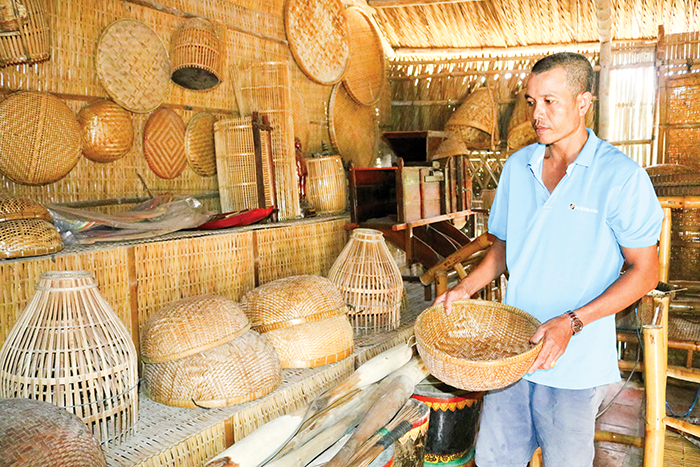
Mr. Kim Nguyen shared about his family's traditional weaving craft.
Nearly three years have passed since the death of artisan Lam Liep, and his creations and mementos have been carefully preserved by his family in a display house made of bamboo and thatched with leaves, measuring approximately 15 square meters. Besides hanging various items such as sieves, winnowing trays, baskets, and bamboo containers, the shelves and floor also display models of agricultural tools like plows, harrows, planting stakes, harvesting rings, rice winnowing machines, tables, chairs, and mortars for pounding flattened rice, as well as models of traditional boats, three-leaf boats, and rice mortars.
In the house displaying agricultural tools and household items associated with the life of the Khmer people in Southern Vietnam, Kim Nguyen, the son-in-law of the late artisan Lam Liep, in Phuoc Quoi hamlet, Thuan Hoa commune, shared his thoughts: "My father's wish was to prevent the family's traditional craft from fading away, so we, his descendants, will continue his legacy, preserving and developing this weaving craft for generations to come."
His wife and children continue the craft of bamboo weaving. Mrs. Ly Thi Che, the wife of the late artisan Lam Liep, is now elderly and has poor eyesight, so she mainly does the work of shaping bamboo and weaving simple items such as baskets, sieves, and trays. Products requiring more meticulous work and greater effort are made by her son-in-law, Mr. Kim Nguyen. Thanks to their skillful craftsmanship and nearly 20 years of experience in bamboo weaving, the products are durable, beautiful, and popular with customers. Besides being used for personal use, customers buy them to decorate their shops and restaurants, or as souvenirs and display items.
“Currently, household items made from plastic and metal are inexpensive, and woven bamboo products are also common in the market. However, in terms of price, our products are more expensive because we use mature bamboo, bound with tendons, ensuring durability and aesthetics. For example, a fish trap costs around 70,000-80,000 VND on the market, while our product costs tens of thousands more because of its sturdiness and long-lasting use,” shared Mr. Kim Nguyen.
Another frequently ordered fishing tool is the fish trap. Especially during the flood season, people from many places come to buy traps to use in their traditional fishing methods, so family members have to work hard to meet customer demand. The mortar and pestle set for pounding flattened rice is also popular during the Ooc-Om-Boc Festival. Every year, around this time, his family sells nearly a dozen sets to various organizations and localities for display and to recreate the traditional flattened rice making craft. In addition to selling seasonal products, Kim Nguyen's family also splits bamboo to sell to customers for making paper offerings, cages, and chicken coops, providing them with a regular income.
With unwavering dedication to preserving the craft, the family of the late artisan Lam Liep has produced thousands of handcrafted bamboo products. Many of these products, which "recreate the ancient craft," are displayed at fairs, museums, and traditional houses, and used in traditional festivals and local cultural events. Like many other bamboo weaving artisans in Phuoc Quoi, the members of the late artisan Lam Liep's family are committed to preserving the craft not only because it provides a stable livelihood but also because it is a source of pride in their inherited craft – a unique cultural beauty of the Khmer ethnic group.
“Although the income from weaving isn't high, our family still chooses to preserve the craft. Nowadays, with societal development and modern technology and machinery, many beautiful items can be created. However, we artisans still have faith and pride in our traditionally woven products, because each item we make contains the effort and dedication of the maker. My husband and I have dedicated our lives to weaving and crafting items from bamboo and rattan. When he was alive, Mr. Lam Liep taught the craft to people in the village, contributing to preserving the traditional craft of our ethnic minority. Fortunately, our children and grandchildren are also wholeheartedly preserving and inheriting it, ensuring that our family's traditional craft does not fade away,” Mrs. Ly Thi Che proudly shared.
Text and photos: XUAN NGUYEN
Source: https://baocantho.com.vn/mot-long-gin-giu-nghe-dan-dat-truyen-thong-a195289.html

![[Image] National Assembly discusses the implementation of the socio-economic development plan.](https://vphoto.vietnam.vn/thumb/1200x675/vietnam/resource/IMAGE/2026/04/20/1776696707422_ndo_br_img-20260420-185419-jpg.webp)
![[Photo] General Secretary and President To Lam meets with National Assembly delegates from ethnic minorities.](https://vphoto.vietnam.vn/thumb/1200x675/vietnam/resource/IMAGE/2026/04/20/1776696701056_a1-bnd-8331-3342-jpg.webp)












































































Comment (0)