


Concentrated, large-scale rice growing area in Can Tho city.
Requirements from practice
The Mekong Delta region's linkages over the past period, viewed from the perspective of institutions, mechanisms, and policies, have had fundamental advantages. Important resolutions such as Government Resolution No. 120/NQ-CP on sustainable development of the Mekong Delta adapting to climate change; Politburo Resolution No. 13-NQ/TW on the direction of socio-economic development and ensuring national defense and security in the Mekong Delta region until 2030, with a vision to 2045; and the Integrated Mekong Delta Regional Planning for the period 2021-2030, with a vision to 2050... have created a fundamental institutional framework, guiding development according to regional spatial planning and multi-sectoral integration, replacing the previous fragmented approach based on administrative boundaries. This is a major driving force encouraging localities to shift from a competitive mindset to a cooperative one. In addition, the Mekong Delta Coordination Council and the Inter-provincial Coordination Team were established, initially creating a mechanism for information exchange and coordination in a number of programs.
According to Associate Professor Pham Thu Huong, Rector of the Foreign Trade University, Resolution No. 13-NQ/TW emphasizes the need to innovate the growth model, build a synchronous infrastructure system, enhance adaptability to climate change, and promote regional linkages as a strategy. This orientation is also entirely consistent with the spirit of the Party's 13th National Congress Resolution, which emphasizes development based on internal strengths and sustainable regional linkages to create national synergy in the context of globalization and the fourth industrial revolution. Furthermore, the current context also demands synchronization and harmony among economic regions across all four pillars: international integration; development of science and technology, innovation and digital transformation; development of the private economy; and institutional reform.
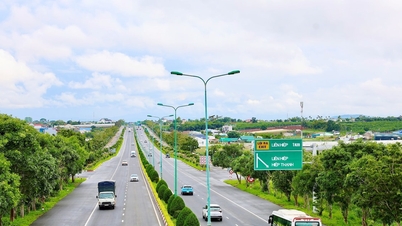
The merger of provincial-level administrative units brings a series of strategic implications for regional linkages in the Mekong Delta, not only in terms of organizational structure but also in maximizing the overall development potential of the entire region. Many key projects such as horizontal and vertical expressways, seaports, logistics, and inter-regional irrigation infrastructure are being invested in with a "regionalization" orientation to increase connectivity in economic and trade development along the value chain.
“After the merger, the Mekong Delta region has shifted from a dispersed development model to a convergent regional model, creating conditions to enhance overall competitiveness, expand economic space, and promote multi-center linkages. The structure of the provinces and cities in the merged Mekong Delta region facilitates integrated economic spatial planning based on three main pillars: modern, sustainable, and climate-adaptive agriculture; marine economy – a gateway for international trade; and deep processing industry and logistics services linked to dynamic urban centers. In addition, the increased area of each locality creates significant room for building large-scale concentrated raw material areas, developing a green economy, and a circular economy…”, shared Dr. Tran Hoang Hieu, Head of the Science Management and International Cooperation Department, Academy of Politics Region IV.
More connected in the new context
According to Mr. Pham Duc Thuan, Deputy Head of the General Planning Department, Can Tho City Department of Finance, regarding spatial connectivity, Can Tho must demonstrate its role as a "convergence point" of economic and natural flows. Beyond its strategic transportation hub, Can Tho must also create an open economic space. This space should be where the entire region's supply chain is perfected by modern logistics and service infrastructure, eliminating administrative boundaries to create seamless resource flow. Furthermore, leveraging its central role is the springboard for creating comparative advantages and sustainable growth momentum. Can Tho should not develop in isolation but in synergy with neighboring localities; the city's advancement in science and technology, healthcare, and education will create a ripple effect, enhancing overall competitiveness and thus realizing the goal of effective and sustainable socio-economic development for the entire region.
Dr. Tran Hoang Hieu proposed that the regional coordination mechanism needs to shift from a voluntary, loosely structured model to one based on legally binding commitments and economic benefits. A mechanism for the fair distribution of benefits among localities is a key condition, because regional linkages are only sustainable when all stakeholders have direct and long-term benefits. Simultaneously, public-private partnership (PPP) models should be encouraged in the development of inter-regional infrastructure such as transportation, logistics, energy, and irrigation. The State should play a "facilitator-leader" role, creating leverage to attract social resources and international capital for projects with spillover effects throughout the region.
Many argue that policies promoting regional linkages in the Mekong Delta should focus on building inter-provincial economic clusters based on comparative advantages in ecology and unique resources. The focus should be on developing high-tech ecological agriculture linked to deep processing; a modern water-land logistics system; renewable energy industries (wind, solar, biomass); sustainable fisheries; and unique river-sea-cultural tourism. To achieve this, special priority policies are needed for leading enterprises in the region's strategic value chains, forming an inter-regional innovation ecosystem, and promoting digital transformation in management, production, and trade. Furthermore, a transparent, consistent, and highly predictable legal environment will be a crucial attraction for investors, while minimizing the widespread competition for investment through incentives among localities, which has caused fragmentation in regional development for many years.
Article and photos: MY THANH
Source: https://baocantho.com.vn/lien-ket-noi-vung-thuc-day-tang-truong-kinh-te-dbscl-a195232.html

![[Photo] The captivating scenery of the fragrant maple forest in Quang Tri](/_next/image?url=https%3A%2F%2Fvphoto.vietnam.vn%2Fthumb%2F1200x675%2Fvietnam%2Fresource%2FIMAGE%2F2025%2F12%2F10%2F1765353233198_lan09046-jpg.webp&w=3840&q=75)
![[Photo] Explore the US Navy's USS Robert Smalls warship](/_next/image?url=https%3A%2F%2Fvphoto.vietnam.vn%2Fthumb%2F1200x675%2Fvietnam%2Fresource%2FIMAGE%2F2025%2F12%2F10%2F1765341533272_11212121-8303-jpg.webp&w=3840&q=75)























![[Video] The craft of making Dong Ho folk paintings has been inscribed by UNESCO on the List of Crafts in Need of Urgent Safeguarding.](https://vphoto.vietnam.vn/thumb/402x226/vietnam/resource/IMAGE/2025/12/10/1765350246533_tranh-dong-ho-734-jpg.webp)


























































Comment (0)