

Hanoi People's Committee Chairman Vu Dai Thang has just issued a directive to strengthen urgent measures to control air pollution in the city.
According to the Chairman of Hanoi, in recent times, the urbanization process has increased emissions and dust from traffic, production, construction, etc., causing a decline in air quality. Especially in recent days, extreme weather conditions (thick fog, low temperatures, temperature inversion) have caused the city's AQI index to reach "bad" and "very bad" levels, affecting people's health and socio- economic activities.
The Chairman of Hanoi requested the Department of Construction to strengthen strict supervision, requiring 100% of construction sites to have strict dust control measures (shielding, washing vehicles when leaving the site, spraying mist to reduce dust, etc.); loose construction waste must be covered, sealed, or bagged at the collection point on the construction site and during transportation, ensuring that dust is not released into the environment.
Units are required to install dust monitoring systems (sensors, cameras) at 100% of construction projects larger than 1 hectare; to be completed by December 2025.
The Department of Construction is responsible for guiding investors and contractors of construction projects to install two fixed misting systems to reduce dust in densely populated residential areas (at high-rise buildings).
Notably, Hanoi Chairman Vu Dai Thang instructed the Department of Construction not to grant permits for excavation work on roadsides and sidewalks (except in cases of emergency response) during the end of the year when air quality is severely polluted.
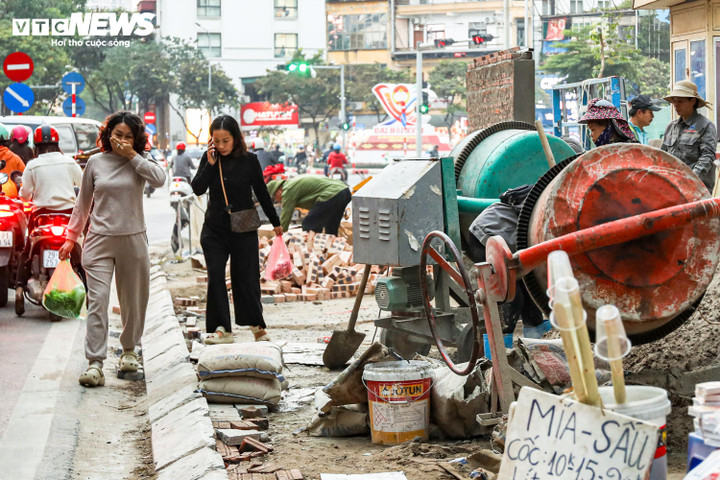
Towards the end of the year, many streets in Hanoi are dug up and turned upside down to replace the paving stones.
The city police have been tasked with organizing a concentrated campaign to inspect and strictly and publicly handle violations such as: transporting construction materials without proper covering, causing material spillage; and illegal burning of industrial solid waste and household waste, especially in craft villages and villages with traditional crafts.
In addition, the city police will soon synchronize the technical infrastructure with a system of security cameras and traffic surveillance cameras integrated with AI to serve the work of inspection, monitoring, and promptly detecting and strictly handling violations and offenders.
The Chairman of Hanoi requested the Department of Education and Training to inform and guide schools to limit outdoor activities for students during hours and days when air quality is at a "poor" level or worse; and to temporarily suspend or adjust students' learning time when the Department of Agriculture and Environment issues a serious air pollution warning.
The Department of Agriculture and Environment implements emergency measures under the coordination of the Ministry of Agriculture and Environment in cases of severe air pollution across regions, provinces, and borders. This unit is required to proactively advise the City People's Committee on mechanisms for coordinating with provinces and cities in the region in controlling inter-regional and inter-provincial air pollution.
The Department of Agriculture and Environment immediately implemented a comprehensive inspection of all solid waste treatment facilities; requiring units to ensure continuous operation and prevent the release of dust and odors.
This department is tasked with overseeing environmental sanitation maintenance contracts according to the hierarchical structure, ensuring sanitation quality on key routes; requiring communes and wards to report results monthly, and directing environmental sanitation units to intensify dust suppression spraying and road cleaning.
The Department of Health, in coordination with media outlets and the People's Committees of wards and communes, advises people (especially the elderly, children, and those with underlying respiratory conditions) to minimize outdoor activities during periods of high VN_AQI levels to protect their health.
Proactively develop disease response plans, requiring healthcare facilities in the inner city and areas at risk of air pollution to have contingency plans in place with equipment and resources to be ready to respond and serve the public in case of severe air quality deterioration affecting the respiratory systems of many people.
The Department of Ethnic Minorities and Religions is launching a campaign to raise awareness and encourage religious and spiritual establishments, places of worship, and the public to reduce the burning of votive paper; and is developing long-term plans and strategies to change people's habits and ultimately eliminate the burning of votive paper.
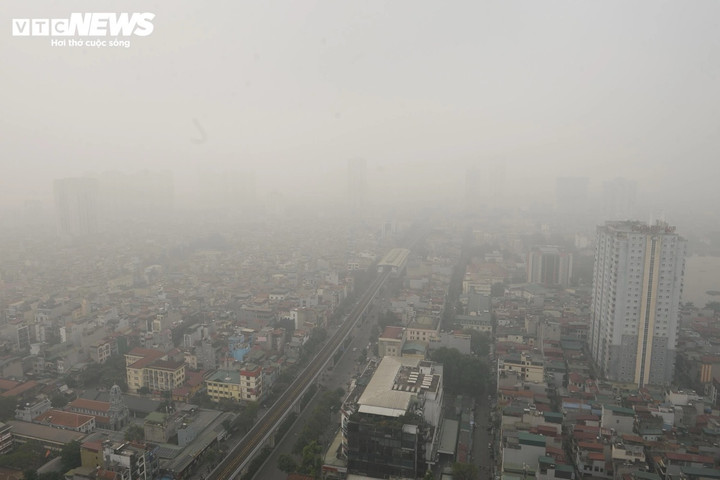
Recently, Hanoi has consistently ranked among the most polluted cities in the world .
The Chairpersons of the People's Committees of communes and wards shall direct relevant agencies to strengthen inspection and supervision of construction sites in their areas, requiring investors and construction units to collect, transport, and process solid waste in accordance with regulations; and strictly handle: vehicles transporting construction materials and waste without proper covering, causing spillage on the road; and acts of burning household solid waste, straw, and agricultural by-products in violation of regulations, causing environmental pollution.
Based on the actual air pollution levels in their respective areas, the chairpersons of the People's Committees of communes and wards should proactively direct environmental sanitation units to: increase the frequency of street sweeping and dust removal; and use specialized vehicles to spray water to wash roads and suppress dust at main traffic arteries and urban gateways.
Street washing and vacuuming should be prioritized during off-peak hours (night and early morning, before 6 am daily) to ensure effectiveness, reduce dust accumulation before peak traffic hours, and avoid congestion.
The Chairpersons of the People's Committees of wards and communes are responsible to the Chairperson of the People's Committee of the city if the burning of garbage and votive offerings, or the improper collection and dumping of waste and debris, causes air pollution in their areas.
Source: https://baolangson.vn/chu-tich-ha-noi-yeu-cau-khong-cap-phep-dao-via-he-khi-khong-khi-o-nhiem-nang-5067680.html

![[Photo] Prime Minister Pham Minh Chinh holds a phone call with the CEO of Russia's Rosatom Corporation.](/_next/image?url=https%3A%2F%2Fvphoto.vietnam.vn%2Fthumb%2F1200x675%2Fvietnam%2Fresource%2FIMAGE%2F2025%2F12%2F11%2F1765464552365_dsc-5295-jpg.webp&w=3840&q=75)


![[Photo] Closing Ceremony of the 10th Session of the 15th National Assembly](/_next/image?url=https%3A%2F%2Fvphoto.vietnam.vn%2Fthumb%2F1200x675%2Fvietnam%2Fresource%2FIMAGE%2F2025%2F12%2F11%2F1765448959967_image-1437-jpg.webp&w=3840&q=75)

































![[OFFICIAL] MISA GROUP ANNOUNCES ITS PIONEERING BRAND POSITIONING IN BUILDING AGENTIC AI FOR BUSINESSES, HOUSEHOLDS, AND THE GOVERNMENT](https://vphoto.vietnam.vn/thumb/402x226/vietnam/resource/IMAGE/2025/12/11/1765444754256_agentic-ai_postfb-scaled.png)





































Comment (0)