

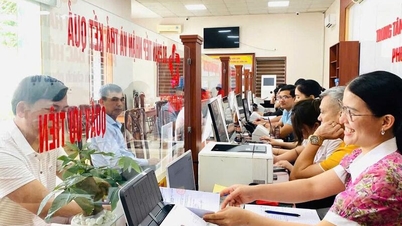
At 7 o'clock, the gentle tapping of the keyboard by Mr. Truong Tai Minh, an official at the People's Council and People's Committee Office of Vinh Hoa Hung commune, broke the early morning silence. On his computer screen, a post had just appeared: a news bulletin warning about a new online scam, accompanied by a link from the authorities. "I posted it early so people could see it right away when they open their phones," Mr. Minh said with a smile.
In this residential area, many elderly people are still accustomed to reading news from unverified sources. Therefore, Minh's concise and easy-to-understand posts become a "clean version of information," helping residents grasp the truth amidst the flood of misinformation.
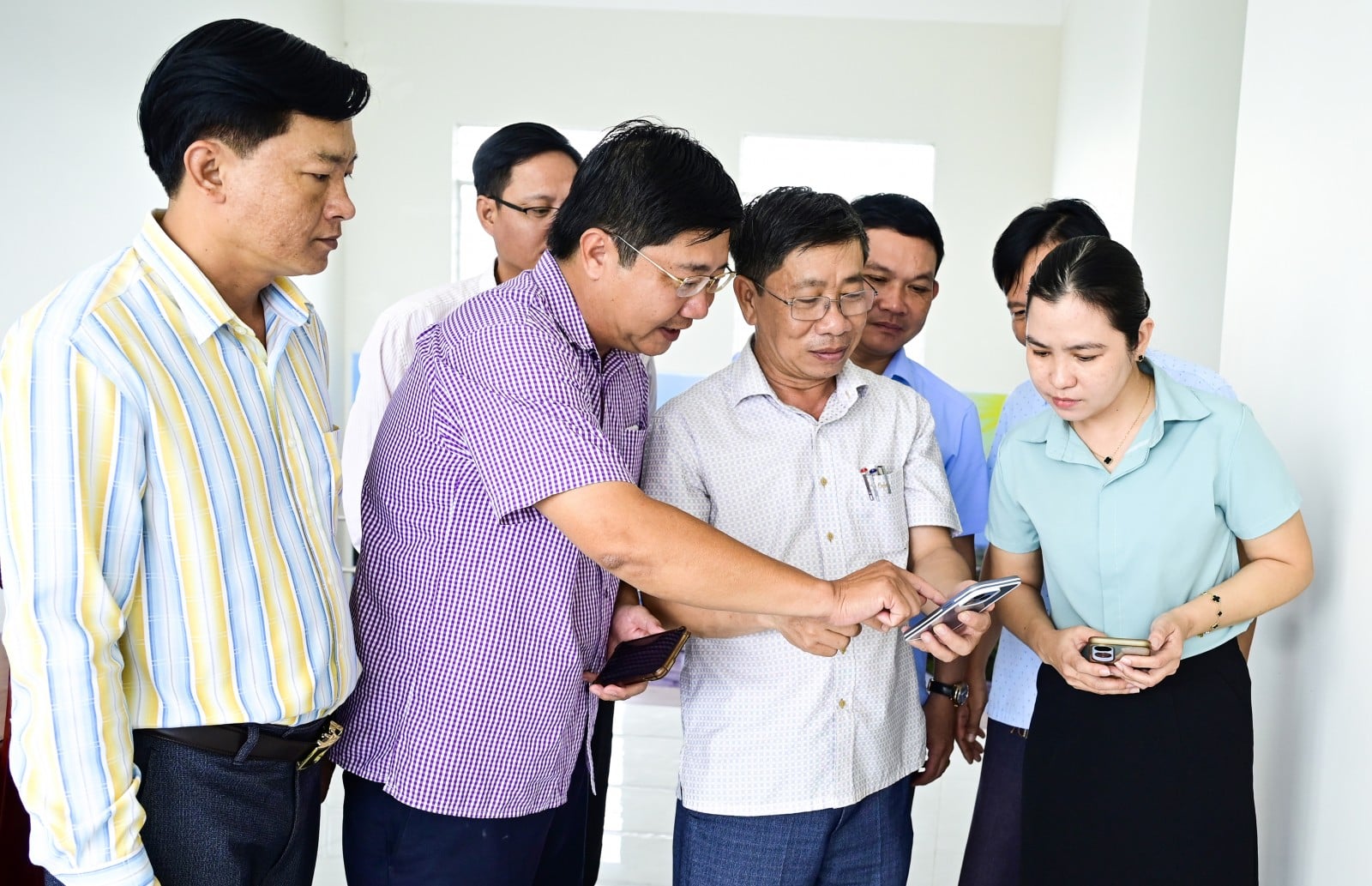
Vo Thanh Xuan (front row, second from the left), Deputy Secretary of the Party Committee and Chairman of the People's Council of Vinh Binh commune, discusses the use of information on social media to promote the protection of the Party's ideological foundation. Photo: Huong Giang
Equipping with digital skills and digital culture.
To truly master cyberspace, Party members and officials need not only strong political resolve but also digital skills and a digital culture. It's worth noting that many online violations don't stem from malicious intent but rather from a lack of understanding, skills, or emotional reactions. Therefore, instead of simply handling incidents, cultivating digital skills and a digital culture among Party members and officials is a proactive and sustainable preventative solution.
Digital skills extend beyond simply using tools and software; more importantly, they encompass online conduct skills: identifying harmful and toxic information, defining the boundaries between personal rights and official responsibilities, carefully considering what to share or comment on, and avoiding joining groups with unclear purposes. These skills help Party members protect their personal and organizational reputation, the reputation of the Party, and contribute to building a healthy online environment.
Simultaneously, as social media becomes the primary information channel, public service communication skills are essential for officials and employees. Without these skills, information is easily misinterpreted, distorted, or inadvertently contributes to the spread of fake news, eroding public trust in government agencies. Therefore, agencies and units need to equip officials and employees with the ability to edit content appropriately, use images and videos effectively, leverage digital tools to reach the public, and develop crisis communication management skills. The core principle must be: official, transparent, truthful information that respects the law.
According to Tong Phuoc Truong, Standing Committee member and Head of the Provincial Party Committee's Propaganda and Mass Mobilization Department, Party members and officials must be pioneers and role models in using social media. This is demonstrated through sharing accurate information; combating false and hostile viewpoints; using civilized language; and absolutely not disclosing confidential information of the Party and the State. In the fast-paced and widespread digital age, these principles are a "shield" that helps Party members and officials maintain their personal reputation and strengthen the people's trust.
Promoting the exemplary role of leaders.
In the digital age, social media is not only a tool for connecting communities but also a channel for information, communication, and shaping public opinion. Amidst a sea of diverse information, the role of leaders in setting a good example is especially important, not only helping subordinates to orient themselves but also strengthening public trust. When leaders fail to set a good example on social media, a gap in information guidance immediately appears, causing subordinates to be confused in their behavior, easily falling into indiscriminate sharing, and creating conditions for the spread of misinformation.
Over the weekend, while browsing Zalo groups, I came across posts about protecting the Party's ideological foundation by Mr. Vo Thanh Xuan, Deputy Secretary of the Party Committee and Chairman of the People's Council of Vinh Binh commune. Each word was clear and easy to understand, helping people quickly grasp the information. Within minutes, the post received dozens of shares and positive comments, opening up a beneficial exchange between Party members and the people. Mr. Xuan not only posted information but also explained policies and guided people and Party members in distinguishing between official information and fake news.
In various localities, many leaders proactively post information about administrative reforms, disease prevention and control, and support for farmers, helping to ensure that official information reaches the people quickly and accurately. The exemplary actions of leaders motivate subordinates to confidently discuss and explain policies and participate in shaping public opinion. Chau Nhut Van, Deputy Head of the Party Building Committee of Long Xuyen Ward, emphasized: “When leaders set an example, Party members and officials are no longer hesitant, they know how to use social media correctly, transparently and effectively, thereby maintaining the prestige of individuals and agencies, and simultaneously creating a foundation for building a healthy information environment.”
When every Party member and Party member is vigilant, intelligent, and responsible in the online environment, they will become "soldiers" on the ideological front in the digital age, contributing to building a healthy and humane online space – where official information flows freely and the people's trust is firmly consolidated.
HUONG GIANG
Source: https://baoangiang.com.vn/can-bo-dang-vien-voi-mang-xa-hoi-bai-cuoi-lam-chu-mang-xa-hoi-trong-thoi-dai-so-a470039.html


![[Photo] Prime Minister Pham Minh Chinh holds a phone call with the CEO of Russia's Rosatom Corporation.](/_next/image?url=https%3A%2F%2Fvphoto.vietnam.vn%2Fthumb%2F1200x675%2Fvietnam%2Fresource%2FIMAGE%2F2025%2F12%2F11%2F1765464552365_dsc-5295-jpg.webp&w=3840&q=75)
![[Photo] Closing Ceremony of the 10th Session of the 15th National Assembly](/_next/image?url=https%3A%2F%2Fvphoto.vietnam.vn%2Fthumb%2F1200x675%2Fvietnam%2Fresource%2FIMAGE%2F2025%2F12%2F11%2F1765448959967_image-1437-jpg.webp&w=3840&q=75)




































![[OFFICIAL] MISA GROUP ANNOUNCES ITS PIONEERING BRAND POSITIONING IN BUILDING AGENTIC AI FOR BUSINESSES, HOUSEHOLDS, AND THE GOVERNMENT](https://vphoto.vietnam.vn/thumb/402x226/vietnam/resource/IMAGE/2025/12/11/1765444754256_agentic-ai_postfb-scaled.png)



































Comment (0)