


Completing the legal framework for the digital nation.
The Law on Digital Transformation comprises 8 chapters and 48 articles, stipulating the principles and policies on digital transformation; national coordination on digital transformation; measures to ensure digital transformation; digital government; digital economy and digital society; and the responsibilities of agencies, organizations, and individuals in digital transformation.
Content related to data, electronic transactions, cybersecurity, telecommunications, artificial intelligence, and other specialized fields shall be governed by their respective laws, but must ensure consistency with the principles and requirements stipulated in this Law.
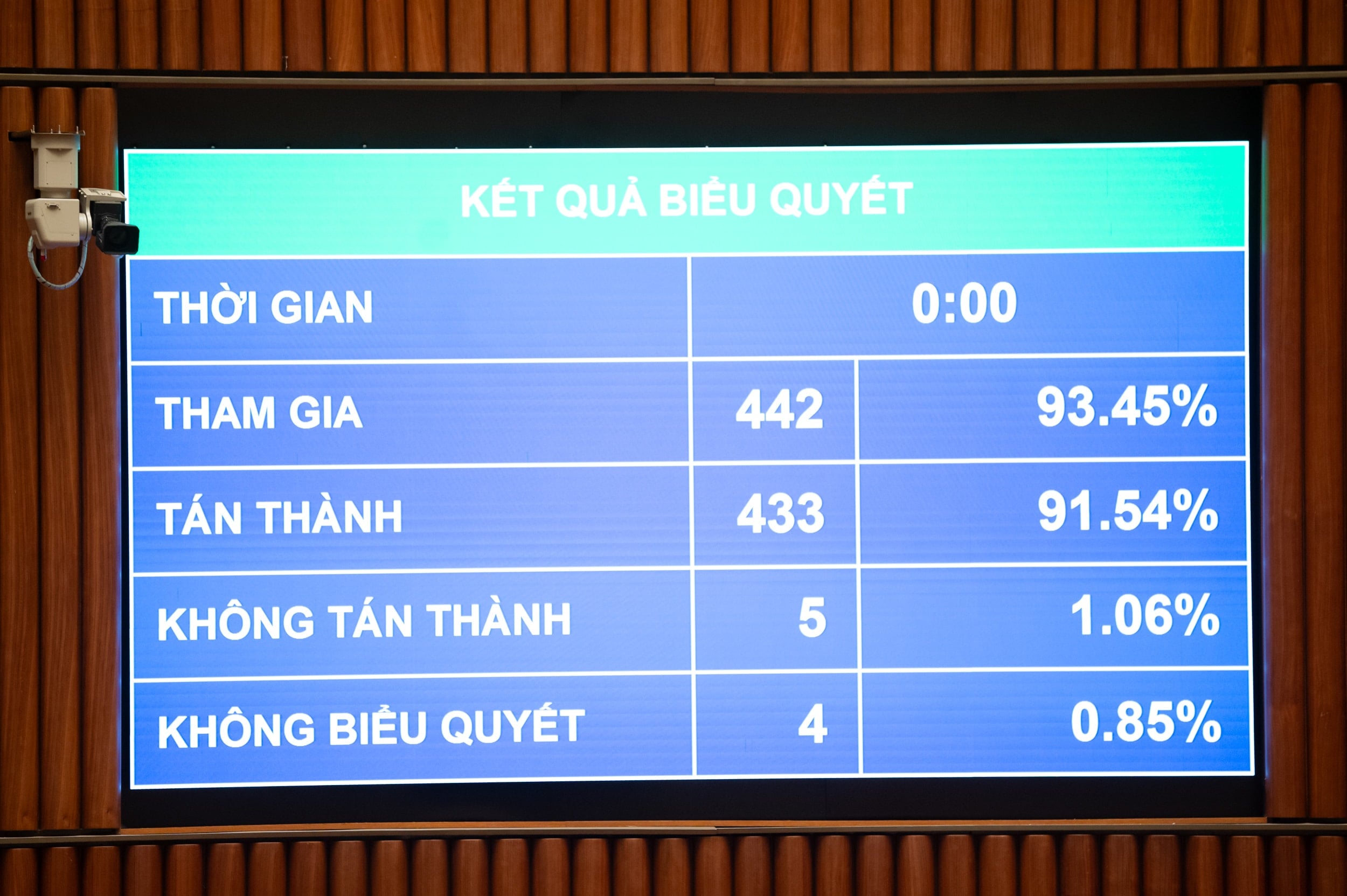
Reporting on the explanation, acceptance, and revision of the draft Law before the National Assembly votes, Minister of Science and Technology Nguyen Manh Hung stated that the Government has directed the Ministry of Science and Technology to accept and revise the draft Law according to the opinions of National Assembly deputies at the group discussion session on November 6, 2025 (Report No. 4493/BC-VPQH dated November 20, 2025) and the plenary discussion session on December 1, 2025.

The revised content has closely followed and relatively fully institutionalized the viewpoints, guidelines, and policies of the Party. The Law ensures the full institutionalization of the Party's guidelines and policies, especially Resolution No. 57-NQ/TW dated December 22, 2024, addressing common difficulties in digital transformation for ministries, sectors, and localities.
The Law on Digital Transformation is designed as a unified framework law for all national digital transformation activities, while integrating two core components: Digital Government and Digital Economy - Digital Society, ensuring there are no legal gaps when the Law on Information Technology is repealed.
The Law on Digital Transformation stipulates the principles and policies on digital transformation; coordination of national digital transformation activities; digital government; digital economy and digital society; measures to ensure digital transformation; and responsibilities of agencies, organizations, and individuals (including: digital workforce; digital transformation infrastructure; digital data...). The focus of the law is on regulating digital transformation within agencies of the political system; at the same time, organizations and businesses can also proactively research and apply it.
Transform first - digitize later
According to Minister Nguyen Manh Hung, one of the most important aspects of the Law is that it for the first time legalizes fundamental concepts of digital transformation – from digital transformation, digital systems, digital data, digital infrastructure, digital platforms to digital government, digital economy, and digital society. The Government has thoroughly reviewed and revised these definitions to ensure scientific rigor and to unify the understanding for the entire political system and all entities participating in digital transformation.
The key point of the draft is to clarify the difference between digital transformation and information technology application: While information technology application only moves old operations to a digital environment, digital transformation is about changing the way operations are conducted, the governance model, and the method of service delivery. This is considered the core philosophy of the law, reflecting the spirit of "transformation first - digitalization later".

Besides refining the conceptual framework, the draft Law clearly stipulates macro-level governance tools such as the National Digital Transformation Program, the National Digital Architecture Framework, the Data Governance Framework, the Digital Competency Framework, and the National Digital Transformation Measurement Indicators Set. These tools are likened to a "central coordinating body," helping the State assess progress, promote implementation, and ensure synchronization between digital transformation at the national, ministerial, and local levels. "Legalizing these frameworks will create uniformity in implementation, avoiding the fragmented investment and inconsistent approach seen in the past," a government representative affirmed.
The law will come into effect on July 1, 2026.
Source: https://daibieunhandan.vn/quoc-hoi-thong-qua-luat-chuyen-doi-so-10400101.html



![[Photo] General Secretary and President To Lam meets with National Assembly delegates from ethnic minorities.](https://vphoto.vietnam.vn/thumb/1200x675/vietnam/resource/IMAGE/2026/04/20/1776696701056_a1-bnd-8331-3342-jpg.webp)
![[Image] National Assembly discusses the implementation of the socio-economic development plan.](https://vphoto.vietnam.vn/thumb/1200x675/vietnam/resource/IMAGE/2026/04/20/1776696707422_ndo_br_img-20260420-185419-jpg.webp)














![[Infographics] Information on the 34 Chairpersons of Provincial and City People's Councils for the 2026-2031 term](https://vphoto.vietnam.vn/thumb/402x226/vietnam/resource/IMAGE/2026/04/21/1776727949303_package-media-53613504261372558961610-84744387961269657917369.png)
















































































Comment (0)