

Unprecedented investment paves the way for breakthroughs.
The government allocates at least 3% of the state budget to science and technology, innovation, and digital transformation. With total resources reaching nearly 95 trillion VND from 2026, this is marking a major turning point in the national development strategy based on knowledge and technology. Decree 265/2025/ND-CP, along with new guidelines on planning, budgeting, and managing public investment, is creating a unified legal framework, helping to remove bottlenecks in allocation and disbursement, unblocking capital flows, and granting more autonomy to ministries, sectors, and localities in implementing science and technology, innovation, and digital transformation tasks.
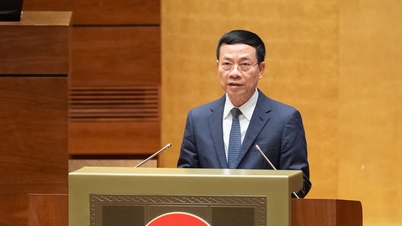
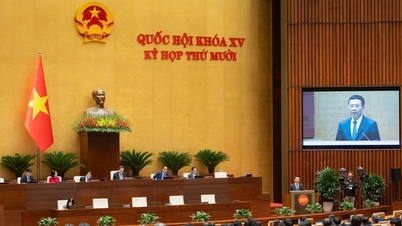
In his opening remarks, Deputy Minister of Science and Technology Bui Hoang Phuong emphasized that the world is moving at an unprecedented pace under the impact of artificial intelligence and digital platforms, technologies that are reshaping all models of production, management, and services. In this context, any nation that can build a sufficiently flexible and visionary mechanism to leverage the advantages of science and technology will hold a competitive advantage and opportunities for sustainable development. Resolution 57-NQ/TW clearly affirms that the development of science and technology, innovation, and digital transformation is a top priority breakthrough for the 2026-2030 period, serving as the foundation for improving national productivity, quality, and competitiveness.
The Deputy Minister stated that, in order for science and technology to truly become a part of life, the Party, State, and Government have identified one of the prerequisite steps as ensuring a minimum of 3% of the state budget is allocated to this field. In 2025 alone, the budget allocated an additional 25,000 billion VND for science and technology, innovation, and digital transformation, a figure demonstrating the Government's strong determination. However, the actual implementation of the allocation and disbursement of these new resources in the initial phase still faces many challenges. To date, the Ministry of Science and Technology, in coordination with the Ministry of Finance, has allocated a total of 16,716 billion VND to 26 ministries, central agencies, and localities.
Notably, at the 5th meeting of the Government Steering Committee on Science and Technology, Innovation & Digital Transformation and Project 06, Prime Minister Pham Minh Chinh concluded that approximately 95,000 billion VND will be allocated to these fields in 2026. This presents an unprecedented development opportunity, but also a significant challenge to the capacity of ministries, sectors, and localities to absorb, manage, and deploy public resources.
According to Deputy Minister Bui Hoang Phuong, to effectively utilize this large budget, it is necessary to start from the planning and budgeting stage, a fundamental step that determines investment efficiency. Although many regulations have been issued, planning in some units still lacks uniformity. The Deputy Minister requested that delegates engage in frank discussions to reach a consensus on understanding and implementation of Decree 265. The Ministry of Science and Technology will continue to work alongside ministries, sectors, and localities, coordinating with the Ministry of Finance to ensure that resources are allocated correctly, sufficiently, and promptly, and to enhance transparency in management.
At the conference, the Deputy Minister also expressed his deepest condolences to Gia Lai for the heavy damage caused by the recent floods, and affirmed that the Ministry of Science and Technology, along with related businesses and organizations, will continue to work together to support the people in overcoming the consequences of the natural disaster.
New policies remove legal barriers.
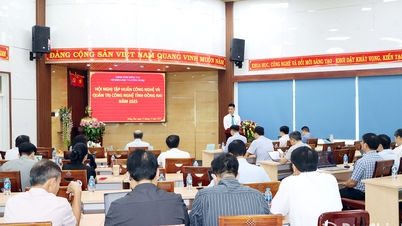
In his welcoming remarks at the conference, Chairman of the Gia Lai Provincial People's Committee Pham Anh Tuan expressed his honor that the province was chosen as the venue for this strategically significant event for the development of science and technology, innovation, and digital transformation. The Chairman emphasized that Decree 265 is a document that has received special attention from the management team, scientists, and the science and technology organization system, as it resolves many long-standing bottlenecks in the management, allocation, and use of the budget.

Gia Lai, like many other localities, is currently dealing with a massive workload, with over 150 tasks requiring implementation at the request of the central government and the province. However, the lack of specific guidance on spending and resource allocation has made many units hesitant and reluctant to implement these tasks. Decree 265 has created a unified and clear legal framework, giving localities more confidence in carrying out their duties.
The Chairman of the Provincial People's Committee requested that departments and agencies seriously heed the guidance given at the conference to ensure safe, effective, and compliant implementation. At the same time, the Chairman expressed gratitude to the Ministry of Science and Technology and other organizations and businesses for their support in helping the province overcome the consequences of Typhoon No. 13, a support of immense material and spiritual value to the province.
At the conference, delegates presented in-depth content revolving around the new financial mechanism in Decree 265. Ms. Nguyen Hong Van (Planning and Finance Department) affirmed that the Decree plays a crucial role as a legal foundation, creating a synchronized and flexible framework to promote science, technology, and innovation activities. The Decree guides budget allocation for infrastructure, funds, scientific organizations, human resource training, and specific policies, demonstrating the State's strong commitment to investing in the development of this field.
Mr. Tran Nhu Hien, Deputy Director of the Planning and Finance Department, presented guidelines for public investment planning. Medium-term and annual planning must align with the socio-economic development strategy, the science, technology, and innovation plans and programs of each ministry, sector, and locality; ensuring macroeconomic balance, public debt safety, and facilitating the attraction of social resources. Public investment resources will prioritize strategic projects, strategic technology laboratories, research centers following the "three-party" model, projects creating new development spaces, and promoting regional and sectoral linkages. Planning must also ensure efficient capital utilization, avoid fragmentation, enhance transparency, and promote rational decentralization to empower localities.
In the field of digital transformation, Mr. Le Anh Tuan, Deputy Director of the National Digital Transformation Department, highlighted new points in the management of IT application and digital transformation investments. Notably, for special public investment projects, the investor is empowered to make decisions on all aspects of the work, to award contracts through direct negotiation, to implement a "design-build" model, and to apply simplified procedures, thereby shortening the implementation time of important digital projects.

Mr. Pham Dinh Nguyen, Director of the Academy of Science and Technology Strategy, shared the Strategy for Science and Technology Development and Innovation until 2030, focusing on removing barriers in the legal system, economic policies, finance, and investment for science and technology and innovation activities, and on the autonomy of science and technology organizations. The strategy emphasizes building superior, specific institutions, mechanisms, and policies to promote the application and transfer of technology. It allows for the implementation of pilot mechanisms for new policies, accepting risks in the deployment and application of new technologies, innovations, and new business models. It promotes the socialization of investment sources for science and technology, innovation, and digital transformation, especially from businesses. It also emphasizes closely linking social sciences and humanities with natural sciences, engineering, and technology in the process of implementing socio-economic development tasks. Clearly define targets and action programs for the application and development of science, technology, and innovation in all aspects of activities at all levels, sectors, and localities.
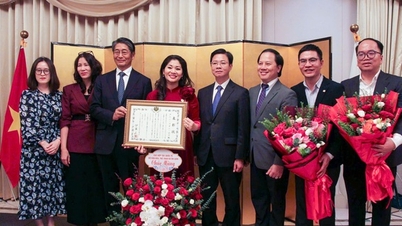
Ms. Tran Bao Hong, Chief Financial Officer of Vietnamobile Mobile Telecommunications Joint Stock Company, donated 25,000 notebooks to students.
Mr. Vo Viet Thanh, representative of Vietnam Payment Solutions Joint Stock Company - VNPay, presented a donation of 100 million VND.
Mr. Dinh Hong Hai, representative of the Posts and Telecommunications Institute of Technology, presented a sponsorship of 30 STEM kits related to strategic technology and supporting tools worth 200 million VND.
Source: https://baophapluat.vn/nam-2026-du-kien-khoang-95-nghin-ty-dong-cho-khcn-dmst-va-chuyen-doi-so.html


























































































Comment (0)