

>>> Part 3: Glory to the heroic seaport
>>> Part 2: Historic train journeys
>>> Part 1: The wharf of war and development
The 165-year history of Saigon port has not recorded any farmer from this region who became the first porter at the wharf. Because during the colonial period, they were the sweat laborers earning their living in the lowly position of the colony.
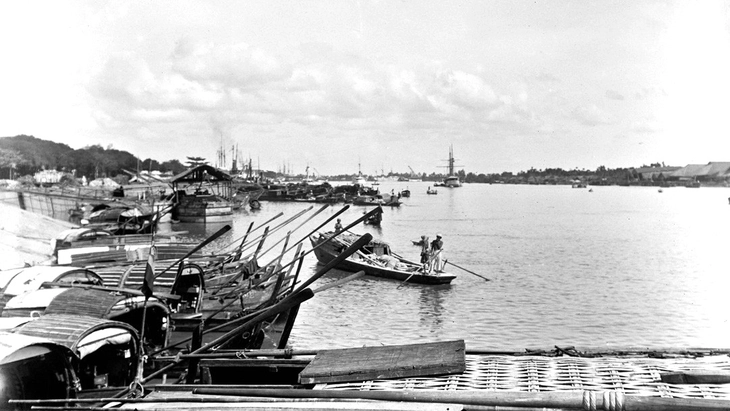
A section of the Saigon riverfront in 1895 – Archival photo
 The development of Saigon Port played a significant role in the development of many people in District 4. The children and grandchildren of port workers received a good education. Many continued to work at the port or found other stable jobs. The land and people along the river changed from then on.

Doctor NGUYEN HONG DUNG
The new regime has transformed the lives of porters.
According to Mr. Dinh Cong Toai, former head of communications at Saigon Port, thousands of laborers, including hundreds of women, entered the loading and unloading profession before 1975. These were low-educated workers who earned a living by carrying goods. Due to harsh working conditions and being looked down upon, most of them felt inferior. They spent every penny they earned on essential necessities, including gambling and drinking.
"Meager wages, a reckless lifestyle, dilapidated houses, children lacking proper education, and a bleak future. These are the hallmarks of a miserable era in the lives of Saigon port workers," Mr. Toai emphasized.
After the country was reunified in 1975, the consequences of the war, along with the vicious cycle of the US embargo and the centrally planned economy , dragged the Vietnamese economy down into an extremely difficult downward spiral. The economy was likened to a car without brakes.
Mr. Hoang Van Nhuong, former Deputy General Director of Saigon Port, said that at that time, workers had low incomes, so corruption and theft of property and goods at the port were rampant and complex. Therefore, the fight against corruption and the protection of assets was an extremely challenging and intense battle.
Under the centrally planned economy, Saigon Port, as a service provider, had to accept the paradox that the more productivity increased, the heavier the losses. This was because the rates for loading, unloading, warehousing, and tugboat services were too low. This voluntaristic approach left Saigon Port with severe consequences. Its technical infrastructure was poor and outdated due to a lack of investment in upgrades.
"The consequences are low labor productivity, difficult living conditions for workers, workers doing shoddy or careless work leading to damage and loss of goods, and rampant corruption... The port's financial resources are gradually depleted, and port operations are often stalled," Mr. Nhuong said.
However, despite the difficult economic conditions during the centrally planned economy era, the port still strived to provide for the material and spiritual well-being of its stevedores. Accordingly, hundreds of female workers were reassigned to more manageable jobs, leaving only a few dozen with reasonable workloads, making the work less strenuous than before. The port also organized supplementary education for 1,000 workers, including those who had graduated from high school, vocational school, and university.
At the same time, workers were also encouraged to develop their abilities in proposing initiatives and technical improvements in port operations. In the 10 years from 1976 to 1986, workers contributed 815 initiatives to improve port operations, including loading and unloading equipment for oil rigs in Vung Tau and equipment for the Tri An hydroelectric project.
After the fall of the Pol Pot regime in Cambodia in 1979, Saigon Port assisted Cambodia in restoring operations at the Phnom Penh and Kongpongxom ports. From 1989 onwards, thanks to innovative business practices, a shift to self-financing accounting, and effective capital accumulation and utilization, the port invested in and expanded its cargo handling capacity. Simultaneously, by proactively paying workers based on productivity, the workers' living standards gradually improved.
Subsequently, Saigon Port implemented a system of piece-rate wages, including contracts for entire vessels and contracts based on productivity and quality. As a result, their salaries increased month after month, and year after year…
According to Mr. Toai, in response to the demands of human resource development in the modernization era, Saigon Port has used its funds to organize cultural, political , and technical training courses for port workers, including sending hundreds of staff members for training abroad. Many workers are proud to have two or three generations connected to the port and have seen their material and spiritual lives improved alongside the port's development.
Nowadays, port workers have minimized the use of manual labor in loading and unloading goods. Skilled workers operate super-heavy cranes to unload containers and machinery for factories and enterprises. Workers at computer keyboards can pinpoint the location of hundreds or thousands of containers on the docks within minutes, ensuring they are quickly delivered to import and export clients…
"The new mechanism has created a real impetus, bringing immense happiness to the lives of port workers. The bleak image of the dockworkers of the past has now faded into oblivion," Mr. Toai said.
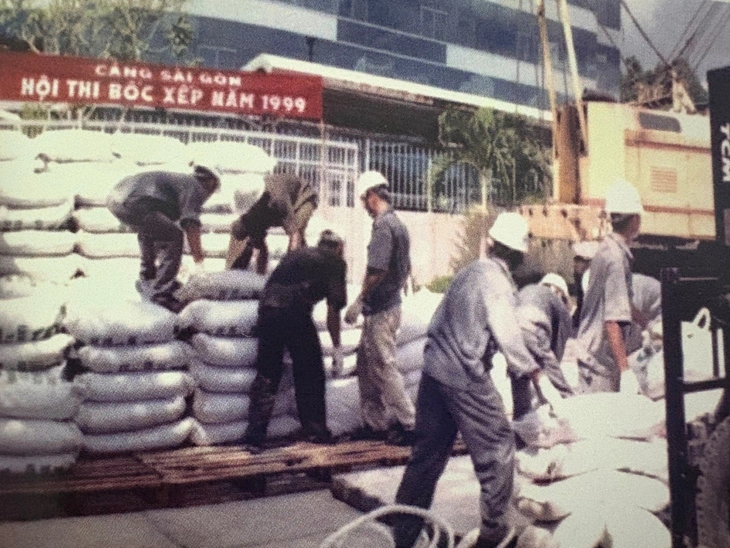
During the period of reform, the material and spiritual lives of Saigon port workers gradually improved – Photo: Saigon port
Changing the poor land by the river
Anyone who has lived or frequently visited the old District 4 will feel the development of this land along with the changes and modern development of Saigon port. Young people now looking at the image of a modern urban area with spacious high-rise buildings reflecting on the docks and boats will certainly find it difficult to imagine how dilapidated and full of complex social evils District 4 was at one time.
“Before 1975, this residential area by the harbor was notorious throughout Saigon. Gang leaders gathered here, and petty thieves and pickpockets loitered around. Then there was drug addiction, gambling, and prostitution everywhere. Back then, we were young men, and in the evenings, unless absolutely necessary, we didn't want to go into the alleys of District 4,” – Mr. Nguyen Van Hanh, 79, a Saigon resident who has frequented this area by the harbor for many years, still remembers.
Like many others, Mr. Hanh stated that over 90% of the workers, mainly dockworkers, are from District 4 or reside there to work. Therefore, a few decades ago, referring to people from this area meant referring to them as "port residents," carrying both positive and heavily negative connotations.
However, after 1975, the situation gradually began to change. People on the port island remained poor for 10 years before the renovation, but the new government made efforts to gradually improve the security, order, and socio-cultural situation here.
Dr. Nguyen Hong Dung, who has been closely associated with the "core" area of Doan Van Bo Street for many years, recounts that when he first came to live there in the 1990s, he was still afraid of the widespread drug addiction among young people, but he also witnessed the gradual changes. The government's determination to eradicate drug abuse has truly transformed the image and lives of the people.
“Entering the 2000s, drug abuse decreased significantly, breathing new life into this riverside area,” Dr. Dung recalled, looking back at the image of the once-dwelling drug-addicted neighborhoods, now transformed into newly built, well-equipped schools that provide young people with opportunities for education and a better life.
Through the period of reform, the Saigon port on the riverbank escaped stagnation and entered a trajectory of rapid development. Then, the land and people around the port gradually developed accordingly. As more and more modern cranes appeared along the riverbank, the residential area across Nguyen Tat Thanh Street also gradually transformed.
Though slowly, the once-slum areas associated with the port workers are gradually being developed with better roads and houses, and high-rise buildings are appearing one after another, creating a new modern urban area that rivals the old District 1.
The changes in the port's life have brought about changes in people's lives. Now, working at Saigon Port is a source of pride, no longer a source of sadness associated with the term "port worker" as in the impoverished and difficult times of the past. The significant contribution of Saigon Port to the development of Ho Chi Minh City and the entire country is partly due to the sweat and intellect of the people living along the river.
Tuoi Tre Newspaper
Source: https://vimc.co/165-nam-thuong-cang-sai-gon-ky-cuoi-doi-cang-doi-nguoi-doi-thay/




![[Photo] Closing Ceremony of the 10th Session of the 15th National Assembly](/_next/image?url=https%3A%2F%2Fvphoto.vietnam.vn%2Fthumb%2F1200x675%2Fvietnam%2Fresource%2FIMAGE%2F2025%2F12%2F11%2F1765448959967_image-1437-jpg.webp&w=3840&q=75)

![[OFFICIAL] MISA GROUP ANNOUNCES ITS PIONEERING BRAND POSITIONING IN BUILDING AGENTIC AI FOR BUSINESSES, HOUSEHOLDS, AND THE GOVERNMENT](https://vphoto.vietnam.vn/thumb/402x226/vietnam/resource/IMAGE/2025/12/11/1765444754256_agentic-ai_postfb-scaled.png)








































































Comment (0)