

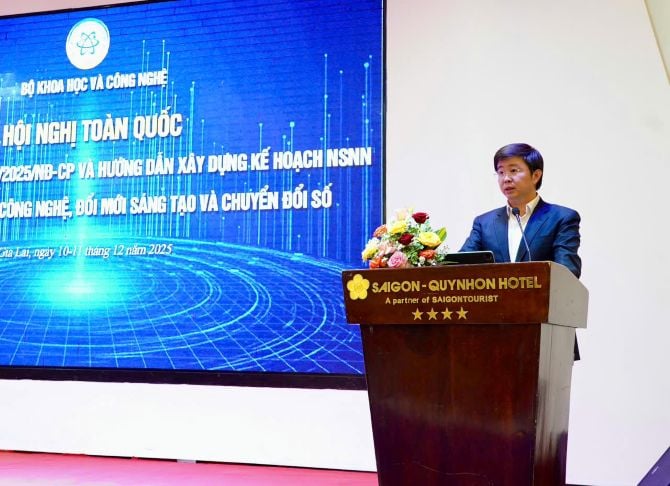
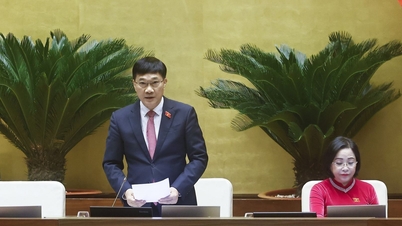
Deputy Minister of Science and Technology Bui Hoang Phuong.
To institutionalize this orientation, the Party and the State have stipulated that a minimum of 3% of the total state budget expenditure must be allocated to the development of science and technology, innovation, and digital transformation, and this level will gradually increase according to development requirements.
To concretize this policy, in 2025, the state budget will add 25,000 billion VND to this sector from the increased revenue of 2024. In particular, according to the conclusion of Prime Minister Pham Minh Chinh at the 5th meeting of the Government Steering Committee, in 2026 it is expected that approximately 95,000 billion VND will be allocated to the fields of science and technology, innovation, and digital transformation.
Deputy Minister Bui Hoang Phuong noted that this is a very large budget allocation, creating unprecedented development opportunities, but also posing a major challenge for ministries, sectors, and localities in terms of their capacity to absorb and manage public resources effectively.
"We cannot allocate funds to ministries and agencies without knowing how they will spend them. We, as managers in the fields of science and technology, innovation, and digital transformation, and as financial managers in these areas, must be responsible for the state funds allocated to us in the implementation and promotion of science and technology," Deputy Minister Phuong emphasized.
To date, the Ministry of Science and Technology, in coordination with the Ministry of Finance, has reported to the competent authorities on the allocation of 16,716 billion VND to 26 ministries and central agencies and 20 localities.
According to Deputy Minister Phuong, to avoid fragmentation and waste, it is necessary to start right from the planning and budgeting stages. Decree No. 265/2025/ND-CP (issued on October 14, 2025) is considered a key to resolving these bottlenecks.
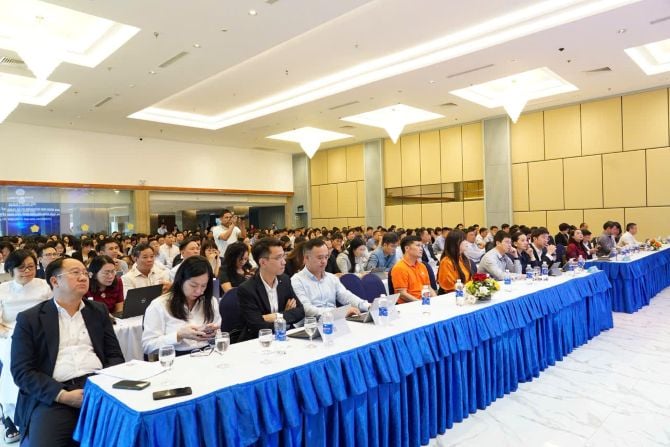
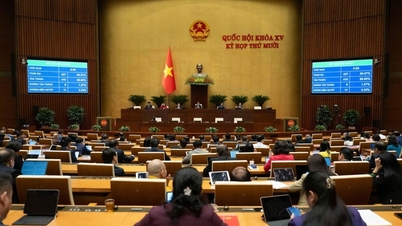
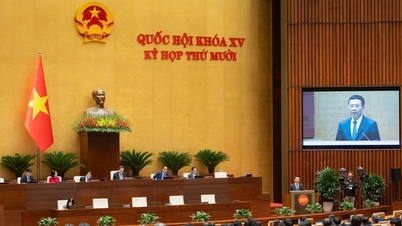
The scene at the conference.
The new decree provides detailed guidance on state budget spending, from infrastructure investment and financial support for funds to human resource training. Particularly in the field of digital transformation, investors in public projects are given greater autonomy, including the right to apply direct contracting, design-build methods, and streamlined procedures to ensure project progress.
At the conference, delegates presented in-depth content, analyzing the new policy system and the requirements for implementing Decree 265.
Regarding public investment planning, Mr. Tran Nhu Hien, Deputy Director of the Planning and Finance Department, stated that medium-term and annual public investment planning must align with the objectives outlined in the socio-economic development strategy, the national, sectoral, and local five-year and annual socio-economic development plans, as well as approved plans; while also ensuring consistency with the five-year overall science, technology, and innovation strategy, program, and plan, and the five-year science, technology, and innovation plan of each Ministry and sector.
The plan needs to be consistent with the capacity to balance public investment capital, capable of mobilizing additional resources from other economic sectors, ensuring macroeconomic balance and public debt safety, ensuring efficient use of capital, avoiding fragmentation and dispersion; and at the same time ensuring transparency, fairness, and equity.
Regarding the field of digital transformation, Mr. Le Anh Tuan, Deputy Director of the National Digital Transformation Agency, presented new points on the management of investment in IT applications and digital transformation.
Accordingly, one of the new points is the investment decision-making process for special public investment projects: The investor is allowed to independently decide on all aspects of the investment activity to organize project implementation, ensuring progress and quality; the direct contracting method can be applied to project packages; the design-build method can be applied; and simplified procedures can be applied as stipulated by the law on state budget and bidding; separate cost norms can be applied for the preparation, appraisal, and approval of project estimates.
With the crucial legal framework from Decree 265, along with the proactive efforts of management agencies and the professional community, this significant resource is expected to create breakthroughs in improving productivity, promoting the digital economy, developing science and technology, and modernizing the state apparatus.
Source: https://doanhnghiepvn.vn/cong-nghe/danh-khoang-95-nghin-ty-dong-ngan-sach-cho-khoa-hoc-cong-nghe/20251211095651830


























































































Comment (0)