

Resolution No. 57-NQ/TW dated December 22, 2024, on breakthroughs in national science, technology, innovation, and digital transformation, identifies the rapid and sustainable development of science and technology, leveraging the role of intellectuals, businesses, and the people, as a crucial driving force for promoting socio-economic development and improving the quality of life for the people.
In that spirit, research institutes are reviewing and adjusting their strategies, strengthening research, application, and implementation of the resolution's major directions, thereby bringing science and technology into practical production and life, making a tangible contribution to national development.
Long-term basic science development strategy
Professor, Dr. Tran Dai Lam, Director of the Institute of Materials Science (Vietnam Academy of Science and Technology), believes that the intellectual community needs to cultivate a sense of responsibility towards the country, a desire to excel, a readiness to face challenges, and to use international standards as a benchmark for all research results. The scientific community needs to be proactive and creative in interdisciplinary and cross-sectoral cooperation; linking research with practical development needs and innovating implementation methods to not only create new knowledge but also bring about tangible application value.
The Institute of Materials Science has proactively reviewed and adjusted its research strategy in accordance with Resolution 57, focusing on developing new materials as a foundation for core technologies with high applicability in high technology, foundational industries, and national defense and security.
"As a major national specialized institute, the Institute of Materials Science identifies its core role in implementing the major directions from Resolution 57, becoming a connecting center, actively participating in key research and application programs related to materials; supporting innovative startups and directly contributing to socio-economic development," Professor, Dr. Tran Dai Lam emphasized.
To effectively implement the resolution, Professor and Doctor Tran Dai Lam suggested that the State needs to define a long-term vision for basic science, a field that may not yield immediate results but plays a fundamental role in future technological breakthroughs. This strategy should have a minimum duration of 20 years, focusing on areas still in their initial stages such as quantum technology, artificial intelligence, new materials, biosynthesis, and fusion energy. These are directions that could create a competitive advantage for Vietnam if invested in early and with a clear focus.
Along with a long-term vision, identifying and nurturing talent should be a top priority.
Professor and Doctor Tran Dai Lam proposed establishing a mechanism for selecting and training gifted students from the secondary school level, especially in basic science subjects such as mathematics, physics, chemistry, and biology. These subjects should become mandatory in the curriculum of specialized and gifted schools, accompanied by scholarship policies, in-depth training, and long-term career development support. Nurturing talent must be done systematically, continuously, and in conjunction with the collaboration of leading scientists in the field.
In addition, a national advisory council on long-term basic science development strategy should be established. This council would differ from the councils of the National Science and Technology Development Fund, which focus on small-scale projects with short implementation periods of 2-3 years. The national council would help plan in-depth basic science programs, ensuring stability and continuity in the long-term development strategy.
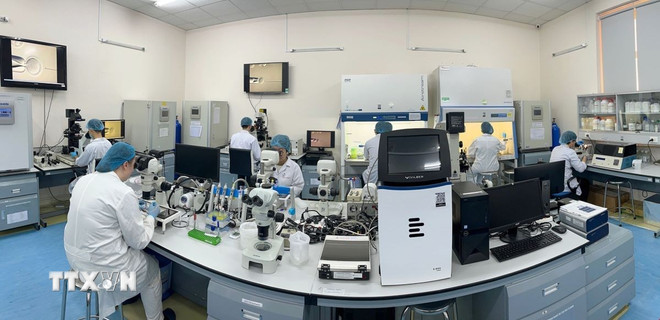
Policies that pave the way for research and innovation.
According to Duong Thi Bich Diep, Director of the Institute of Green Economy (Vietnam Union of Science and Technology Associations), Resolution 57 clearly defines the requirement to innovate thinking, improve institutions and mechanisms, and policies on science and technology, innovation, and digital transformation.
According to her, these guidelines provide an important foundation for promoting research, development, and application of technology, while encouraging science and technology organizations to participate more actively in innovation.
The Institute of Green Economy has closely followed the spirit of Resolution 57 and is implementing many research programs to serve practical needs, such as knowledge-based economic models, technology for high-quality agriculture, technological solutions for communities, and models for environmental improvement. Expanding international cooperation helps the institute access new technologies and implement pilot models suitable for Vietnamese conditions.
Ms. Duong Thi Bich Diep believes that science and technology are only meaningful when they bring practical benefits to the people. Applying advanced technological models helps increase productivity, reduce production costs, improve the environment, and raise incomes, especially in disadvantaged areas. This is also a way to realize the goal of Resolution 57 in making science and technology a direct driving force for socio-economic development.
The innovation process requires close coordination between research institutions, businesses, and regulatory agencies. Research institutions provide knowledge and technology; businesses develop products; and regulatory agencies refine policies and create a favorable environment for innovation. The close connection between these entities plays a decisive role in developing new technologies and achieving development goals in the coming period.
Source: https://www.vietnamplus.vn/nghi-quyet-57-thanh-cong-la-khi-nguoi-dan-huong-loi-tu-khoa-hoc-cong-nghe-post1082443.vnp




![[Photo] Closing Ceremony of the 10th Session of the 15th National Assembly](/_next/image?url=https%3A%2F%2Fvphoto.vietnam.vn%2Fthumb%2F1200x675%2Fvietnam%2Fresource%2FIMAGE%2F2025%2F12%2F11%2F1765448959967_image-1437-jpg.webp&w=3840&q=75)











































![[OFFICIAL] MISA GROUP ANNOUNCES ITS PIONEERING BRAND POSITIONING IN BUILDING AGENTIC AI FOR BUSINESSES, HOUSEHOLDS, AND THE GOVERNMENT](https://vphoto.vietnam.vn/thumb/402x226/vietnam/resource/IMAGE/2025/12/11/1765444754256_agentic-ai_postfb-scaled.png)






































Comment (0)