

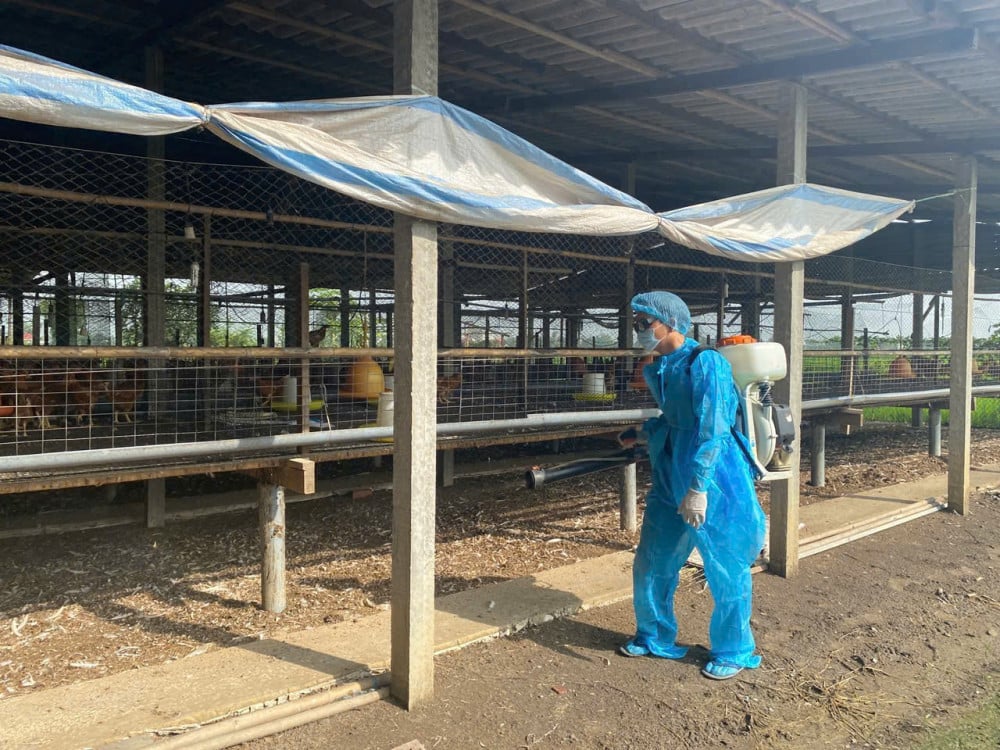
Livestock farmers regularly clean their barns to prevent disease outbreaks among their animals.
There are still many difficulties.
In recent years, the livestock industry has continued to affirm its pivotal role in the agricultural structure of Tay Ninh province, gradually transforming towards a modern and sustainable direction. Many circular livestock farming models, applying high technology, ensuring biosafety and environmental friendliness, have been implemented, contributing to increased added value and production efficiency.
Over the past two years, the livestock industry has faced numerous challenges. One of the leading causes is the sharp increase in input costs. Specifically, the cost of animal feed, breeding stock, and veterinary medicine has continuously risen, while product prices have been unstable. The price of live pigs has at times fluctuated around 46,000-49,000 VND/kg, significantly lower than the production cost. Farmers have suffered losses, with many households reducing their herds or even abandoning their farms to await more favorable market conditions.
Mr. Nguyen Van Thanh (Nhon Ninh commune) shared: “Last year, the price of live pigs dropped too low, resulting in a loss of several hundred thousand dong per pig sold. Therefore, I didn't dare to restock. From the beginning of 2025 until now, the price of pigs has increased again, currently at over 7.2 million dong per quintal. The increase in the price of live pigs also means the price of piglets has increased, so I'm still hesitant and haven't restocked yet.”
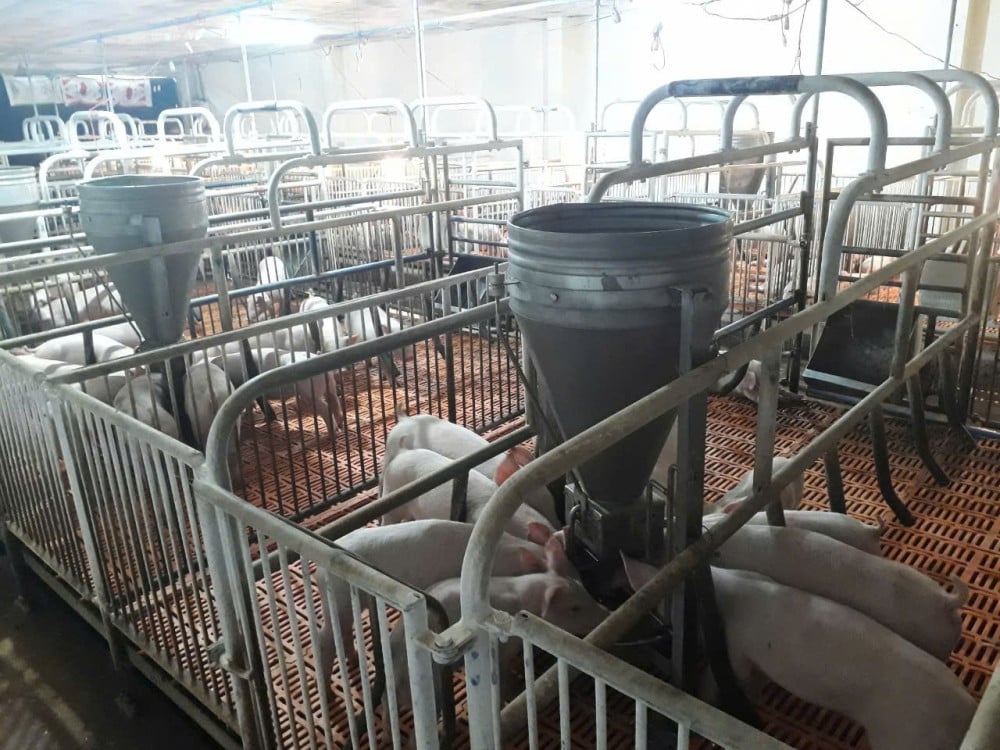
Besides prices, animal diseases are also a major cause of hardship for livestock farmers. Although authorities have done a good job controlling diseases such as avian influenza, foot-and-mouth disease, and African swine fever, the risk of recurrence remains. Many small-scale farmers lack the resources to invest in enclosed barns and have not fully implemented biosecurity measures, thus facing significant risks.
| The province aims to develop the livestock industry by 2030 by reducing the number of small-scale farms, increasing the proportion of high-tech farms; increasing the production of livestock products that meet food safety standards; and simultaneously improving the capacity to control the livestock environment and building product brands associated with production areas. |
Ms. Nguyen Thi Huong, a broiler chicken farmer in Tan Lan commune, said: “Previously, I only raised broiler chickens, about 2,000 per batch, with a profit of 20-30 million VND per batch. But since the beginning of 2025, feed prices have increased sharply while chicken prices have been volatile, sometimes falling below 40,000 VND/kg. Raising chickens is no longer profitable, so I plan to reduce my flock.”
Meanwhile, some farms that have invested systematically and applied high technology face difficulties in accessing the market. Most livestock products lack branding and a closed-loop supply chain from production to consumption, making them vulnerable to price manipulation and dependence on middlemen. This makes investment in livestock farming risky and unsustainable.
Aiming for safe and environmentally friendly livestock farming.
Faced with the challenges of the livestock industry, the Department of Agriculture and Environment has been closely coordinating with relevant departments and agencies to develop comprehensive guidelines and solutions to restore and develop livestock farming in a sustainable manner.
First and foremost, the Department focuses on building and expanding disease-free livestock farming zones. This not only ensures the safety of domestic production but also creates favorable conditions for gradually exporting livestock products.
Simultaneously, the Department is promoting linkages between businesses, cooperatives, and livestock farmers to provide technical support and stable output, reducing market risks.
One notable direction is the development of circular farming, utilizing by-products as fertilizer and bioenergy, thereby minimizing environmental pollution. Many large farms have invested in biogas systems, organic fertilizer composting pits, and wastewater treatment, saving costs and reducing environmental waste. This development direction aligns with the green and clean agriculture trend that the province is pursuing.
In the long term, the Department will advise the Provincial People's Committee to replan the livestock system by region, ensuring it is suitable for ecological conditions and population density. New investment projects must meet requirements for environmental treatment technology, disease safety, and be consistent with the orientation of developing high-tech agriculture.
In addition, the Department will soon supplement policies to support preferential loans and green credit for livestock farmers to invest in upgrading barns, waste treatment systems, and switching to high-yielding livestock breeds that are better adapted to climate change and diseases.
By 2030, Tay Ninh province aims to develop its livestock industry by reducing the number of small-scale, scattered farms, increasing the proportion of high-tech farms; increasing the production of livestock products that meet food safety standards; and simultaneously improving the capacity to control the livestock environment and building product brands associated with production areas.
In this challenging period of transformation, difficulties are inevitable but not insurmountable if there is unity among the people, businesses, and the government. With a sustainable development orientation, focusing on environmental factors and biosafety, Tay Ninh province has every opportunity to build a modern livestock industry, create stable livelihoods for its people, and make a positive contribution to the province's agricultural growth in the future.
Bui Tung
Source: https://baolongan.vn/go-kho-cho-nganh-chan-nuoi-a198264.html


![[Photo] General Secretary and President To Lam presides over a meeting on preparations for the review of one year of operation of the three-tiered government system.](https://vphoto.vietnam.vn/thumb/1200x675/vietnam/resource/IMAGE/2026/06/02/1780391821195_a1-bnd-4595-9717-jpg.webp)









































































Comment (0)