

Amending the Securities Law: Removing the bottleneck to solve the upgrade problem.
Amending regulations to pave the way for clearing and settlement of securities transactions on the market through a central counterparty clearing mechanism is one of the three main groups of contents in the amendment of the Securities Law.
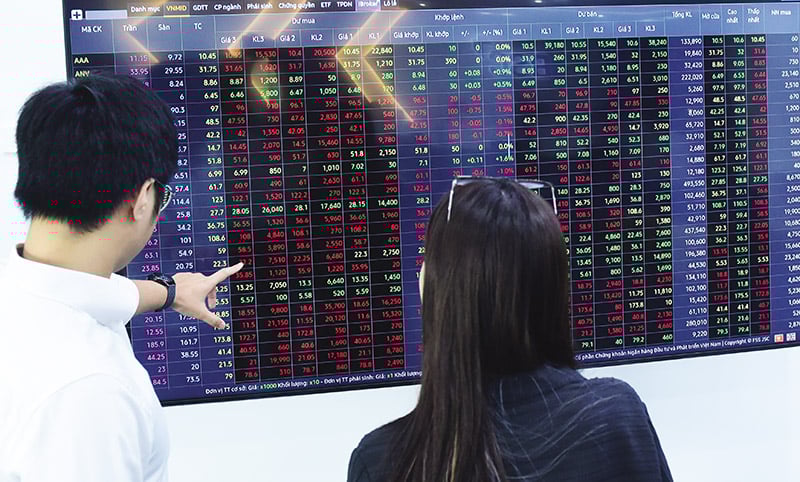 |
| The Vietnamese stock market aims to be upgraded by 2025. Photo : D.T. |
Controversy surrounding the CCP mechanism.
At the eighth session of the 15th National Assembly , amending the Securities Law is one of the contents of the draft Law amending and supplementing a number of articles of the Securities Law; Accounting Law; Independent Auditing Law; State Budget Law; Law on Management and Use of Public Assets; Tax Management Law; and National Reserve Law, which will be presented to National Assembly deputies in the coming days.
Speaking at the recent workshop to gather feedback on amendments to the Securities Law, a representative from the State Securities Commission stated that perfecting the legal framework to implement clearing and settlement of securities transactions on the market under the Central Counterparty Clearing (CCP) mechanism in the Vietnamese securities market is one of three main objectives aimed at resolving practical obstacles, promoting the development of the securities market, and upgrading its ranking.
Simply put, the CCP model is a mechanism that allows the Vietnam Securities Depository and Clearing Corporation (VSDC) to become the buyer of all sellers and the seller of all buyers. CCP has been applied to the derivatives market, but it has not yet been implemented in the underlying market.
"There are still differing interpretations between the banking and securities sectors regarding whether commercial banks and branches of foreign banks should be allowed to act as clearing members in the underlying securities market," the Drafting Committee of the Bill emphasized.
Specifically, the guiding documents for point a, clause 4, Article 56 of the Securities Law in the securities and banking sectors are inconsistent in the licensing process to include this activity in the licenses issued by the State Bank of Vietnam to commercial banks and branches of foreign banks. Furthermore, without changing the current regulations, there will be insufficient legal basis to establish a subsidiary of VSDC to perform the CCP function. Consequently, it will be difficult to control operational risks when VSDC performs the CCP function for the entire underlying securities market.
Amending and establishing a legal basis for the application of Clearing Corporations (CCPs) in the underlying securities market would allow commercial banks and branches of foreign banks to become clearing members and participate in the CCP system. This aligns with international practices, meets the criteria for ensuring asset safety for foreign investors, and could attract more foreign capital into the Vietnamese securities market. However, at the meeting to review the draft law, chaired by the Ministry of Justice , the State Bank of Vietnam suggested that clearing should only be implemented in the derivatives market, as participating in clearing in the underlying market could create many risks in the relationship between banks and affect their liquidity.
Untangle the knot precisely.
It should also be noted that the application of the CCP mechanism has long been desired by members of the stock market. Circular 68/2024/TT-BTC, recently issued by the Ministry of Finance, paves the way for foreign institutional investors to trade shares without requiring sufficient funds on the purchase date. This can also be considered a short-term solution to meet the requirements of rating agencies such as FTSE Russell in order to satisfy the criteria for market upgrade. However, according to experts, in the long term, the fundamental solution remains the implementation of securities transaction clearing and settlement under the CCP mechanism.
 Commenting on the draft law amending and supplementing a number of articles of 7 laws, Deputy Speaker of the National Assembly Nguyen Duc Hai requested the Government to urgently direct the drafting agency and relevant agencies to study and incorporate the opinions of the National Assembly Standing Committee, the opinions of the verification agency, and the principles to finalize the draft, narrow down the proposed amendments, ensure that only necessary and urgent issues need immediate amendment, and achieve high consensus.
In fact, new regulations have been added in new laws and decrees over the years, but investors are still waiting anxiously for their implementation. A typical example is the story of non-voting depositary receipts (NVDRs) – a very new financial instrument, first defined in the 2020 Enterprise Law and subsequently in Decree No. 155/2020/ND-CP detailing the implementation of some articles of the 2019 Securities Law. NVDRs are issued by subsidiaries of stock exchanges to foreign investors based on the company's shares. However, after half a decade since their enactment, the implementation of this instrument remains stalled, despite initial legal frameworks.
In its 2024 stock market classification report published on October 8th, FTSE Russell acknowledged efforts to address margin requirements, while also emphasizing the need to improve the account opening process. Furthermore, an effective mechanism to facilitate transactions between foreign investors involving securities that have reached or are close to reaching foreign ownership limits was also deemed "an important measure."
Opening the way for the CCP mechanism in this law revision is the first step towards a long-term goal, rather than a direct solution to the target of upgrading the stock market by 2025. In a recent report, FTSE Russell also emphasized that the Vietnamese stock market needs to maintain its momentum if it wants to achieve the upgrade target by 2025.
Source: https://baodautu.vn/sua-luat-chung-khoan-go-trung-nut-that-giai-bai-toan-nang-hang-d227535.html


![[Photo] Prime Minister Pham Minh Chinh attends the Conference on the Implementation of Tasks for 2026 of the Industry and Trade Sector](/_next/image?url=https%3A%2F%2Fvphoto.vietnam.vn%2Fthumb%2F1200x675%2Fvietnam%2Fresource%2FIMAGE%2F2025%2F12%2F19%2F1766159500458_ndo_br_shared31-jpg.webp&w=3840&q=75)
































































































Comment (0)