

 |
Credit will still flow into the real estate sector, but more selectively.
Speaking at last week's meeting of the Central Steering Committee on Housing Policy and Real Estate Market, Prime Minister Pham Minh Chinh requested that the State Bank of Vietnam strictly control speculative real estate lending and focus on meeting the actual housing needs of the people.
Previously, in a document sent to credit institutions regarding the control of credit growth in 2026, the State Bank of Vietnam (SBV) requested that credit institutions control the credit growth rate for the real estate sector compared to the end of 2025 so that it does not exceed the overall growth rate compared to the end of 2025 of that particular credit institution.
According to the State Bank of Vietnam, real estate credit is projected to increase by 22% in 2025, not significantly higher than the overall credit growth rate. Statistics from the Ministry of Construction show that credit for commercial real estate alone is expected to increase by 28%.
According to economist Dr. Nguyen Tri Hieu, the government and the State Bank of Vietnam's policy of tightening real estate credit will lead to more selective lending by banks and higher interest rates. There is even a risk that speculative investors heavily reliant on borrowed capital will be forced to sell off their properties due to high interest rates.
 The corporate bond market is expected to surge to 1 trillion VND in issuance this year. After deducting 200,000 billion VND maturing, the net new issuance will still reach approximately 800,000 billion VND, offsetting the decline in long-term credit from commercial banks and the increase in bank interest rates.
- Mr. Nguyen Quang Thuan, Chairman of the Board of Directors of FiinGroup
According to analysts at Vietcombank Securities Company (VCBS), credit control is part of the government's overall solution to revitalize the real estate market. In addition to curbing credit, the government has issued numerous legal documents to stimulate supply. Furthermore, the government officially stipulated regulations on real estate identification from March 1, 2026 (Decree No. 357/2025/ND-CP).
“Recent regulatory policies demonstrate the State's consistent orientation towards shifting the real estate market from growth based on speculation and expectations to operation based on transparency, financial discipline, and actual supply and demand. Standardizing transaction data contributes to curbing speculation, improving tax management efficiency, and forcing the brokerage market to adjust its operating model towards greater transparency as practices such as hoarding, creating artificial scarcity, and profiting from price differences are gradually reduced,” VCBS commented.
According to analysts, the real estate market in 2026 will have many similarities to 2014 (recovery after the 2008-2011 crisis). Accordingly, during this period, market sentiment will be more cautious but also more stable. The market is still expected to recover strongly, focusing on genuine housing needs. Access to capital will be more selective and controlled, and the risk of systemic default will be low…
In reality, given the current economic growth model and the intricate network of backroom deals held by major bank shareholders, even with government and central bank restrictions, significant capital will still flow into real estate. However, project selection will become more stringent.
According to Mr. Phan Dung Khanh, Director of Investment Consulting at Maybank Investment Bank, this year, capital will continue to flow into real estate, but not indiscriminately. Instead, it will be more selective, prioritizing segments with high liquidity, especially residential properties, moderately priced products (under 10 billion VND), and industrial real estate.
Reportedly, even before the Lunar New Year, many bank branches had already used up their credit growth "room" for the first quarter of 2026. Furthermore, the restrictions on real estate credit have caused concern among many businesses in this sector. Even with high interest rates, not all real estate businesses can access bank loans.
Mr. Vo Hong Thang, Deputy General Director of DKRA Group, said that over the past three years, real estate businesses have tried every way to restructure their operations and capital flows, including selling assets to repay debts. Therefore, there is not much room left for businesses to continue "restructuring" if banks stop lending.
However, many experts believe that, in recent times, capital flowing into real estate has largely served speculative purposes. This speculative money is causing many negative consequences: driving up house prices dramatically, preventing capital from flowing into production and business, and causing macroeconomic instability. Therefore, controlling credit for speculative real estate is necessary and a condition for capital to flow into production and business.
Curbing the growth of real estate credit – especially in the speculative segment – will cause difficulties for some developers and homebuyers. However, this is a necessary solution to filter the market. Through this, businesses with sound finances, clean land reserves, and complete legal documentation will survive. Businesses experiencing rapid growth and relying too heavily on leverage will be subject to market consolidation.
For homebuyers, the increased difficulty in obtaining loans and higher interest rates will also reduce speculation. However, what worries experts is the current high and uniform interest rates on real estate loans. Accordingly, first-time homebuyers and those buying second or subsequent homes pay the same interest rate, regardless of whether the property is luxury or affordable.
Therefore, while supporting the control of real estate credit, experts suggest that more effective solutions are needed to direct credit in this sector to the right priority segments.
Businesses need to shift more strongly towards the bond market.
With limited room for real estate credit growth, the most frequently asked question by many real estate businesses is: where will they find the capital?
In 2025, the amount of new capital that real estate businesses can access through credit channels is approximately VND 450,000 billion, while the amount of capital raised through bond issuance is only about VND 135,000 billion. If we subtract the maturing bonds, the net amount of capital that real estate businesses raise through bond issuance is insignificant.
In other words, currently, real estate businesses still rely heavily on bank credit and have yet to find an alternative channel.
In the context of tightened real estate credit and rising interest rates, according to Mr. Duong Duc Hieu, CFA - Director and Senior Analyst at VIS Rating, real estate businesses are forced to increase capital mobilization through other channels, and the most feasible option is bonds.
“We have met with a number of investors, many of whom said they plan to shift their funding sources from bank loans to bond issuance to finance new project development. We hope that the bond market will be utilized more by investors in 2026,” Mr. Hieu said.
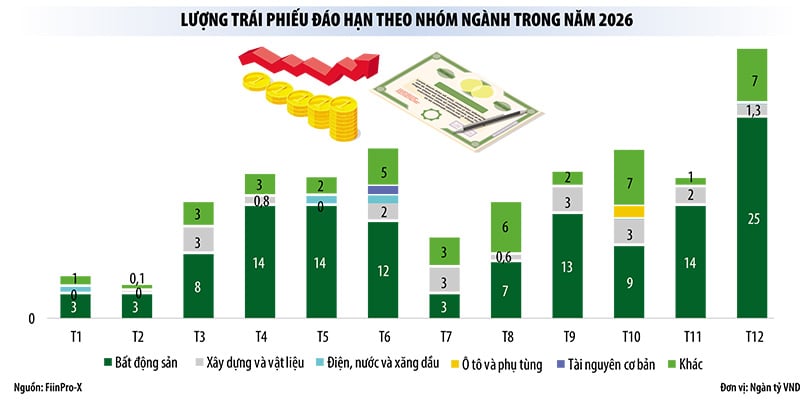
According to VCBS, in 2026, the pressure of bond maturity for real estate companies will remain very high. At the same time, access to new sources of capital, including bond issuance and credit borrowing, is predicted to continue to be more tightly controlled, both in terms of issuance conditions and capital costs. Companies with weak financial capacity, high leverage, and illiquid project portfolios will face greater refinancing risks. This will also serve as a screening process for investors in the new cycle.
Since the beginning of the year, there has been no breakthrough in real estate corporate bond issuance. As of February 13, 2026 (before the Lunar New Year holiday), the amount of corporate bonds issued since the beginning of the year was recorded at VND 8,413 billion. Of this, only one bond issuance by Khai Hoan Land was recorded with an issuance value of VND 190 billion (2.2%). Although the amount raised is insignificant, real estate businesses this year face significant pressure from maturing bonds (VND 121,000 billion).
According to economic experts, with pressure to compensate for the shortfall from the credit channel, real estate bonds will increase sharply this year, with large enterprises like Vingroup leading the race.
Source: https://baodautu.vn/ham-phanh-tin-dung-trai-phieu-bat-dong-san-co-bung-no-tro-lai-d536312.html
















































































































Comment (0)