

A military training ground during the war against the Americans.
With its rugged mountainous terrain, during the years of the war against the US to save the country, Tu Son served as a "green shield" protecting military units during training, safeguarding young soldiers as they honed their skills before entering the battlefields of the South. We visited Bai Da village, Luc Son commune, to meet teacher Tran Van Du (born in 1952) - a veteran who once trained in the Lan Trai area.
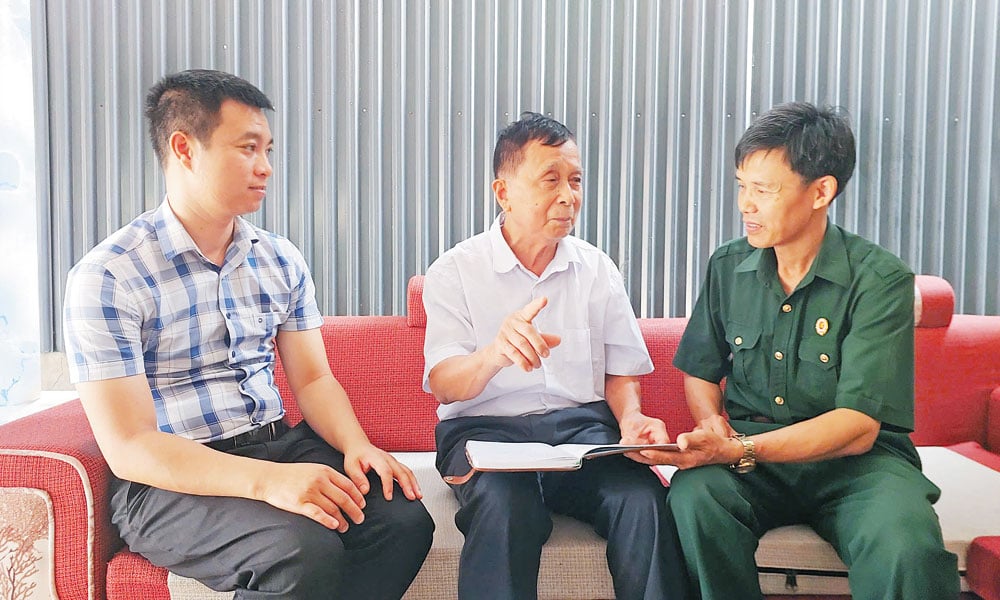 |
Mr. Tran Van Du (center) recalls his six months of training at Tu Son before heading to the battlefield in Southern Vietnam. |
In his well-equipped multi-story house located next to the inter-communal concrete road, he slowly recounted: "In 1972, while working as a teacher at a primary school in Luc Nam town, I received orders to enlist and train in Tu Son. Back then, training was like going to the battlefield. Each person carried a basket of stones weighing over twenty kilograms, marched through the forest, practiced lying down, practicing jumping up when an alarm sounded, and even practiced how to put on sandals for mobility. All actions had to be quick and precise."
At the training camp where Mr. Du's unit was stationed, there were over 500 new recruits, aged eighteen to twenty, from many provinces and cities in the North. On some nights, amidst the high mountains and deep forests, these young soldiers sang revolutionary songs together, nurturing their belief in the day of national reunification.
Mr. Du will never forget the day he left Tu Son after six months of training (September 1972). That day, many teachers and elementary school students walked all the way to the main road to see him off to the battlefield. "Seeing the little students silently waving goodbye, I left with tears streaming down my face," he said, his voice choked with emotion.
Like the soldiers, the people of Tu Son are full of patriotism. Mrs. Nguyen Thi Y (born in 1955) in Diem Ren village, Truong Son commune, recounted that back then, many fourteen and fifteen-year-olds in the commune actively joined the militia, taking turns guarding day and night.
During the arduous war, the bond between soldiers and civilians grew even stronger. The people here readily shared their food and clothing, providing supplies and secretly protecting the soldiers during their training. Today, the bamboo and thatched huts are gone, and the footprints of the marches have been erased by time, but the spirit of "forward, complete victory will surely be ours" still flows in the veins of the land and the souls of the people here.
Unlocking the potential of the mountains and forests.
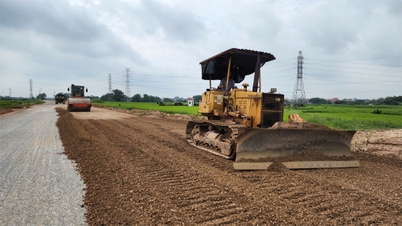
Tu Son is no longer a battlefield of war, but a "training ground" of willpower and aspirations for development. Provincial Road 293, connecting the provincial center with Tay Yen Tu, is nearly 100 km long and passes through Tu Son, creating momentum for the area's development. It is easy to see that the electricity, road, school, and health station systems have been invested in comprehensively, and the lives of the people are constantly improving.
The Resolution of the First Party Congress of Truong Son Commune (formed by the merger of Truong Son and Vo Tranh communes), for the term 2025-2030, identifies the key tasks as focusing on developing the agricultural and forestry economy along the value chain, protecting the environment, and improving the lives of the people. The hills that were once covered with vast expanses of myrtle and reeds are now green with acacia and eucalyptus trees interspersed with patches of medicinal plants.
Right next to Provincial Road 293 in Nhan Ly village, a shop showcasing products from the mountains and forests of Tay Yen Tu has been there for 7 years. It's the shop of Truong Son High-Tech Medicinal Herbs Cooperative.
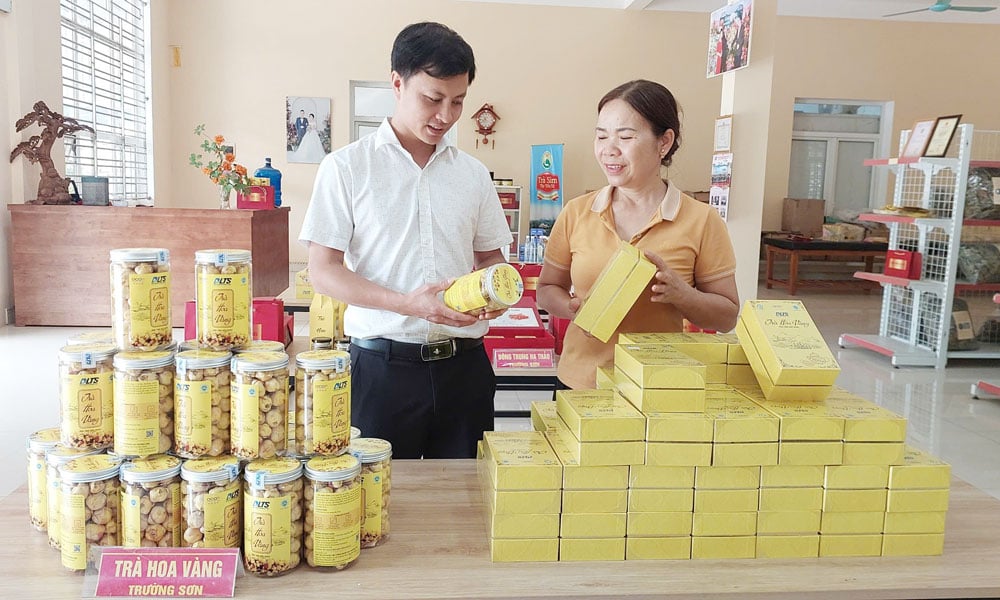 |
Ms. Ha Thi Chanh introduces golden flower tea - a signature product of Truong Son commune. |
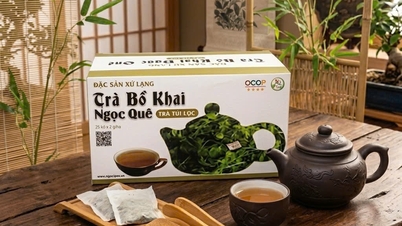
Ms. Ha Thi Chanh, a member of the cooperative, said that her family used to mainly trade medicinal herbs. Seeing that the golden flower tea plant – a rare medicinal herb growing on the Tay Yen Tu mountain range – was being over-harvested, she and her husband propagated and brought the plant to cultivate on low hills, now totaling 4 hectares. In 2017, her family established the Truong Son High-Tech Medicinal Herbs Cooperative, focusing on the production and processing of golden flower tea. The product has received OCOP 4-star certification. By 2025, the cooperative aims to purchase the flowers and leaves of this plant for processing, achieving revenue of over ten billion VND.
According to Mr. Pham Duc Canh, a specialist in the Economic and Social Affairs Department, Truong Son currently has 34 hectares of golden flower tea. The Truong Son High-Tech Medicinal Herbs Cooperative plays a central role in linking production, investing in processing, and building the brand. The golden flower tea plant helps many households achieve stable income and improve their living standards.
Exploiting the potential of the land, some households in the commune have planted forests on a large scale. A prime example is Mr. Vu Chi Trung in Vua Ba village, who owns 50 hectares of eucalyptus forest, earning approximately 2 billion VND annually. These models demonstrate that the Party's resolution on developing the forest economy and reducing poverty has been implemented in the lives of the local people.
Luc Son commune (formed by the merger of Binh Son and Luc Son communes) boasts a large forest area. Landmarks such as Suoi Nuoc Vang (Golden Water Stream), Anh Vu Waterfall, May Waterfall, and the ancient green lim tree forest on Phat Son mountain not only possess ecological value but also offer potential for sustainable tourism development. In Khe Nghe village, the Dao ethnic minority attracts tourists with the beauty of their cultural life. Visitors can experience making five-colored sticky rice, traditional wine, and enjoy ancient folk songs amidst the pristine mountain forest.
Alongside this, The Kind Hotel & Resort Bac Giang complex in Dong Dinh village is initially forming a tourism ecosystem combining relaxation and nature experiences. Comrade Nguyen Trong Hieu, Deputy Secretary of the Party Committee of the commune, stated: Based on the local potential and strengths, after the merger, the Party Committee of the commune issued three resolutions on digital transformation, ecotourism development, and private sector development. To improve infrastructure, the project to renovate and upgrade Dinh Lake (phase 2) and several transportation projects are currently underway; 12 projects have been added to the investment plan for the 2026-2028 period. The poverty rate in the commune is 3.66%, and the near-poverty rate is 2.88%.
From a wartime training ground, the Tu Son region today no longer resounds with the pounding footsteps of soldiers, but instead boasts vast forests, winding new roads, and many successful economic models. In the past, the people of Tu Son sheltered and nurtured the soldiers; now, they are continuing their journey with the aspiration to build a beautiful and prosperous homeland.
Source: https://baobacninhtv.vn/hanh-trinh-moi-tu-thao-truong-nam-ay-postid444520.bbg


























































































Comment (0)