

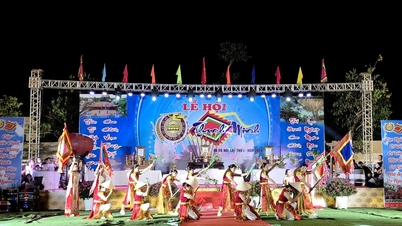
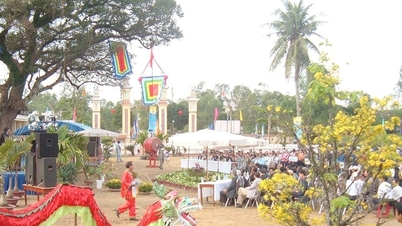
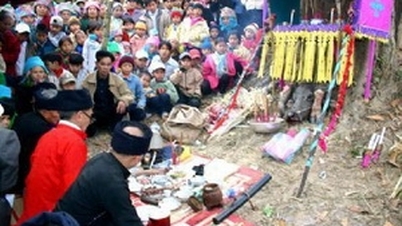
Throughout Khanh Hoa province, seaside communal houses stand as cultural landmarks of the coastal region. From river mouths and rocky shores to distant islands, wherever people have settled, there is a communal house facing the sea. For generations, coastal people have regarded the communal house as a place to entrust their hopes for protection. Their work involves facing rain, wind, big waves, and rough seas, so the rituals of worship are meticulously cared for. The most vibrant and sacred is the Spring Fishing Festival. When drums, gongs, and the sounds of boatmen's chants resound, groups of young men in traditional attire proudly sail out to sea on their boats. They bring the spirit of the God of the South Sea from the distant ocean back to the village communal house. Five-colored flags flutter, the scent of incense mingles with the sea breeze, and the rhythmic drumming of the festival echoes like the heartbeat of the entire village. All of this creates a scene that is both sacred and vibrant amidst the spring sky.
 |
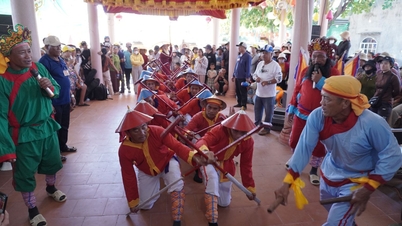
| Dance in the ritual singing. |
After the procession and welcoming of the deity, the villagers gather in the temple courtyard to watch "Hát án"—a unique form of traditional Vietnamese opera found only in coastal temples of Central Vietnam. This heritage has been passed down since the time of the country's expansion, when migrants brought the art of opera from the North Central region to the South. The most distinctive operas and stories blend with the rhythm of life in the coastal fishing community. While the North has "Chèo" and "Quan Họ," the Central region has "Bài Chòi," "Hò Bá Trạo," and opera. When performed in a coastal temple, opera transforms into "Hát án"—singing before the altar. This is a folk cultural form used to worship deities and ancestors, and also for the villagers to enjoy the art during the sacred festival.
Hát án (a type of folk opera) often uses classic plays from traditional Vietnamese opera such as: Sơn Hậu (the Queen), Lã Bố and Điêu Thuyền (Lu Bu and Diao Chan), Quan Công and Nhị Tẩu (Guan Gong escorting his two sisters-in-law)... The villagers believe that watching plays about loyalty, filial piety, and righteousness at the beginning of spring will bring good luck and help fishermen stay safe when going out to sea. The three nights of hát án are three nights the seaside temple is brightly lit, illuminating the faces of the captivated people. Elderly men and women familiar with the rhythm of the sea from dawn till dusk can stay up for three consecutive nights to watch the entire long play. Exclamations of "Ack!", "Charge!", "Excellent!" resound, blending with the drums of applause, filling the temple courtyard with lively sounds. Children run around, adults sip hot tea. People give the talented male and female performers banknotes tucked into cards. This is considered a New Year's blessing for the folk artists who have dedicated themselves to the community of the seaside village. That atmosphere, those sounds, the scent of the sea breeze mingled with the fragrance of incense and the smell of theatrical costumes – all combine to create a unique cultural character of this coastal village.
Although in modern times, traditional Vietnamese opera (tuồng) has faced some pressure from new forms of entertainment, for the people of the coastal villages, the art of "hat an" (a type of folk singing) has never disappeared. The villagers still invite troupes to perform at religious ceremonies, and still set up stages in front of the communal house with pride, saying, "Without 'hat an,' the spring festival is incomplete."
For coastal people, spring is not only about beautiful weather, but also the season of fishing rituals, folk songs, offerings of silver fish and pink shrimp, and the resounding rhythm of drums... creating a spring rich in the flavor of the sea. There, the blue sea is not just a source of livelihood, but also a memory, a belief, and a connecting thread for the community. Amidst the sound of the waves in spring, standing in front of the communal house and listening to the folk songs, one feels the enduring vitality of the maritime culture.
LE DUC DUONG
Source: https://baokhanhhoa.vn/van-hoa/202602/hat-an-o-dinh-bien-ngay-xuan-1332508/

![[Image] Close-up view of the 10-lane road connecting to Long Thanh Airport](https://vphoto.vietnam.vn/thumb/1200x675/vietnam/resource/IMAGE/2026/04/04/1775291871988_ndo_br_1-resize-5690-jpg.webp)































































Comment (0)