

However, paradoxically, only about 3,400 billion VND of the 145 trillion VND credit package allocated to this sector has been disbursed, equivalent to less than 3% of the program's scale. When businesses face bureaucratic hurdles and people have difficulty accessing loans, preferential funds have not truly reached those who need housing the most.

The capital is there, but it hasn't flowed strongly yet.
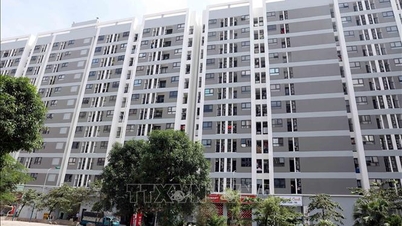
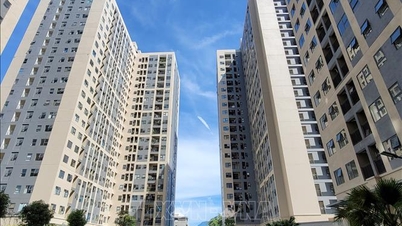
After a long period of slow growth, the social housing segment is entering a new phase of accelerated development.
According to Government Resolution No. 07/NQ-CP on assigning targets for social housing development to localities for the period 2026-2030, the whole country must complete more than 158,700 apartments in 2026 alone. In just the first four months of this year, an additional 40 social housing projects have been started, with a scale of approximately 36,590 apartments.
According to the Ministry of Construction , cumulatively across the country, there are currently 226 projects that have commenced construction with approximately 228,725 apartments, equivalent to 144% of the assigned target. At the same time, about 5,426 apartments have been completed and put into use; 25 localities have met or exceeded their commencement targets for this year.
To support the supply, the banking sector has implemented a preferential credit program for social housing development, currently worth approximately 145,000 billion VND. This is considered one of the important financial tools to realize the goal of housing security.
However, actual disbursement has not kept pace with expectations. To date, only 38 out of 63 localities have announced the list of projects eligible for loans. In total, approximately 100 projects are eligible to access the program, with a capital requirement of around 70,000 billion VND.
However, the total disbursed capital has only reached approximately 3,400 billion VND, equivalent to less than 3% of the entire program's scale. Of this, about 2,940 billion VND has been disbursed to investors in 21 projects; homebuyers have only accessed about 460 billion VND in 19 projects.
According to experts, the large gap between the size of the credit package and the amount of capital disbursed reflects the market's still low capacity to absorb capital.
Dr. Can Van Luc, Chief Economist of the Vietnam Investment and Development Bank (BIDV), believes that as bank credit increasingly focuses on the real estate market's demand for housing, the market will develop in a more sustainable direction. However, for the capital flow to be effective, it is necessary to simultaneously address the issues of supply, legal framework, and housing prices.
These bottlenecks were also a matter of particular concern to General Secretary and President To Lam during a recent working session with the Party Committee, the Government, and relevant agencies on the development of social housing. Accordingly, the right to legal housing is a fundamental right of citizens, and the State has a housing development policy aimed at ensuring everyone has a place to live. To realize this goal, procedures related to investment, planning, land allocation, construction permits, and access to preferential credit need to be streamlined, ensuring convenience, clear deadlines, and individual accountability.
One of the biggest bottlenecks currently is the prolonged project implementation process due to overlapping procedures. Many projects take years to complete procedures related to planning, land allocation, determining selling prices, approving eligible homebuyers, and investment procedures.
"To increase supply and bring down housing prices, we must first improve the licensing process, simplify administrative procedures, and shorten project implementation time," emphasized Dr. Can Van Luc.
Sharing the same view, Mr. Nguyen Van Dinh, Chairman of the Vietnam Real Estate Brokers Association, believes that if planning and procedural barriers are not removed, even with increased credit volume, efficiency will be difficult to improve.
When low-income individuals have difficulty accessing capital.
While businesses may struggle to access funding for project development, the biggest obstacle for homebuyers lies in long-term financial pressure.
After years of renting in Hanoi, Le Xuan, a mechanical worker, had repeatedly researched social housing projects to prepare for settling down. However, when calculating the bank loan repayment period of over 20 years, his family still hesitated to make a final decision.
According to Mr. Xuan, the initial preferential interest rate is positive, but what worries many workers most is the interest rate after the preferential period. With incomes only sufficient to cover living expenses and children's education, any fluctuations in borrowing costs can significantly impact the family budget.
Meanwhile, for Ms. Nguyen Thi Mai, a self-employed food service businesswoman in Hanoi, the obstacle lies in meeting the bank's loan requirements.
Ms. Mai said that her family had accumulated some matching funds and were eligible to apply for social housing. However, when researching the loan application process, she found that proving a stable income was not simple at all.
"My income is real, but it's not always reflected in payslips or employment contracts. When applying for a loan, many documents had to be submitted multiple times, so the approval process took longer than expected," Ms. Mai said.

According to current regulations, in addition to being eligible for social housing policies, borrowers must also meet credit conditions such as having the ability to repay the debt as committed, having a valid contract to purchase or lease-purchase social housing, and implementing loan collateral measures as prescribed.
These requirements are intended to ensure credit safety for banks, but in reality, they also make it difficult for a segment of low-income or unstable-income workers to access loans.
These concerns are also shared by many experts.
Mr. Nguyen Xuan Bac, Deputy Director of the Department of Credit for Economic Sectors (State Bank of Vietnam), said that building a stable, long-term interest rate mechanism for buyers of social housing is extremely necessary.
"Buyers of social housing typically have low or middle incomes and limited financial resources. Designing a mechanism for preferential and stable interest rates over a long period will help them feel secure in borrowing and have a better ability to repay the debt," Mr. Bac said.
According to Mr. Bac, with the loan program under Government Decree No. 100/2024/ND-CP detailing some provisions of the Law on Housing regarding the development and management of social housing, homebuyers can borrow at an interest rate of approximately 5.4% per year and with a maximum loan term of up to 25 years.
However, many experts believe that for low-income groups, what is important is not only preferential interest rates but also the stability of credit policies in the long term. The ability to predict monthly repayment obligations will help people feel more confident in deciding to buy a house.
From another perspective, legal consultant and lawyer Nguyen Van Dinh argues that there is a "mismatch" in policy in practice. Many people eligible for social housing policies lack the financial means to borrow money to buy a house, while those who are financially capable are not eligible.
"With incomes barely enough to live on, people often struggle to repay the principal of their home loans, let alone the interest. On the other hand, low incomes also make it difficult for people to prove their ability to repay the debt, leading to banks not disbursing the loan," Mr. Dinh analyzed.
This leads to the paradox that those who need housing the most are also the group with the least access to capital.
We cannot rely solely on the market.
In a recent conclusion on housing development orientation, General Secretary and President To Lam emphasized: "The State does not subsidize housing, but neither does it completely leave it to the market to regulate itself."
According to experts, this is also the spirit that needs to be instilled in the development of credit policies for social housing. Professor Hoang Van Cuong, a member of the National Assembly's Finance and Budget Committee, believes that the low disbursement rate of social housing credit programs shows that there are shortcomings in the way they are organized and implemented.
"We are mixing market mechanisms with state welfare mechanisms. Social housing is a social security policy, and as a social security policy, the State must use its tools to regulate it, but currently we are using market tools," Mr. Cuong emphasized.
According to him, social housing is a humanitarian program, so it also needs a humane credit mechanism that creates the most favorable conditions for people to access capital, from loan procedures to interest rates.
In addition, many experts suggest that the National Housing Fund should be put into operation soon, forming long-term capital sources for social housing development instead of relying mainly on commercial credit.
Notably, the Party and State's new orientation is also strongly shifting towards developing rental housing. General Secretary and President To Lam requested prioritizing the development of rental housing, especially the model of rental apartments in large cities, industrial zones, economic zones, and areas with strong development potential.
Lawyer Nguyen Van Dinh believes this approach aligns with the practical needs of workers. In attracting private enterprises, the State needs strong financial mechanisms to encourage investment. "The State could support a loan package covering 80% of the total project investment, with a loan term of over 20 years and a preferential interest rate below 3% per year," Mr. Dinh proposed.
The target of one million social housing units by 2030 demonstrates the strong determination of the Party, the State, and ministries and agencies in ensuring the right to housing for the people. However, for these apartments to truly reach low-income earners, preferential capital flows need to be channeled synchronously from businesses to homebuyers. Only when bottlenecks in procedures, interest rates, and credit mechanisms are removed can social housing fully fulfill its role as a sustainable social security pillar of the economy.
Article 4: Da Nang seeks solutions through social housing for rent.
Source: https://baotintuc.vn/kinh-te/hien-thuc-giac-mo-an-cu-bai-3-vuong-mac-tu-nut-that-tin-dung-20260601175141598.htm






























![[Photo] Reception to welcome General Secretary and President To Lam and his wife on their State visit to the Philippines](https://vphoto.vietnam.vn/thumb/1200x675/vietnam/resource/IMAGE/2026/06/01/1780295488620_vna-potal-chieu-dai-chao-mung-tong-bi-thu-chu-tich-nuoc-to-lam-va-phu-nhan-tham-cap-nha-nuoc-toi-philippines-8798060-7855-jpg.webp)











































































Comment (0)