


Instead of pursuing the expectation that Vietnam will surpass Singapore, Hong Kong (China), or Dubai, the primary goal should be to establish a more effective hub for attracting international capital to support Vietnam's faster long-term economic growth. This is the recommendation of Dr. Ho Quoc Tuan, a senior lecturer at the University of Bristol (UK), in an interview with a reporter from Nhan Dan Monthly on this issue.
Addressing multiple core issues simultaneously.
The Vietnamese government has set a target for international financial centers in Ho Chi Minh City and Da Nang to be operational by the end of this year. This is not just a single economic and financial goal, but a strategic step in the process of global financial integration. In your opinion, what are the most crucial elements that Vietnam needs to focus on to successfully build an international financial center?
In my opinion, the core elements needed are a legal system and governance mechanisms. Minimizing administrative regulations and moving towards the highest possible level of capital flow liberalization is a successful experience of financial centers like Dubai or Singapore. However, given Vietnam's specific characteristics, capital flow liberalization carries many potential risks and needs to be implemented cautiously and step by step, as the legal system is not yet broad enough in terms of openness.
Capital is considered a major bottleneck for Vietnam's financial market. Therefore, it is necessary to improve the legal framework and the enforcement of contracts, including laws on companies, assets, contract dispute resolution, recognition and enforcement of arbitration awards, and laws on civil enforcement. Simply implementing these effectively and aligning them with international best practices would be sufficient to unlock resources for intermediary activities, channeling international capital into projects in Vietnam without the need to bypass other financial centers as is currently the case.
An international financial center cannot operate effectively without a modern and integrated infrastructure, especially information technology infrastructure. The application of advanced technologies such as blockchain, artificial intelligence (AI), and big data analytics in financial operations not only enhances efficiency but also ensures security and transparency.
We also need a well-structured and in-depth human resource training strategy in fields such as finance, banking, fintech, and risk management to ensure sufficient capacity to operate international financial markets. In addition, attractive policies are needed to attract Vietnamese expatriate and international financial experts to return and work in a professional environment with career development opportunities and competitive salaries.
In particular, Vietnam needs a more realistic view of the concept of "success." Instead of pursuing the expectation of surpassing Singapore, Hong Kong (China), or Dubai, which are becoming regional financial centers that even new financial centers in Europe find difficult to surpass, it needs to set specific, realistic goals. For example, if it is possible to mobilize international capital without or with minimal need to go through the "gates" of the aforementioned financial centers, that would already be considered a success. The primary goal of a financial center should be to create a more efficient hub for attracting international capital to support Vietnam's faster economic growth in the long term.
For the international financial center to truly fulfill its role as a hub for attracting international capital flows, are the current resources in Vietnam sufficient to realize this goal?
The first factors to consider are soft infrastructure, legal framework, and operational mechanisms. In reality, Vietnam still lags behind Singapore, and even Thailand and Malaysia, in terms of human resources, infrastructure, and technology. On the other hand, with a sound mechanism, human resources could be supplemented from the group of foreign workers currently employed in other financial centers in the region and from the group of Vietnamese workers abroad.
Regarding the human resources gap, I believe it's not difficult to bridge. Domestic and international organizations will be able to solve this problem themselves if they truly feel they have "opportunities to utilize" in the international financial market in Vietnam. Therefore, the prerequisite is a mechanism and legal framework that allows financial institutions to participate in the financial market and feel they have growth prospects.
In other words, when Vietnam creates a shared belief that the international financial market will offer many interesting and innovative opportunities within permissible frameworks, private organizations will not hesitate to cooperate and invest.
Clearly define the roles of creation and operation.
In the context of the reshaping of global supply chains, international investment flows are seeking new destinations outside of traditional financial centers. So, what lessons and experiences can Vietnam learn from international financial center models?
There are two existing models we can refer to. Firstly, a model with a superior legal system, independent jurisdiction, and adherence to international standards. Singapore and Dubai have succeeded by adopting a legal framework that closely resembles the common law system of the United Kingdom – a country possessing a superior legal system for facilitating contracts and resolving disputes in the financial market. This creates a transparent, safe, and reliable investment environment for international financial institutions. However, the freedom offered by Dubai or Singapore in certain areas is not suitable for Vietnam's conditions.
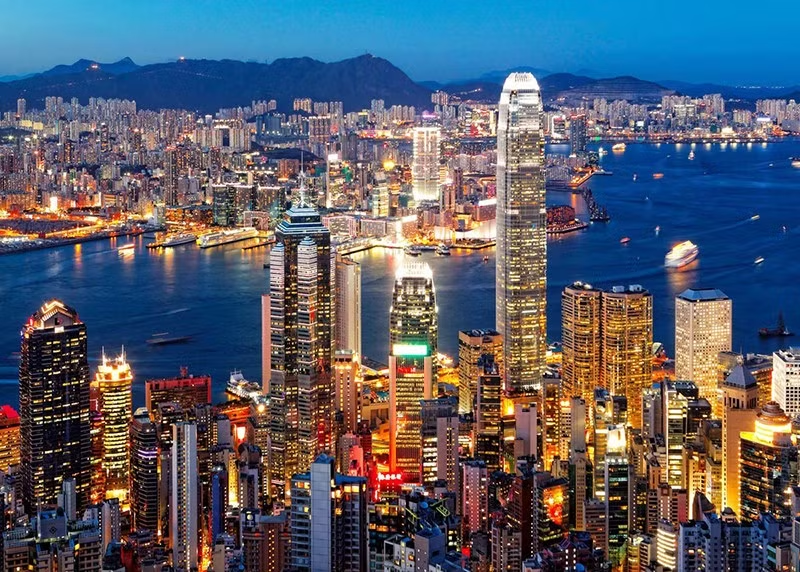
Secondly, there is the "controlled opening" model of Shanghai (China). The liberalization of capital accounts under this model has a clear roadmap, and of course, it cannot be as fast as Dubai and not as "open" as Singapore.
Considering each factor and the operational experience gained from these two models, Vietnam could aim for a hybrid model between Singapore and Shanghai, starting with a clear and cautious roadmap.
In liberalizing capital accounts and opening up financial markets, the appropriate approach is the Shanghai model to avoid the risks of macroeconomic instability, given that Vietnam's foreign exchange reserves are not yet large enough to absorb major financial shocks. However, legally, Vietnam can move faster because many types of transactions carry lower risks as they do not directly involve capital outflows. These transactions can be subject to new, more flexible mechanisms. Furthermore, contract enforcement and dispute resolution can be expedited because they do not always involve the free movement of capital. This is how the Singapore and Dubai models are being implemented.
This approach might disappoint some who expect a "breakthrough" to reach the level of established financial centers like Singapore and Hong Kong (China), or emerging ones like Dubai and Shanghai. In fact, even Singapore and Shanghai are considered too cautious in the eyes of some international investors, for example in the digital asset sector. Therefore, Vietnam doesn't need to rush and then run out of steam; instead, it needs to plan a long-term strategy to avoid failure.
Based on your experience and research at international financial centers around the world , how should we position the roles of the State and the private sector within the future "overall spectrum" of international financial centers when implementing financial centers in Vietnam?
There are now rankings and charts published periodically and irregularly, all of which include indicators on institutions, connectivity, expertise, taxation, and even indicators related to living and working environments.
I believe that the Vietnamese government should focus on its proactive role rather than setting targets or striving to meet ranking criteria. Because when the proactive role is well-executed, those targets will naturally improve. This proactive approach should be viewed from three perspectives: policy and institutional development; infrastructure development; and the development of a foundation for monitoring and risk management.
The state needs to build a solid, transparent, and sufficiently open legal framework to experiment with groundbreaking activities and mechanisms, creating conditions for the development of international financial activities. These pillars include enacting preferential tax policies and administrative procedures, as well as establishing a superior and attractive judicial system for operations within the international financial market.
Regarding infrastructure investment, the State is responsible for leading investment in essential infrastructure such as roads, airports, seaports, and especially information technology infrastructure. Private enterprises can participate in investment, but the State's involvement is still needed in some large and key projects.
Regarding supervision and risk management, the State needs a plan to ensure the stability and safety of the complex financial system, preventing and promptly addressing risks. Part of this could be a public-private partnership, with private organizations also participating in the supervisory board, as they are well-versed in the new changes in their field. To achieve this, the international financial market regulator should not be a state management agency or administrative unit, but rather a partnership model, where the State participates in a facilitating and supervisory role, while operational management and strategic planning should be entrusted to the private sector and local authorities. This model would compel the financial market regulator to disclose information transparently, making it easier for current government and market supervisory bodies to monitor and control.
When establishing an international financial center, what are Vietnam's outstanding competitive advantages compared to other countries in the region, and what risks will it face, sir?
I believe that the financial market is just the tip of a much larger iceberg than the entire economy. Therefore, our outstanding competitive advantage lies in the competitive advantage of the Vietnamese economy within the region.
These advantages include rapid economic growth with ambitious goals, macroeconomic and political stability, ample fiscal space allowing for international borrowing, and a high proportion of the population in the working age group, despite a relatively high aging rate. Over the next 10 years, these will remain Vietnam's strengths. Compared to Indonesia, we have the potential to develop infrastructure and implement legal reforms more effectively. Compared to Thailand and Malaysia, we are maintaining a rapid growth rate. However, these advantages are not immutable and need to be fully utilized.
The top three current risk factors for financial markets are: money laundering, cyberattacks, and the contagion of global volatility.
In any international financial market, when international capital flows in, the risk of illicit funds, money from organized crime, or terrorist activities using the financial system to legitimize them increases. Complex, cross-border transactions and the diversity of financial products make supervision more difficult.
One of the leading risks for international financial centers over the past two years has been cyberattacks. This is an inevitable consequence of the digitalization and global interconnection of the financial system. The risk of cyberattacks, data theft, or disruption of financial transactions will increase significantly.
Similarly, as international capital flows in, the connectivity and sensitivity to global financial markets increase. This contagion manifests itself through fluctuations in market interest rates, exchange rates, and asset prices, which are easily amplified when encountering external shocks.
Therefore, it is necessary to improve monitoring capabilities and resilience to risks. However, "it's easier said than done," because it is a consequence of investing in infrastructure, human resources, and a suitable mechanism that allows monitoring and operating organizations to invest in human resources and infrastructure smoothly.
Thank you very much, sir!
Source: https://nhandan.vn/hinh-thanh-mot-dau-moi-thu-hut-von-quoc-te-hieu-qua-hon-post909188.html
![[Photo] Solemn bathing ceremony and Buddha procession in Hue](https://vphoto.vietnam.vn/thumb/1200x675/vietnam/resource/IMAGE/2026/05/31/1780228263543_1-jpg.webp)
![[Photo] The General Secretary, President and his wife begin their state visit to the Philippines.](https://vphoto.vietnam.vn/thumb/1200x675/vietnam/resource/IMAGE/2026/05/31/1780230559452_anh-man-hinh-2026-05-31-luc-19-28-11.png)


![[Photo] Admire the coral "masterpiece" amidst the million-year-old heritage of Dak Lak province.](https://vphoto.vietnam.vn/thumb/1200x675/vietnam/resource/IMAGE/2026/05/31/1780221235105_anh-man-hinh-2026-05-31-luc-16-53-27.png)










![[Video] Sunset at Lap An Lagoon – Where the sun sets over the fishing nets](https://vphoto.vietnam.vn/thumb/340x192/vietnam/resource/IMAGE/2026/05/31/1780192137701_beach-landscape-sea-water-nature-grass-745871-pxhere-com.jpeg)

![[Video] Weather forecast for tonight and tomorrow, June 1st, 2026: Northern Vietnam experiences rising temperatures, Southern Vietnam continues to have thunderstorms.](https://vphoto.vietnam.vn/thumb/402x226/vietnam/resource/IMAGE/2026/05/31/1780232471628_thumb-toi-3105-png.webp)







































![[Photo] Admire the coral "masterpiece" amidst the million-year-old heritage of Dak Lak province.](https://vphoto.vietnam.vn/thumb/402x226/vietnam/resource/IMAGE/2026/05/31/1780221235105_anh-man-hinh-2026-05-31-luc-16-53-27.png)





























Comment (0)