

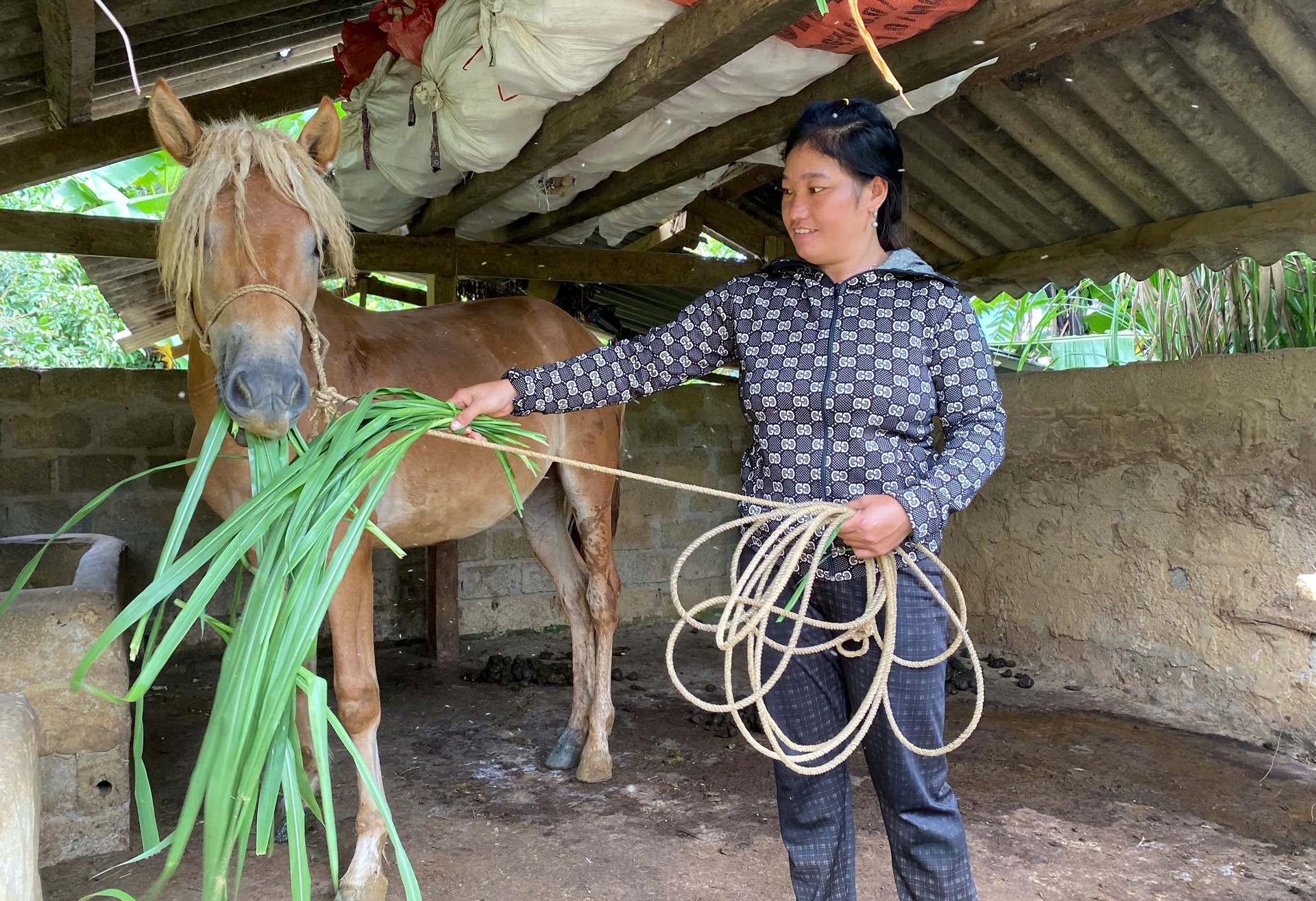
Residents in Seo Pả neighborhood (Doan Ket ward) receive support for caring for breeding horses.
The Seo Pả residential area has 121 households with over 550 inhabitants, mainly ethnic Mong and Dao people. Seo Pả has potential for livestock development; however, most people face difficulties in accessing quality breeding stock and modern care techniques. Therefore, the development of suitable livelihood programs and projects that utilize existing conditions is a priority for the local Party committee and government.
According to Mr. Giàng A Giao, head of the Seo Pả residential group: "As a locality with many natural grasslands, it is favorable for raising large livestock, especially horses - animals familiar to the people. This is why the residential group was chosen to implement the content of supporting horse breeding in the project 'Diversifying Livelihoods, Developing Poverty Reduction Models', helping households to rise out of poverty."
Accordingly, nine poor and near-poor households were selected to receive horse support, provided they met the requirements for stables and committed to strictly adhering to the animal care procedures. During the selection process, the ward prioritized households with experience in animal husbandry or those willing to learn and adopt new techniques. The horses provided all met standards in weight and health, had clear origins, and were inspected by veterinary officers before handover. The support process was open and transparent, witnessed by the government, neighborhood committee, and representatives of the people.
One of the households receiving breeding horses is that of Mr. Trang A Su, a near-poor family with a disability. With his existing livestock farming experience, Mr. Su proactively renovated the stables and prepared thoroughly before receiving the horses. Thanks to regular technical support from veterinary officers, Mr. Su's family is actively caring for the horses, and they are developing healthily. "I am very happy to have another opportunity to develop my family's economy . Horses are easy to raise and suitable for the conditions of the highlands. If well cared for, in a few years they can be bred and sold on the market," Mr. Su shared.
Similarly, the family of Mr. Tan A Nai, classified as a poor household, also benefited from the project. After receiving the breeding horses, Mr. Nai was very excited and actively learned the techniques through training sessions by veterinary officers and direct exchanges with other households in the village. Mr. Nai shared: “Previously, due to difficult economic conditions, my family did not have money to buy breeding livestock. Thanks to the attention of the local government, my family received support in the form of breeding horses. After a period of care, the horses developed healthily and entered the breeding period.”
Throughout the process of caring for the horses, the households consistently received timely support from the local authorities. Veterinary officers and the neighborhood group leader regularly visited to check the horses' development, provide guidance on feeding techniques, barn hygiene, and disease prevention. The households actively shared experiences and supported each other in the animal care process. As a result, they learned how to monitor the horses' health, especially adjusting the daily feed amount according to the animals' needs. This not only helped the horses develop healthily but also avoided leftover feed, preventing waste and maintaining barn hygiene. This is a positive change, demonstrating a clear shift in the mindset and practices of the people, moving towards the goal of efficient and sustainable livestock farming.
To date, 100% of the horses provided to households have developed healthily and adapted well to local conditions. In particular, some are now in their breeding period, helping to increase the herd and form a sustainable and integrated livestock production model.
The project "Diversifying Livelihoods and Developing Poverty Reduction Models" in Seo Pả residential area not only provides livestock but also contributes to raising awareness and helping people become more proactive in developing their household economies. If it continues to be effective, the ward will consider expanding the support to other residential areas with similar conditions, contributing to creating more sustainable livelihoods for the people.
Source: https://baolaichau.vn/kinh-te/ho-tro-sinh-ke-tu-nuoi-ngua-sinh-san-1104609


![[Photo] Standing Committee member of the Party Central Committee Tran Cam Tu working with the Central Inspection Committee](https://vphoto.vietnam.vn/thumb/1200x675/vietnam/resource/IMAGE/2026/05/28/1779969579668_ndo_br_bnd-2495-jpg.webp)




































































Comment (0)