


The focus is not on issuing more regulations, but on definitively resolving overlaps, improving the quality and effectiveness of implementation, thereby removing the "bottlenecks" that are hindering investment flows and the growth capacity of the economy.
7 practical solutions proposed by VCCI.
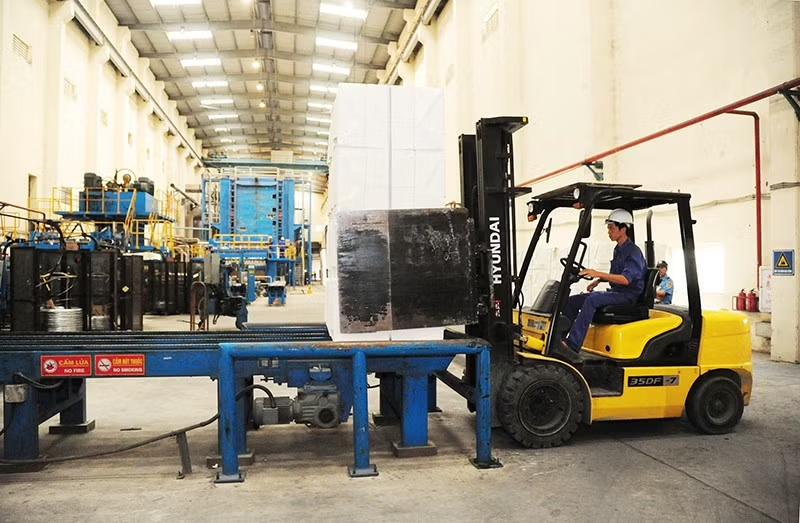
First, according to the Vietnam Chamber of Commerce and Industry (VCCI), the initial and most fundamental bottleneck lies in the overlapping of laws – a seemingly old problem that has yet to be fully addressed. In the traditional approach, each law is reviewed separately, but in reality, businesses do not "live" within each law, but operate in a continuous chain from investment to production. A processing company in the Central Highlands once had to suspend its project for more than a year simply because it could not determine whether to prepare an environmental impact assessment report first or apply for a construction permit first. The environmental agency required a detailed design, while the construction agency required the completion of the environmental documentation. Both doors were locked, and the business was stuck in the middle. This case clearly shows the reality: procedures are being designed according to the management logic of each agency, not according to the operational logic of the business. Therefore, the proposal to review the law according to the "business chain" is not just a technical issue, but a shift in mindset, forcing the legal system to "keep pace" with the journey of businesses. When procedures are redesigned according to the chain, eliminating conflicting intersections, project preparation time can be shortened from several years to a few months, meaning trillions of dong in investment capital are freed from a "waiting" state.
If policy overlap is a "static bottleneck," then policy instability is a "dynamic risk," directly impacting long-term investment decisions. In the renewable energy sector, many businesses have experienced a volatile cycle. A solar power investor in central Vietnam built a project based on a fixed FIT (Feed-in Tariff) price mechanism for 20 years, with a meticulously calculated financial plan down to every cash flow. However, when the policy shifted to a negotiated price mechanism, the project was completed but did not receive the preferential price in time, becoming stalled due to the lack of a price sufficient for efficient operation. Not just one business, but an entire wave of investment stalled. Based on this reality, the Vietnam Chamber of Commerce and Industry (VCCI) proposes a minimum transition period of 12 to 24 months for changes in legislation directly affecting business operations, except in emergency cases.
One less-publicized but increasingly serious problem is the quiet expansion of business regulations. Reforms have primarily focused on reductions, but lack mechanisms to prevent their reappearance. A logistics company wanting to operate a warehousing chain must navigate numerous hurdles, each requiring a different license and standard from a different agency; individual regulations may be reasonable, but they accumulate into a mountain of compliance costs. Therefore, the "one-in, one-out" proposal acts like a "lock valve": adding a new regulation necessitates removing an old one, forcing each regulation to justify its necessity instead of continuing to pile up.
Furthermore, the paradox of pre- and post-inspection remains a persistent problem. Businesses have to "apply" for permits before operating, yet they may also face intense inspections after they begin operations. The Vietnam Chamber of Commerce and Industry (VCCI) proposes a comprehensive review of all existing licenses, business conditions, and administrative procedures. This review should assess whether each is truly necessary, whether it can be replaced by post-inspection, and the compliance costs for businesses. A shift to intelligent post-inspection, based on data and risk classification, would reduce the burden on businesses that comply with regulations, while simultaneously focusing resources on areas requiring supervision – a move from scattered management to effective governance.
The business environment is also influenced by the effectiveness of the dispute resolution system. Currently, the time taken to resolve commercial disputes in Vietnamese courts is lengthy, the capacity to adjudicate complex commercial cases is limited, and the civil enforcement mechanism is ineffective. In particular, the bankruptcy mechanism is almost non-functional in practice (in 2025, only 244 bankruptcy cases were resolved, a very small number compared to nearly 1.1 million active businesses). The proposal to establish specialized commercial courts and develop commercial arbitration and mediation aims not only to resolve disputes faster but also to facilitate faster capital turnover – a crucial factor for an economy seeking accelerated growth.
Another less-discussed but directly impactful barrier to market efficiency is the lack of uniformity in law enforcement across localities. A retail business might open a store in Da Nang in just a few weeks, but expanding to Hanoi takes twice as long due to differing documentation requirements. These "soft borders" increase costs, slow expansion, and inadvertently fragment the domestic market. The proposal for a "unified national market" therefore serves as a cornerstone of reform, ensuring all businesses operate within a consistent legal framework, regardless of location.
Finally, a fundamental but often overlooked reform is improving the quality of policy impact assessments. When each new regulation is enacted without quantifying the compliance costs, the burden silently shifts to businesses. The Vietnam Chamber of Commerce and Industry (VCCI) argues that the quantification of compliance costs for businesses should be mandatory in all new policy proposals: each draft legal document must answer the question of how much time and cost businesses will have to spend to comply with this regulation. The assessment of the impact quality should be entrusted to an independent entity, not the drafting agency.
Looking back at all of VCCI's recommendations, a common thread runs throughout: institutional reform must start with specific business "cases." A project stalled due to overlapping procedures, a factory shut down because of policy changes, a business exhausted by prolonged disputes, or a business chain stagnating because of differing interpretations in each locality – each case is a link hindering growth. When each link is untangled, the economy will not need massive boosts, but will generate its own momentum.
"Paving the way" through institutions.
The practical demands mentioned by VCCI also align with the top-level governance direction, where institutional reform is no longer just a slogan, but is identified as a direct lever for growth.
In his opening remarks at the beginning of his term, Prime Minister Le Minh Hung clearly outlined a priority: To achieve high growth, the first priority must be to "pave the way" through institutional reforms. The focus is not only on perfecting the legal system towards synchronization and transparency, but also on reviewing and definitively resolving overlapping regulations, substantially reducing administrative procedures, and removing bottlenecks that are hindering the flow of capital and opportunities. Along with this is the requirement to build a streamlined, efficient, and effective administrative apparatus, because if institutions are the "road," then the apparatus is the "road-paverser."

Notably, this approach doesn't stop at policy design but goes straight to implementation. The head of government emphasized that with the same "economic vehicle," the pace of development will be vastly different if the "institutional infrastructure" is upgraded smoothly. However, growth cannot come at the expense of instability; it must be accompanied by macroeconomic stability and a long-term foundation. Therefore, the requirement for 2026 is to conduct a comprehensive review of the legal system, develop a legal strategy for the new phase, and address obstacles in the operation of the apparatus, especially in the two-tiered local government model.
Going deeper, institutional reform is directly linked to implementation capacity at the grassroots level, with communes, wards, and special zones considered the "front line" of growth, where policies no longer remain on paper but become concrete results. This requires not only amending laws but also improving the quality of officials, perfecting planning, and land use planning in a synchronized and unified manner. When the institutional "path" is opened from the central to the grassroots level, growth will no longer be an imposed goal, but a natural consequence of a smoothly and efficiently functioning system.
Prime Minister Le Minh Hung affirmed that the Government will focus on implementing three strategic breakthroughs identified by recent National Party Congresses. These are breakthroughs in institutions, infrastructure, and the quality of human resources.
Source: https://nhandan.vn/hoan-thien-the-che-de-co-xe-kinh-te-tang-toc-post956386.html
![[Image] Close-up view of the interchange connecting the two expressways and Long Thanh Airport.](https://vphoto.vietnam.vn/thumb/1200x675/vietnam/resource/IMAGE/2026/05/25/1779703378210_ndo_br_z7863716673926-224453a31600126cce10622af6290afd-4549-jpg.webp)
![[Image] Hanoi's urban life under the challenge of a "scorching hot" environment](https://vphoto.vietnam.vn/thumb/1200x675/vietnam/resource/IMAGE/2026/05/25/1779706979265_nang-nong-t5-2026-minh-duy-7-4636-jpg.webp)

























































































Comment (0)