


The war is long over, and the highlands are covered in lush green vegetation, but beneath that green, more than 1,200 fallen soldiers remain undiscovered. With each passing day, the chances of finding them become more difficult as the terrain changes and the traces of war fade with time. Therefore, the search and repatriation of the remains of fallen soldiers is not only a political task but also a "command from the heart."
Focus on collecting information about fallen soldiers.
In implementing the "500-day campaign to intensify the search, collection, and identification of the remains of fallen soldiers," Tuyen Quang province has focused on decisive leadership and direction with high political determination, mobilizing the participation of the entire political system; adhering to the "6 clear principles": clear person, clear task, clear time, clear responsibility, clear output, clear authority; and simultaneously linking the responsibility of the head of each agency to the results of implementation.
Colonel Nguyen Minh Khoi, Deputy Political Commissar of the Tuyen Quang Provincial Military Command, said that the search operation is currently focused mainly on mountain slopes and high points along the border, where the terrain is particularly difficult, wide-ranging, and treacherous. Therefore, to ensure the campaign is as effective as possible, the Provincial Military Command has reinforced its forces and technical equipment, and organized in-depth training for the team searching for and collecting the remains of fallen soldiers.
The search efforts are currently focused primarily on mountain slopes and high points along the border, where the terrain is particularly difficult, extensive, and treacherous. Therefore, to ensure the campaign is as effective as possible, the Provincial Military Command has reinforced its forces and technical equipment, and organized intensive training for the team searching for and collecting the remains of fallen soldiers.
Colonel Nguyen Minh Khoi, Deputy Political Commissar of the Tuyen Quang Provincial Military Command
Accordingly, after being reorganized and having its personnel increased, the team for searching and collecting the remains of fallen soldiers was divided into five sub-teams. Three sub-teams directly carried out the task at seven key locations, including high points 685, 300, 772, A5 in Thanh Thuy commune; high points 1,688, 1,800A, 1,800B in Lao Chai commune; and high point 1,030 in Minh Tan commune. The remaining two sub-teams followed the engineering units that were deploying to clear mines along the border to identify locations suspected of containing the remains of fallen soldiers.
Lieutenant Colonel Tran Quang Huy, Head of the Team for Searching and Collecting the Remains of Fallen Soldiers, stated that gathering information on the locations where fallen soldiers lie buried on the battlefield is a key task. The team has coordinated with local authorities to intensify propaganda efforts targeting veterans who directly fought in the war and residents living in the border area. Through these efforts, since the beginning of the campaign, they have received 22 pieces of information and conducted surveys on 19 of them.
Detachment 3 of the Search and Collection Team for the remains of fallen soldiers, carrying out its mission in the border communes of Minh Tan and Tung Vai, received numerous pieces of information from local people. Among them was information provided by Mr. Vang Seo Tang from Hoang Ly Pa village, Minh Tan commune. According to Mr. Tang, elderly villagers recounted that during the fighting to protect the northern border, there was a high point near the border where a military unit was stationed and where fallen soldiers were buried. However, the exact location could not be remembered.
Based on this information, Detachment 3 conducted a field survey, compared it with historical documents about the battles, and determined that the information was credible. In early May, the unit mobilized its forces to organize a search. After nearly a week, officers and soldiers found the remains of the fallen soldier along with many remaining artifacts.
Most recently, veteran Nguyen Van Quyen from Lang Giang commune, Bac Ninh province, formerly the Deputy Political Officer of Battalion 5, Regiment 266, Division 313, provided information: At Hill 1,030, Ma Hoang Phin village, Minh Tan commune, a platoon was attacked by the enemy and the remains of the fallen soldiers have not yet been recovered. Mr. Quyen stated: “At that time, the battlefield was fierce, and the hilltop was occupied by the enemy, so the bodies of the fallen soldiers could not be recovered. I provided this information and hope that the authorities will soon organize a search to bring my comrades back to their families.”
Based on information provided by veterans, the team searching for and collecting the remains of fallen soldiers conducted surveys and verifications, confirming the information was credible and is preparing to organize the search and collection process.
Breaking rocks, digging trenches to find comrades.
Because most of the suspected locations containing the remains of fallen soldiers are situated on high, rugged, rocky and earthen mountains with difficult access, motorized vehicles are almost inaccessible. Furthermore, many soldiers who died in trenches, caves, and mountain crevices have been buried by artillery fire over the years, making the search and collection of their remains extremely difficult and dangerous.
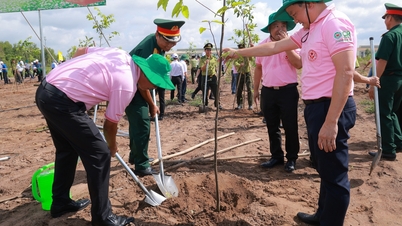
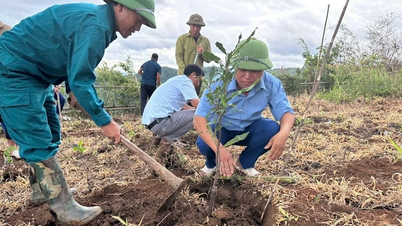
For example, at high point A5, Giang Nam village, Thanh Thuy commune, after receiving information from veterans, in early May, the team searching for and collecting the remains of fallen soldiers deployed its search efforts under difficult and dangerous conditions. To access the area suspected of containing the remains of fallen soldiers, officers and soldiers had to use drills, sledgehammers, and expanding powder to break up the rocks.
Major Mac Van Can, a member of the team searching for and collecting the remains of fallen soldiers, said: “At high point A5, the locations suspected of containing the remains of fallen soldiers were deep within caves and ravines that had been destroyed by artillery fire. Despite the lack of oxygen, cramped space, and constant risk of landslides, the team members persevered, using manual tools and patiently breaking through rocks to reach the location of the remains. Although arduous, the team members were overjoyed to have found three fallen soldiers.”
To find the remains of fallen soldiers in Hoang Ly Pa village, Minh Tan commune, Detachment 3 had to mobilize all its forces to conduct a search over an area of nearly 4,000 square meters . Due to the complex terrain, officers and soldiers had to manually dig trenches 1.5 to 1.8 meters deep along the hillside; each trench was spaced 1 meter apart. After digging the sixth trench, with approximately 200 square meters of earth and rock excavated, the unit finally found the remains of the fallen soldiers.
Lieutenant Colonel Hoang Vu Dung, Deputy Head of the Search and Collection Team for the Remains of Fallen Soldiers, in charge of Detachment 3, said: “On the border, the weather is harsh. There are days when we work continuously in the scorching heat, our clothes soaked with sweat, our hands bleeding from shovels and picks, but no one loses heart. Every time we find a piece of canvas, a button, or a belt left under the ground, everyone gains more hope of finding their comrades.”
On the harsh border, there were days of continuous work under the scorching sun, clothes drenched in sweat, hands bleeding from shoveling, but no one lost heart. Every time they discovered a piece of canvas, a button, or a belt lying buried underground, everyone's hope of finding their comrades was rekindled.
Lieutenant Colonel Hoang Vu Dung, Deputy Head of the Team for Searching and Collecting the Remains of Fallen Soldiers, in charge of Detachment 3.
Since the beginning of the campaign, the team searching for and collecting the remains of fallen soldiers has conducted searches over an area of approximately 410 hectares; excavated and filled more than 4,000 cubic meters of earth and rock; and recovered 10 sets of remains of fallen soldiers and two mass graves.
Currently, Tuyen Quang province has 170 martyrs' graves requiring DNA testing, divided into two phases from 2026 to 2030. Phase 1, from June 2026 to July 2027, will involve collecting samples from 92 unidentified graves in 10 martyrs' cemeteries across the province; Phase 2, from July 2026 to 2030, will collect samples from 78 graves.
The province aims to locate and collect approximately 600 remains of fallen soldiers by the end of 2026. According to Mr. Vuong Ngoc Ha, Vice Chairman of the People's Committee of Tuyen Quang province, the province has directed relevant departments, agencies, and localities to enhance their responsibility and coordinate closely in implementing the campaign; simultaneously accelerating the progress of bomb and mine clearance, information verification, and DNA testing; and strengthening propaganda and mobilization of the people to provide information to support the search and collection of fallen soldiers' remains, striving to achieve the set goals.
Source: https://nhandan.vn/tim-dong-doi-บน-cac-diem-cao-bien-gioi-post964665.html

![[Image] Close-up view of the interchange connecting the two expressways and Long Thanh Airport.](https://vphoto.vietnam.vn/thumb/1200x675/vietnam/resource/IMAGE/2026/05/25/1779703378210_ndo_br_z7863716673926-224453a31600126cce10622af6290afd-4549-jpg.webp)

![[Image] Hanoi's urban life under the challenge of a "scorching hot" environment](https://vphoto.vietnam.vn/thumb/1200x675/vietnam/resource/IMAGE/2026/05/25/1779706979265_nang-nong-t5-2026-minh-duy-7-4636-jpg.webp)































































Comment (0)