

Vietnamese language, and when studied at the secondary school level, it's called literature, considered the subject that 'has the most influence in everyone's life,' and is one of the two compulsory subjects in the high school graduation exam and the entrance exam for grade 10...
How can I learn Vietnamese well, adapt to changes in exams, and use it effectively in life?
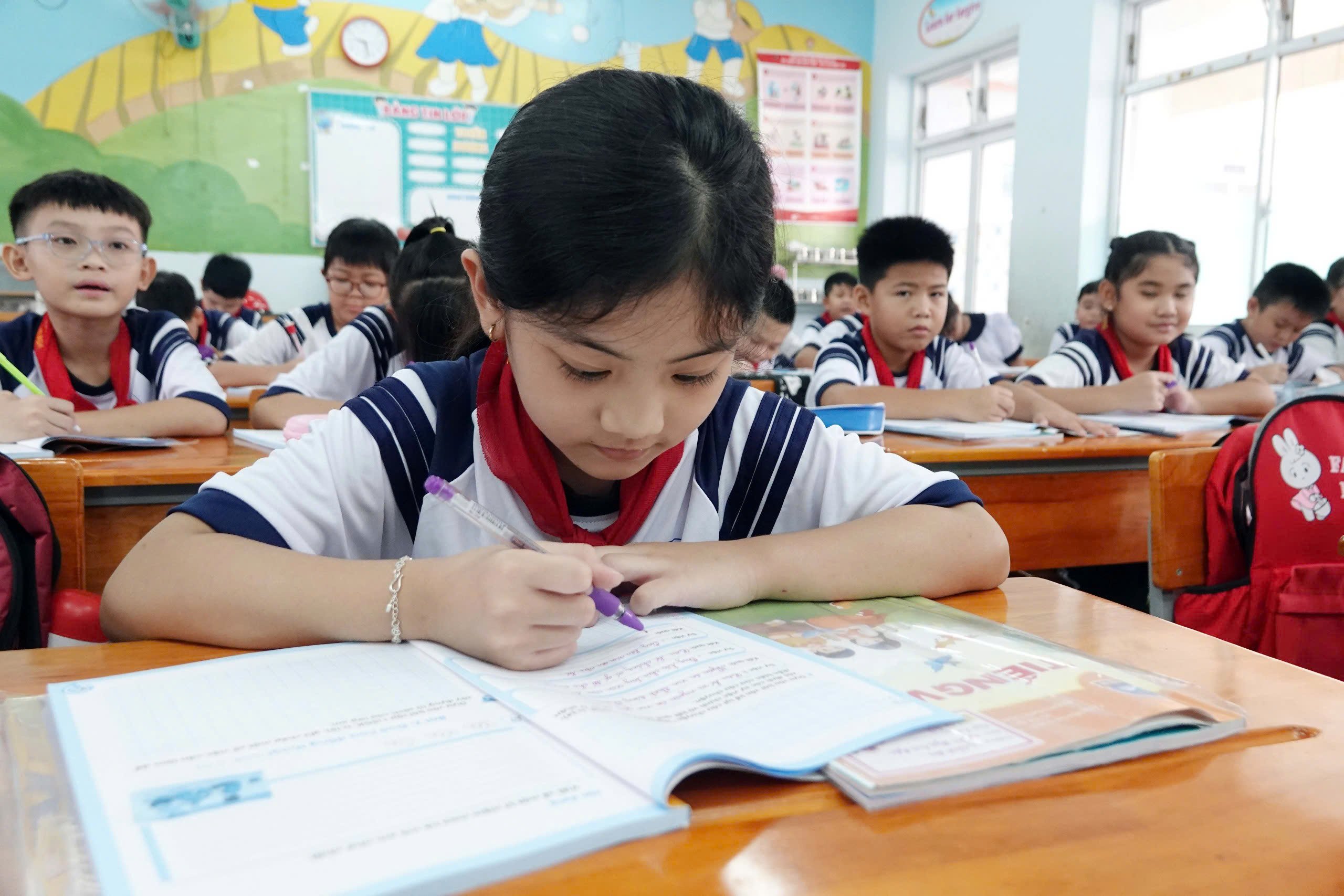
Primary school students have many opportunities to practice their Vietnamese reading, writing, speaking, and listening skills according to the new curriculum.
PHOTO: DAO NGOC THACH
Experts believe this is not just a matter for the education sector alone, in the context of implementing the 2018 General Education Program, but also a responsibility of families and society in the era of globalization.
PROMOTE "EXTENDED READING" AND "CREATIVE WRITING"
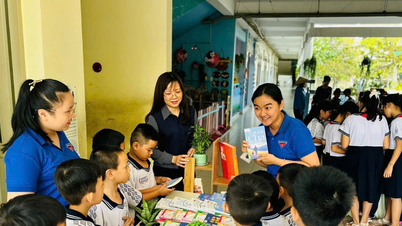
Most students in class 3/5 at Luong Dinh Cua Primary School, District 3, Ho Chi Minh City, look forward to Vietnamese class. Mr. Cao Hoang Huy, their homeroom teacher, usually dedicates a lot of time to extended reading, allowing students to enthusiastically discuss the books they've read at home, focusing on specific topics suggested by the teacher. During this class, students also proudly show off their completed reading worksheets, each bringing a different story or meaning they've discovered.
"The 2018 General Education Program, with its student-centered approach and focus on developing learners' competencies, uses teachers as guides to encourage students to explore, discuss in groups, and be more proactive in the learning process. Specifically for Vietnamese language, the new program emphasizes developing students' reading and writing skills," Mr. Huy shared.
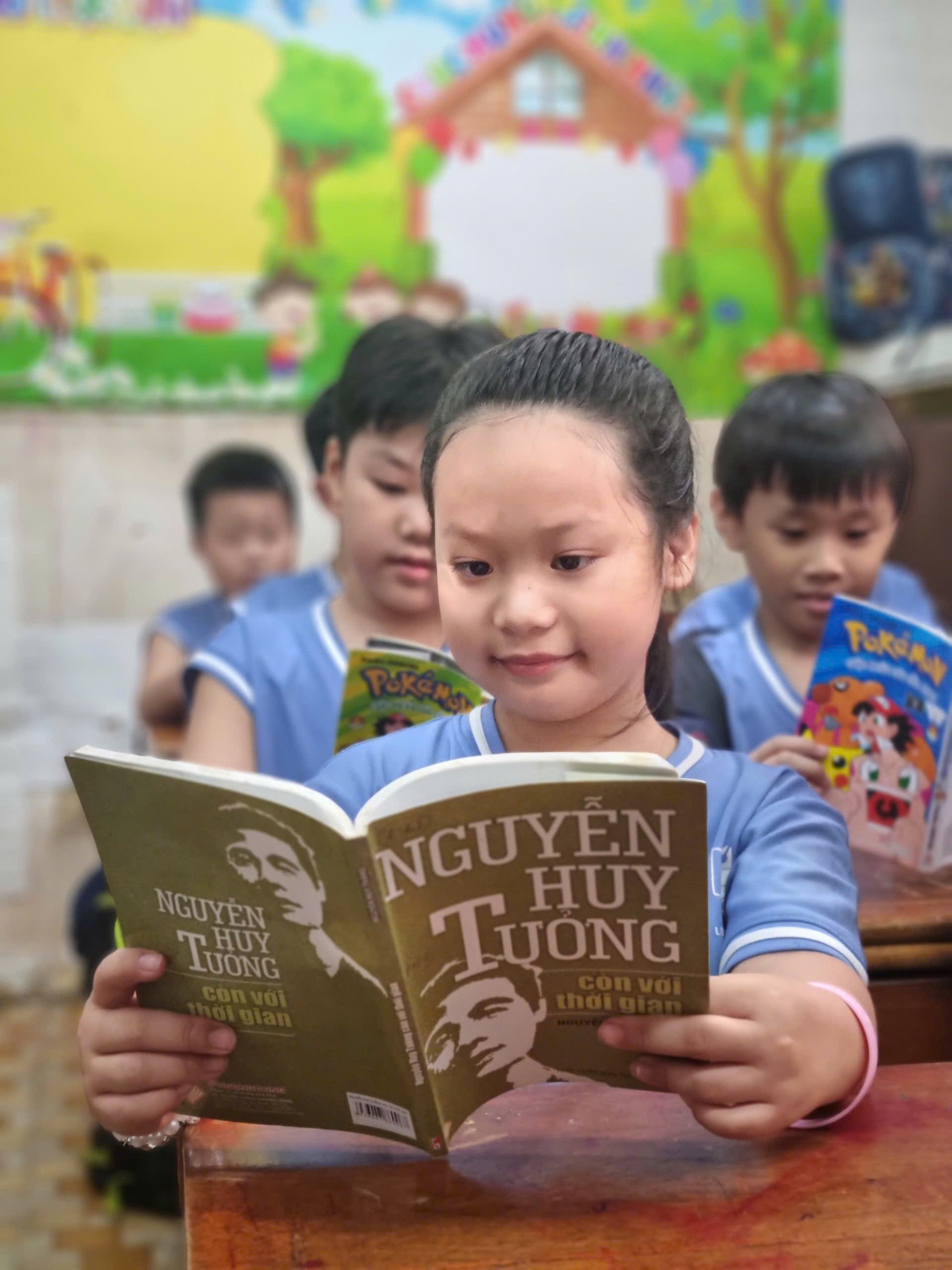
Students in class 3/5 at Luong Dinh Cua Primary School, District 3, Ho Chi Minh City, read additional books in the extended reading section during their Vietnamese language lesson.
"The extended reading section encourages students to explore and read many books from online learning resources, libraries, and family books and newspapers. Afterwards, they discuss and share with teachers and classmates. Thus, even if the textbook only teaches one text, after a day they can share up to 20 other works with each other, expanding their vocabulary," Mr. Huy added.
According to Mr. Huy, the new program encourages teachers and students to focus on creative writing, helping elementary school students break free from model essays and similar-sounding pieces, creating paragraphs and essays with their own personal touch. Mr. Huy considers this an important foundational step for students at higher levels, especially when participating in important exams such as the 10th grade entrance exam and the high school graduation exam, where the literature exam will not include works from textbooks, requiring students to have higher reading skills and a stronger reading culture.
POSITIVE CHANGES FROM THE NEW PROGRAM
Mr. Ha Thanh Hai, Deputy Head of the Education and Training Department of District 7, Ho Chi Minh City, said that for the Vietnamese language subject at the primary school level, the new curriculum is designed in an open-ended way and focuses on equipping students with four skills: reading, writing, speaking, and listening. "Why is the order of skills reading, writing, speaking, listening, and not listening, speaking, reading, writing? Because before entering primary school, students have already learned and practiced two skills: speaking and listening. In the 'listening' skill, the new curriculum focuses on listening comprehension. In the 'speaking' skill, the new curriculum focuses on interactive speaking skills in dialogue and conversation," Mr. Ha Thanh Hai added.
Mr. Hai gave many examples showing that learning Vietnamese is currently engaging and highly applicable for primary school students. In particular, to help students speak naturally and avoid feeling constrained, which could lead to imitation, the new curriculum focuses on creating natural communication situations connected to students' real lives, giving them opportunities to practice their speaking and listening skills.
Dr. Tran Thi Quynh Nga, a senior lecturer in the Department of Primary Education at Hue University of Education, stated that the 2018 General Education Program aims to develop students' qualities and competencies. From the perspective of teaching Vietnamese at the primary school level, the new aspects regarding educational goals and content, reflected in the required learning outcomes and specific Vietnamese language and literary knowledge for each grade, as well as the orientation towards innovative teaching methods, Dr. Nga believes that the new program has created positive changes in schools.
"If, in the first school year of 2020-2021, the new first-grade textbook curriculum was introduced to schools, some teachers were still hesitant to approach and connect with it. However, based on initial experiences, we have observed that teachers now clearly understand the learning objectives and knowledge frameworks, and are flexible in applying active teaching methods and techniques. Students also have many opportunities to practice reading, writing, speaking, and listening skills using new Vietnamese language teaching materials that are suitable for their psychological characteristics and thinking abilities," said Dr. Nga.
No matter how integrated and globalized we become, we cannot disregard the Vietnamese language; doing so would be contrary to our culture and the direction of primary education.
Ms. Lam Hong Lam Thuy
(Head of Primary Education Department, Ho Chi Minh City Department of Education and Training)
MORE EFFORTS FROM PARENTS AND SCHOOLS ARE NEEDED
Ms. Le Thi Yen Oanh, Deputy Principal of Dao Son Tay Primary School, Thu Duc City, Ho Chi Minh City, believes that parents should not be left out of the effort to cultivate their children's love for Vietnamese language and literature, and to nurture their love for their mother tongue and Vietnamese culture. There are very simple ways to do this, such as parents needing to talk and discuss everyday life with their children more, guiding them to read books. Grandparents and parents can read Vietnamese fairy tales, folk songs, and proverbs together. Parents can also go shopping for books with their children, read good stories together, introduce them to good books suitable for their age group, and then discuss the meaning of the words with them.
Dr. Tran Thi Quynh Nga stated that if teachers pay more attention to certain aspects, the effectiveness of teaching Vietnamese in primary schools in particular, and other subjects and educational activities in general, under the new curriculum will be affirmed in the next few years.
First, teachers need to read and analyze the learning objectives more thoroughly and closely connect the curriculum with the textbook. This helps teachers quickly grasp the lesson's ideas and goals in forming new knowledge or in developing reading, writing, speaking, and listening skills. Next, when reading and studying a specific lesson, teachers should develop the habit of placing it within a system – that is, considering the lesson within the framework of reading, writing, speaking, and listening skills, and the knowledge framework – to ensure systematic and scientific accuracy and avoid "wasting" teaching materials that have already been designed according to the principle of integration. At the same time, Ms. Nga believes that in some lessons, teachers need to carefully analyze the level of suitability for students in different regions, thereby selecting key content and avoiding overcomplicating things.
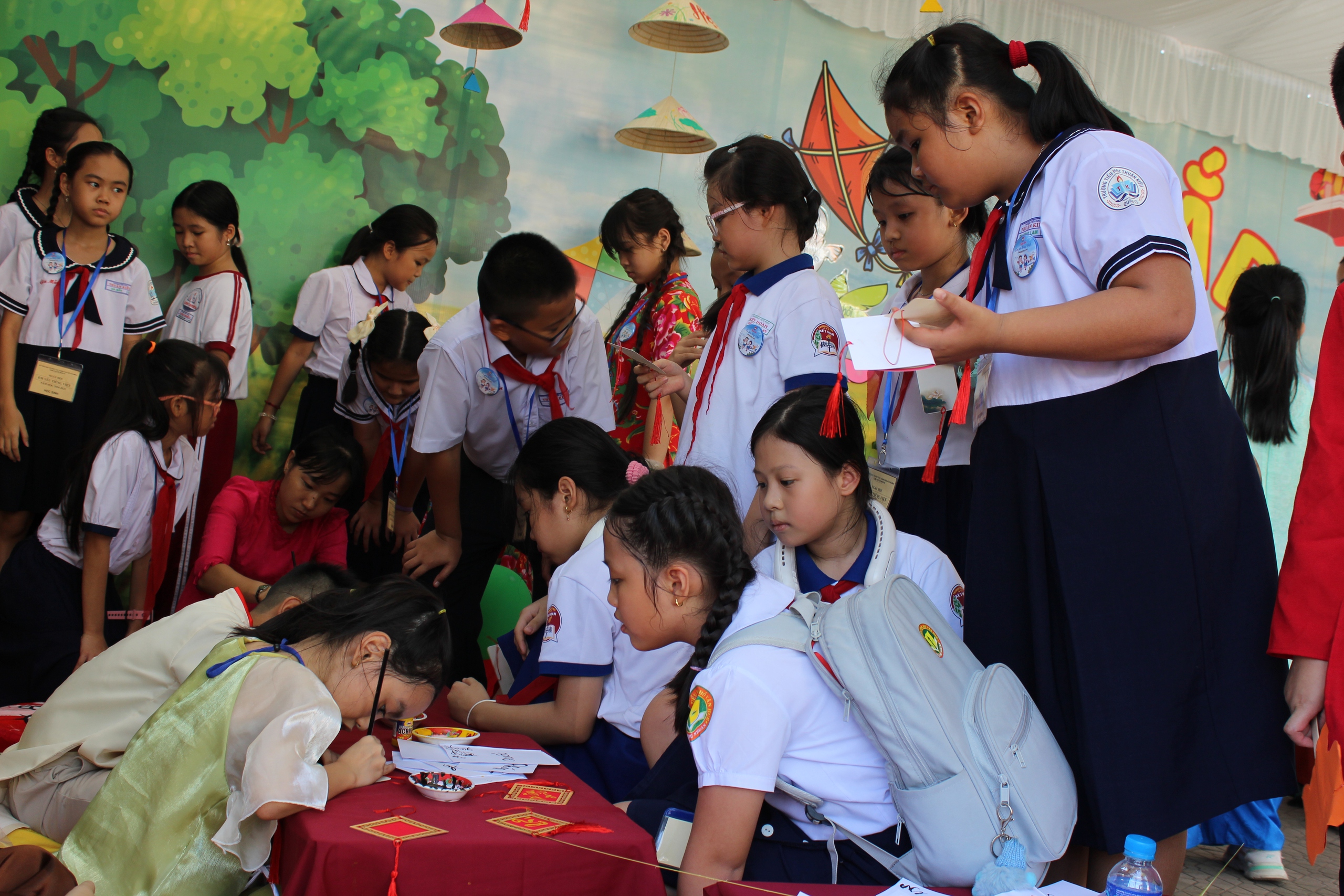
Elementary school students participate in an exchange event themed "I love the Vietnamese language".
"Vietnamese language and literature is a subject well-suited for integration, encompassing various objectives such as integrating environmental protection education, education on ideals, ethics, and lifestyles, and human rights education for students... However, teachers need to carefully select and incorporate these integrated contents into Vietnamese language lessons in primary school so that students are truly enthusiastic and ready to 'transform' them into life values for themselves," Dr. Nga shared.
THE VIETNAMESE LANGUAGE CANNOT BE TAKEN LIGHTLY
From the perspective of a professional and administrator, Ms. Lam Hong Lam Thuy, Head of the Primary Education Department of the Ho Chi Minh City Department of Education and Training, affirmed: "Vietnamese is the mother tongue; from the very beginning, children have been exposed to it, learning to read, listen, speak, and write. When entering school, some students learn multiple foreign languages, and their ability to communicate in Vietnamese is more limited than their peers. However, in this matter, it is necessary to recognize the responsibility of all parties: family, school, and society in maintaining and developing Vietnamese language proficiency for children. Regardless of what foreign language children use at school, at home, parents and grandparents need to communicate with their children in Vietnamese; we cannot lose Vietnamese even within the family. No matter how much integration and globalization there is, we cannot underestimate the importance of Vietnamese; because that would be contrary to our culture and the direction of primary education."
Loving the Vietnamese language starts with practicing handwriting.
On November 22nd, five years after the start of the 2018 General Education Program, the Ho Chi Minh City Department of Education and Training organized its first ever elementary school student exchange event with the theme "I Love the Vietnamese Language".
Ms. Lam Hong Lam Thuy, Head of the Primary Education Department of the Ho Chi Minh City Department of Education and Training, stated that preserving and loving the Vietnamese language can be demonstrated through the practice of handwriting. Currently, with the development of science and technology, many people underestimate the importance of handwriting. However, Ms. Thuy affirmed that practicing handwriting is essential for students, especially from primary school age, because "handwriting reflects character." Furthermore, learning Vietnamese is not only about practicing handwriting, writing essays, letters, and applications, learning neatness in structure, sentence construction, and presentation of documents, but also about developing reading, speaking, and listening skills in their mother tongue. All these skills are the foundation for learning other subjects and will be applied, creating an impact on students throughout their lives.
Source: https://thanhnien.vn/hoc-va-giu-tieng-viet-thoi-toan-cau-hoa-185241125210944239.htm

![[Image] Close-up view of the interchange connecting the two expressways and Long Thanh Airport.](https://vphoto.vietnam.vn/thumb/1200x675/vietnam/resource/IMAGE/2026/05/25/1779703378210_ndo_br_z7863716673926-224453a31600126cce10622af6290afd-4549-jpg.webp)



![[Image] Hanoi's urban life under the challenge of a "scorching hot" environment](https://vphoto.vietnam.vn/thumb/1200x675/vietnam/resource/IMAGE/2026/05/25/1779706979265_nang-nong-t5-2026-minh-duy-7-4636-jpg.webp)












































































Comment (0)