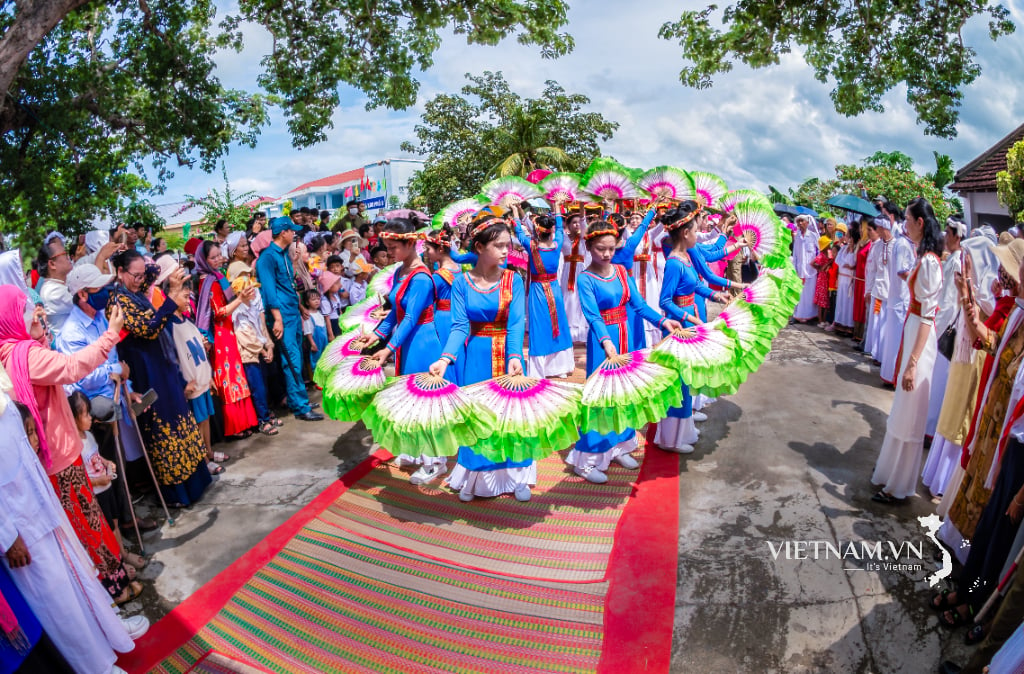
Recently, the preservation and promotion of the cultural beauty of ethnic groups has undergone an interesting transformation. No longer confined to traditional festivals, the traditional costumes of the Cham and Khmer people are stepping into everyday life, becoming a unique tourism product through costume rental services. This economic approach has become both a popular photography trend and the closest bridge connecting ethnic cultures to the hearts of tourists from all over the world.
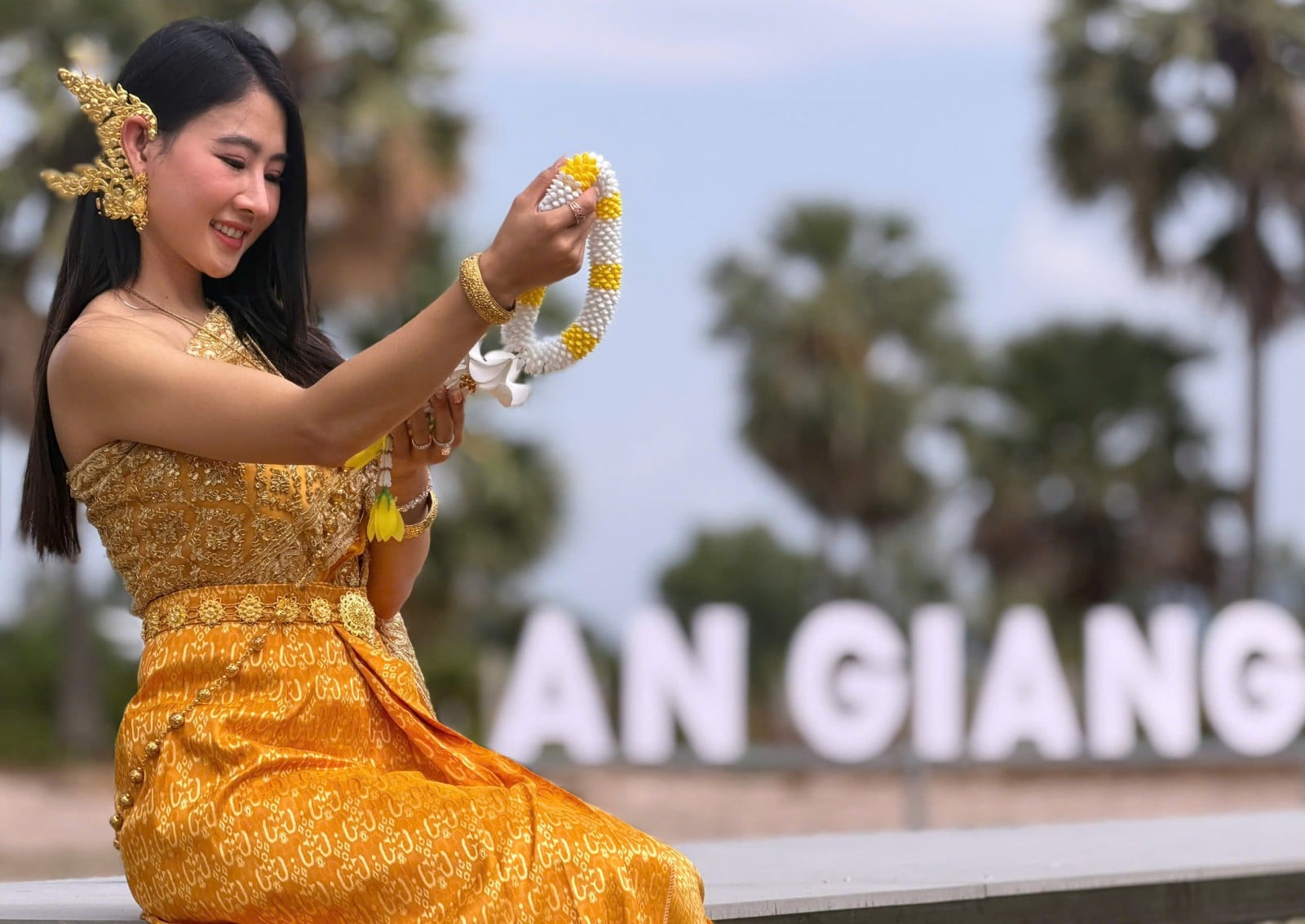
Female tourists enjoy immersing themselves in the atmosphere of the Bay Nui region while wearing Khmer traditional clothing. Photo: KHANH AN
For the Khmer and Cham people in An Giang, traditional clothing is a story of history, a source of pride passed down through generations. According to the 2024 study "Exploiting cultural values to serve the development of community tourism of the Khmer people in An Giang" by Dr. Vu Thi Uyen, the traditional clothing of Khmer men is called sampot. It is a wide piece of cloth, similar to a blanket, wrapped around the body from the hips down. The front part of the cloth is pulled through between the legs and around to the back, looking like a pair of large, baggy trousers that reach the knees.
Everyday women's clothing is made of silk, in vibrant colors, including skirts and blouses woven from silk or embroidered with various patterns using gold thread. The "áo tầm vông" (also called a round-neck blouse) is harmoniously combined with a sarong and sbay. The sarong is a piece of brocade fabric, about 1 meter wide and 3.5 meters long, worn by wrapping it around the lower half of the body. The sbay is a type of silk scarf wrapped diagonally from the left shoulder down the right side, enhancing the woman's gentle appearance. Beads, sequins, and other patterns are also added to the garments to make the colors even more dazzling.
According to researcher Vinh Thong, Cham men wear shirts and sarongs, and hats both inside and outside the house. According to Islamic law, women must cover their faces, hair, and both hands with a headscarf, leaving only their eyes exposed. However, the Cham people of Southern Vietnam have been flexible to make it easier for women to live, so they don't need to cover their faces completely, only their hair. At home, women usually use simple scarves with few colors and patterns. When attending parties, they often use more elaborately decorated scarves.


Previously, tourists visiting An Giang mainly focused on sightseeing and taking photos of the scenery. In recent years, however, the demand for immersive experiences and immersion in the local culture has increased. Recognizing this, many households and young people have opened services renting traditional costumes. For a relatively affordable price of 100,000-200,000 VND, tourists can wear a magnificent Khmer outfit or an authentic Cham ao dai. What's commendable is that most of the rental shop owners are locals. They not only rent out clothing but also act as "cultural ambassadors."
Meticulously guiding tourists on how to properly wrap a sampot, how to secure a sbay on a woman's shoulder, and what accessories to wear with it, Ms. Do Huynh Nhu (born in 1997) - representative of the Palm Forest Tourist Resort in An Cu commune - shared: "Tourists from all over come here, and everyone is excited to wear Khmer ethnic costumes and experience life in an area with densely growing palm trees, a characteristic of the Bay Nui region, where many Khmer people live."
The Khmer costumes that Ms. Nhu rents out are mostly traditional wedding attire, handcrafted with meticulous stitching and beadwork, and are quite expensive. After each rental, she puts a lot of effort into washing them clean. Even a slight mistake could ruin the costume, making it unusable again.
The development of costume rental services has had a positive impact on the preservation of traditional crafts. To provide tourists with beautiful, high-quality costumes, rental shops have sought out traditional brocade weavers in Chau Phong village or traditional tailors in the surrounding hamlets. “Thanks to this, the looms, which were previously quiet, are now bustling with the sound of shuttles. Young people in their late teens and early twenties, instead of leaving their hometowns to work in the city, can now stay, learn sewing, embroidery, hairstyling, makeup, and guide tourists,” said Mr. Mohamad, owner of the Phum Soai Cham traditional brocade weaving facility in Chau Phong commune.
Photos of tourists checking in at Mubarak Mosque, Neang Non Pagoda, or amidst the vibrant heart-shaped palm trees have been widely shared on social media. These personal experiences have created a natural and highly effective wave of tourism promotion for the province. Ms. Nguyen Thi Kim Thao, a resident of Long Xuyen ward, enthusiastically shared: “I’m quite self-conscious about my figure, but when I put on the Khmer traditional clothing and touched each stitch, I understood more about the meticulousness and aesthetic sense of the people here. After the trip, I have many beautiful photos and incredibly interesting memories.”
However, wearing traditional ethnic minority costumes for photos should go hand in hand with respect for the culture. When wearing the traditional attire of an ethnic group, tourists should pay attention to their gestures and actions, avoiding excessive poses that are inappropriate and contrary to local customs, especially when taking photos in sacred spaces such as temples and mosques. Local authorities and relevant agencies need to provide guidance and support to the people in terms of cultural knowledge to avoid excessive "commercialization," leading to the arbitrarily distorting and altering of traditional costumes.


KHANH AN
Source: https://baoangiang.com.vn/hon-dan-toc-trong-sac-ao-a485937.html


![[Photo] General Secretary and President To Lam working with the Technical and Professional Center, Ministry of Public Security](https://vphoto.vietnam.vn/thumb/1200x675/vietnam/resource/IMAGE/2026/07/06/1783318005842_a1-bnd-1129-2263-jpg.webp)