

"In the past, the fees collected from the people were very high, but they mainly served to support the fee collectors; the state budget didn't get anything in return..." This was a statement made by General Secretary To Lam not long ago, when speaking about the management of parking on sidewalks and roads.
And it's true that the state budget isn't getting any revenue, and is even incurring losses, when it comes to the issue of parking fees in Ho Chi Minh City, specifically regarding the operations of the Youth Volunteer Public Service Company Limited.
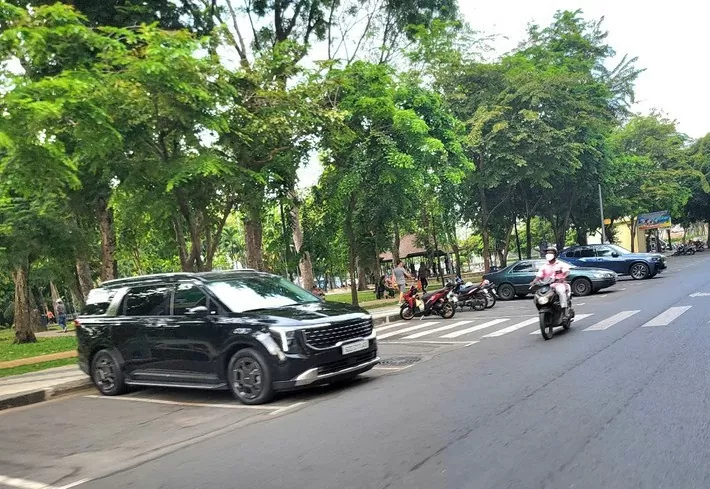 |
| The road is already in place, just marked lines, and tolls are collected upon entry, yet after 4 years, it reports losses of 2.2 billion VND. This seemingly absurd economic paradox is unfolding in Ho Chi Minh City. (Illustrative image) |
The Youth Volunteer Public Service Company Limited, a state-owned enterprise, is tasked with organizing paid parking services on over 20 streets in Ho Chi Minh City.
From December 2020 to October 2024, the company had total revenue of over 22 billion VND, but labor costs, software rental fees, etc., totaled approximately 24.32 billion VND, exceeding revenue by 2.2 billion VND.
To put it simply, after four years of only having the task of marking parking lines and collecting parking fees on 20 roads, the Youth Volunteer Public Service Company Limited incurred a loss of 2.2 billion VND.
Explaining the economic paradox of "it's so difficult, yet it can be done!", the Ho Chi Minh City Department of Transport and Public Works cited data from four years, along with positive signs: during this period, fees collected increased while expenses gradually decreased over time. However, overall, the expenses for this work still exceed the revenue by 2.2 billion VND.
"From December 2, 2020 to June 30, 2022, revenue exceeded 4.3 billion VND, expenditure exceeded 8.6 billion VND (expenditure exceeded revenue by 4.3 billion VND); from July 1, 2022 to June 6, 2023, revenue exceeded 5.9 billion VND, expenditure exceeded 6.6 billion VND (expenditure exceeded revenue by 0.7 billion VND); from July 1, 2023 to March 31, 2024, revenue exceeded 6.7 billion VND, expenditure exceeded 5.2 billion VND (expenditure was 1.5 billion VND lower than revenue); from April 1, 2024 to October 30, 2024, revenue exceeded 5 billion VND, expenditure exceeded 3.7 billion VND (expenditure was 1.3 billion VND lower than revenue)," according to data from the Ho Chi Minh City Department of Transport and Public Works.
Looking at these figures, it seems the situation has improved somewhat, but considering the entire process, total revenue still hasn't covered total expenditure.
Notably, the Ho Chi Minh City transportation department previously calculated that these parking spaces would generate approximately 6.7 billion VND per month. Mechanically speaking, this could generate around 80 billion VND per year, or approximately 320 billion VND after four years.
There is a significant discrepancy between actual revenue and calculated figures, approximately 298 billion VND. So, where did this 298 billion VND go?
The answer is: Either the transportation sector is "counting its chickens before they hatch," making miscalculations; or there is weakness in management, leading to revenue flowing to places that do not belong in the budget; or the answer is both.
Whatever the answer, the undeniable truth is: This is a failure not only in sidewalk management but also in the way the business is run.
This issue cannot simply be resolved with "lessons learned" or "rectification." A thorough investigation is needed to clarify every penny lost and assign specific responsibility.
If there are signs of embezzlement or corruption, not only administrative penalties but also criminal prosecution must be pursued. Public funds cannot be siphoned off without anyone being held accountable.
Where else in the world would you have to incur such a huge financial loss just to collect money?
Source: https://congthuong.vn/ke-vach-thu-tien-bao-lo-kho-the-cung-lam-duoc-380475.html
![[Photo] Secretary of the National Assembly Party Committee, Chairman of the National Assembly presides over the meeting of the Standing Committee and Executive Committee of the National Assembly Party Committee.](https://vphoto.vietnam.vn/thumb/1200x675/vietnam/resource/IMAGE/2026/06/03/1780480353201_ndo_br_bnd-2585-jpg.webp)




![[Photo] General Secretary and President To Lam presides over a meeting with the Central Organizing Committee.](https://vphoto.vietnam.vn/thumb/1200x675/vietnam/resource/IMAGE/2026/06/03/1780482764658_a1-bnd-4741-3342-jpg.webp)
























![[Photo] General Secretary and President To Lam attends the 14th Congress of the Vietnam Trade Union](https://vphoto.vietnam.vn/thumb/1200x675/vietnam/resource/IMAGE/2026/06/04/1780543339765_anh-man-hinh-2026-06-04-luc-10-22-07.png)



























![[Video] Sunset at Lap An Lagoon – Where the sun sets over the fishing nets](https://vphoto.vietnam.vn/thumb/1200x675/vietnam/resource/IMAGE/2026/05/31/1780192137701_beach-landscape-sea-water-nature-grass-745871-pxhere-com.jpeg)






































Comment (0)