

Having received formal training at the Moscow Architectural University (Russia), held many important professional positions, and spent over two decades heading the Central Center for Design and Restoration of Monuments (now the Institute of Conservation of Monuments), author Hoang Dao Kinh has contributed a wealth of profound experience to this book. The highlight of the book is the author's perspective on preservation as a way of engaging with national memory and identity. The author emphasizes that heritage is constantly changing over time, and the way people preserve it also evolves according to the mindset of each era.
In the writings of author Hoang Dao Kinh, under scientific assessments, relics and heritage sites are always accurately identified using specialized terminology. For example, when writing about Hoi An, the author asserts: "For Hoi An, 'urban resources' is more appropriate, because what belongs to the heritage has a large proportion in terms of space and physical scale, and should be recognized as a key factor for development. However, this resource must be exploited quite differently from other resources." This precise naming demonstrates the sophistication of a leading architect's thinking and suggests new approaches to the conservation of historical urban areas.
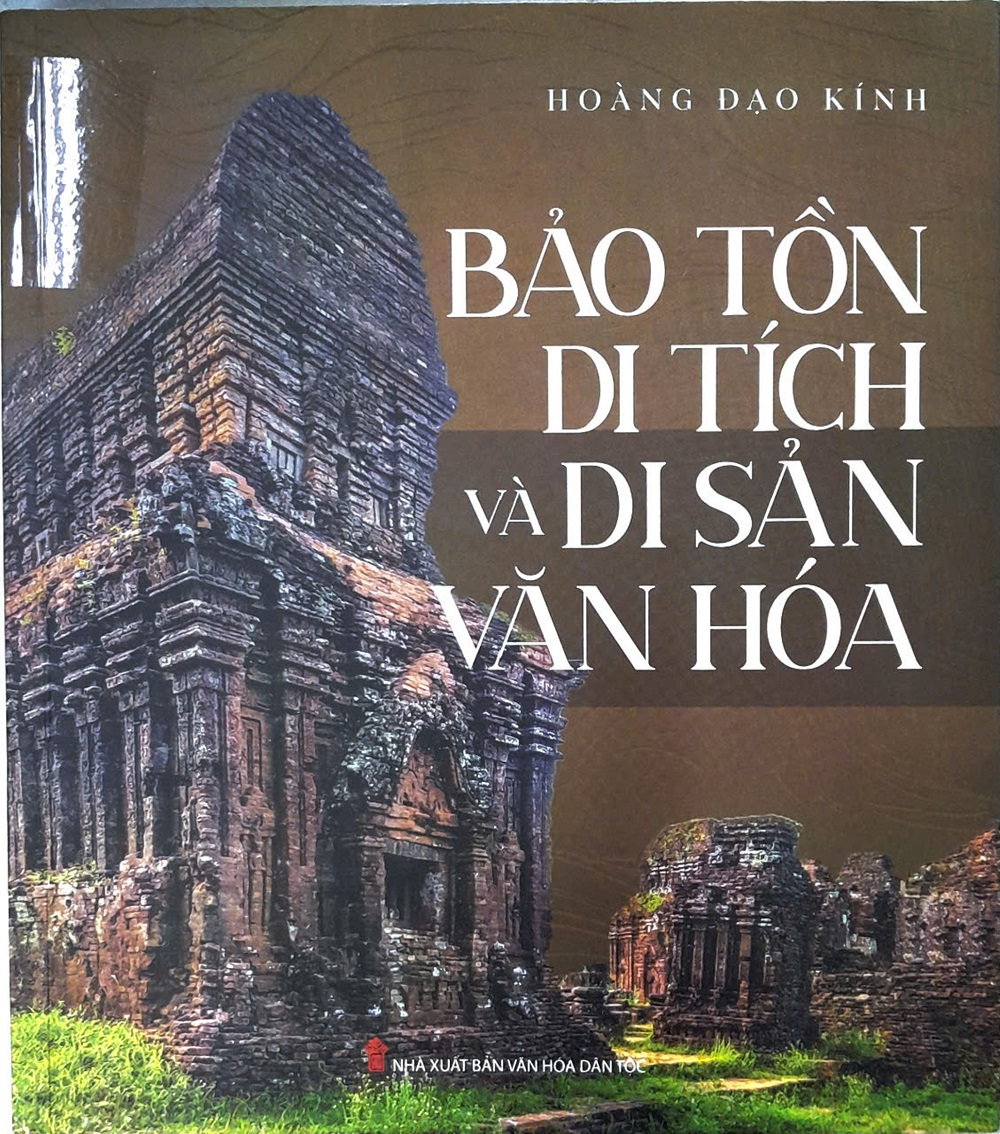 |
| The book cover. |
Beyond his solid academic foundation, when expressing his thoughts from the heart, the historical sites in Hoang Dao Kinh's writings appear as living beings amidst humanity. Ancient towers emerge as witnesses to time; urban and rural spaces are called "vibrant symbiotic organisms"; city structures take on the form of "urban bodies," possessing "unique faces," and exhibiting "organic unity, unity in diversity." Because he views heritage as "beings with souls," he always keeps in mind that "when dealing with historical sites, one should be cautious and considerate," because before intervening, one must "know how to behave"; and when "treatment" is necessary, "please choose a trustworthy doctor."
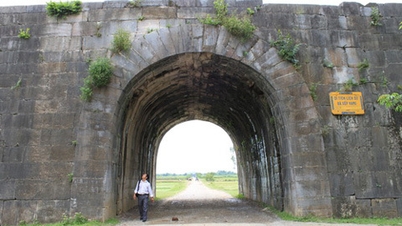
Just by reading the titles of the articles, readers can somewhat sense the concerns the authors are conveying: "Attempting to determine appropriate steps for the preservation and promotion of the value of the Thang Long Imperial Citadel - Hanoi ", "Preventing the further loss, rejuvenation, and devaluation of Hue's tangible cultural heritage", "How to deal with the Dong Duong Buddhist Monastery relic"... Each title is a big question, a warning against the dangers that could damage or diminish the identity of heritage.
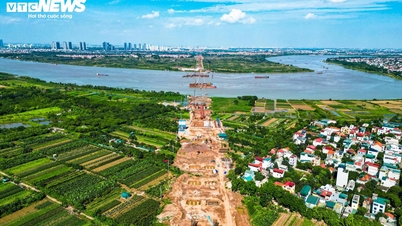
The book also broadens the perspective to include heritage sites familiar to the community and deeply connected to the shared memories of many generations: from Long Bien Bridge, Lam Kinh historical site, Cat Tien to Pac Bo... Each heritage site presents a unique challenge, requiring careful consideration of its historical space, cultural landscape, and the relationship between past and present. Significantly, the author never offers a fixed formula for every case. He chooses an approach based on the "character" of each site, thereby finding the most appropriate and humane solution.
The book "Preservation of Historical Sites and Cultural Heritage" by author Hoang Dao Kinh summarizes a lifetime of dedication, concern, and wholehearted commitment to the country's historical sites and heritage. The book is not only essential for managers and professionals in the field but also useful for anyone interested in national culture, helping people to further appreciate, cherish, and value the historical legacy passed down to present-day generations.
Source: https://www.qdnd.vn/van-hoa/sach/ket-noi-van-hoa-doc-them-yeu-di-san-dan-toc-tu-mot-cuon-sach-1042331
![[Photo] First session of the 14th Congress of the Vietnam Trade Union](https://vphoto.vietnam.vn/thumb/1200x675/vietnam/resource/IMAGE/2026/06/03/1780465947883_ndo_br_img-3852-jpg.webp)
















































![[Video] Sunset at Lap An Lagoon – Where the sun sets over the fishing nets](https://vphoto.vietnam.vn/thumb/1200x675/vietnam/resource/IMAGE/2026/05/31/1780192137701_beach-landscape-sea-water-nature-grass-745871-pxhere-com.jpeg)































Comment (0)