

 |
Chinese tourists wearing kimonos visit Sensoji Temple in Asakusa Ward, Tokyo, Japan, in November 2025. Photo: The Japan Times . |
According to the Japan National Tourism Organization (JNTO), Japan welcomed approximately 3.69 million international visitors in April, a 5.5% decrease compared to the same period last year, but still the highest monthly figure this year. For the first four months of the year, the country recorded around 14.37 million international visitors, surpassing the 14 million mark for the second consecutive year.
Demand for travel to Japan surges during cherry blossom season, particularly in East Asian and Southeast Asian markets. Vietnam is among the top nine markets with the highest number of visitors to Japan ever recorded in April alone.
| TOP 10 INTERNATIONAL MARKETS SENDING TOURISTS TO JAPAN IN APRIL 2026 | |||||||||||
| Source: Japan National Tourism Organization (JNTO) | |||||||||||
| Label | Korea | Taiwan (China) | Mainland China | America | Hong Kong (China) | Thailand | Australia | Philippines | Vietnam | Canada | |
| Number of visitors | Thousand views | 878.6 | 643.5 | 330.7 | 330 | 226 | 164.8 | 102.5 | 88.4 | 76 | 70.3 |
Specifically, the number of Vietnamese visitors to Japan reached approximately 76,000 in April, an increase of 18.6% compared to the same period last year. In the first four months of the year, the total number of Vietnamese visitors reached approximately 282,000, an increase of 11.7%.
According to JNTO, demand for travel to Japan from Vietnam continues to remain positive thanks to holidays and the opening of new flight routes between Hanoi and Shizuoka. However, the agency also noted that the Vietnamese market has a large proportion of students, technical trainees, and long-term workers.
While the number of Vietnamese, South Korean, and Taiwanese (China) tourists increased significantly, the number of mainland Chinese tourists to Japan plummeted. In April, Japan received only about 330,700 Chinese tourists, a decrease of 56.8% compared to the same period last year. The total number of Chinese tourists in the first four months of the year reached approximately 1.4 million, a decrease of more than 55%. The Japan National Tourism Organization (JNTO) stated that the reasons stemmed from the cooling demand for tourism in Japan, flight reductions, and travel restrictions issued by China.
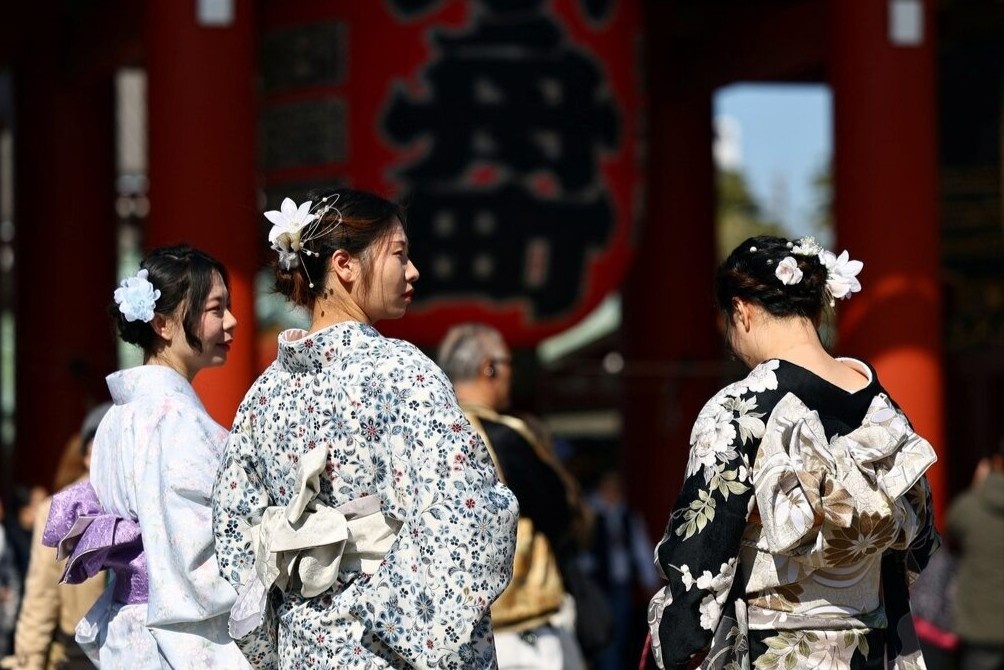 |
Tourists wearing traditional Japanese kimonos stroll near Sensoji Temple in Asakusa district, a popular tourist spot in Tokyo, Japan, in 2025. Photo: Reuters. |
South Korea continues to be Japan's largest international visitor market with nearly 879,000 arrivals in April, setting a new record for the month. Taiwan (China) ranked second with approximately 643,500 arrivals. The United States recorded around 330,000 visitors, its highest ever for the month of April.
Some European markets, such as France and Russia, also recorded record high visitor numbers for April, while the UK, Germany, Italy, and Spain all saw declines due to this year's Easter holiday falling at a different time than last year.
According to JNTO, the weak yen continues to be a driving factor for Japanese tourism in many international markets. However, in Europe, flight schedule changes due to conflict, resulting in longer flight times, remain a factor affecting travel demand.
In addition, the Japan National Tax Service announced that, effective July 1st, the international travel tax applied to passengers departing Japan will be increased to 3,000 yen (approximately 497,000 VND) per person per departure. Passengers using tickets issued before or on June 30th will still be subject to the old tax rate of 1,000 yen, and children under 2 years old are exempt from the tax.
This tax is levied on passengers departing by air and sea. Typically, carriers will add the fee directly to the ticket price and remit it to the Japanese government .
The Japanese government stated that revenue from the international tourism tax will be used for three main objectives: creating a more convenient and comfortable travel environment for tourists; enhancing access to information about unique Japanese destinations; and developing tourism resources based on indigenous cultural and natural values.
Source: https://znews.vn/khach-viet-di-nhat-ban-tiep-tuc-tang-post1654032.html
![[Photo] The courage of new recruits of Brigade 144 on the training ground.](https://vphoto.vietnam.vn/thumb/1200x675/vietnam/resource/IMAGE/2026/05/27/1779881651341_anh-man-hinh-2026-05-27-luc-18-32-52.png)


![[Photo] The heat at the fireworks display site on the opening night of the Da Nang International Fireworks Festival 2026](https://vphoto.vietnam.vn/thumb/1200x675/vietnam/resource/IMAGE/2026/05/27/1779889741485_ndo_br_z7872039145157-fecaba5112f39e8352544099d7ef4738-5140-jpg.webp)


























































![[Photo] The courage of new recruits of Brigade 144 on the training ground.](https://vphoto.vietnam.vn/thumb/402x226/vietnam/resource/IMAGE/2026/05/27/1779881651341_anh-man-hinh-2026-05-27-luc-18-32-52.png)



































Comment (0)