

In the spring of 1653, obeying the orders of Lord Nguyen, Commander Hung Loc took over the land from south of Ca Pass to north of Phan Rang River, establishing Thai Khang garrison (present-day Khanh Hoa province). Looking back at the 370-year process of building and developing Khanh Hoa province within the continuous flow of national history, we can feel even more proud of the glorious past of our ancestors.
Writing a golden chapter in history.
The history of a region is inseparable from the history of its nation and people. The same is true for Khanh Hoa. For the past 370 years, the ethnic groups living in Khanh Hoa province have always united their strength and hearts to overcome hardships in the struggles against feudal corruption and the resistance against colonialism and imperialism. Ancient historical records show that during the period 1775-1795, many young men from various ethnic groups in Binh Khang district (Khanh Hoa) stood under the banner of the national hero Quang Trung Nguyen Hue, fighting against the corrupt Nguyen lords' regime in Dang Trong.
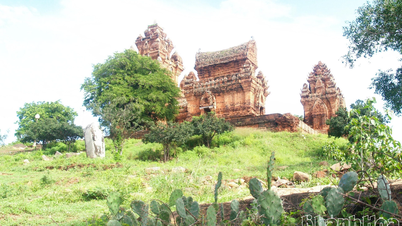
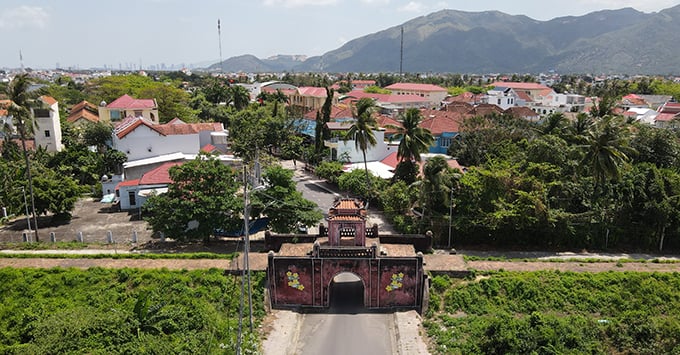 Dien Khanh ancient citadel. Photo: MA PHUONG |
Subsequently, in 1885-1886, responding to King Ham Nghi's call for resistance against the French, under the leadership of General Trinh Phong, the people of Khanh Hoa bravely fought against the French colonial invaders. Although the resistance failed, the example of the "Three Heroes of Khanh Hoa, Three Heroes of Quang Phuoc" remains deeply etched in the memory of the people of this land of agarwood. Time has changed, the landscape has transformed, but the names of the land and the people remain. Every time I travel from Nha Trang to Dien Khanh citadel, looking at the solemn, moss-covered appearance of the ancient citadel, my heart is filled with emotion, echoing the neighing of horses and the shouts of soldiers from the Tay Son dynasty hundreds of years ago; I see the figures of Trinh Phong and Le Nghi rallying the troops to resist the French invaders in the Can Vuong war, a battle that will be remembered for eternity.
Continuing the glorious patriotic tradition of previous generations, on July 16, 1930, more than 1,000 people from Ninh Hoa district, under the leadership of the Party, staged a demonstration in support of the Nghe Tinh Soviet movement, seizing the district headquarters and striking fear into the hearts of the colonial and feudal officials. This event is a bright milestone in the golden history of the land of agarwood and swallows' nests, and July 16 has become the traditional revolutionary struggle day of the Party Committee and people of Khanh Hoa province. During the August Revolution of 1945, the provincial Party Committee led the people to seize the opportunity and quickly gain power in Van Ninh and Ninh Hoa districts. Then, on the afternoon of August 19, 1945, at Nha Trang Stadium, the revolutionary masses overthrew the puppet government, declaring the establishment of a revolutionary government in Khanh Hoa, at the same time as in the capital Hanoi .
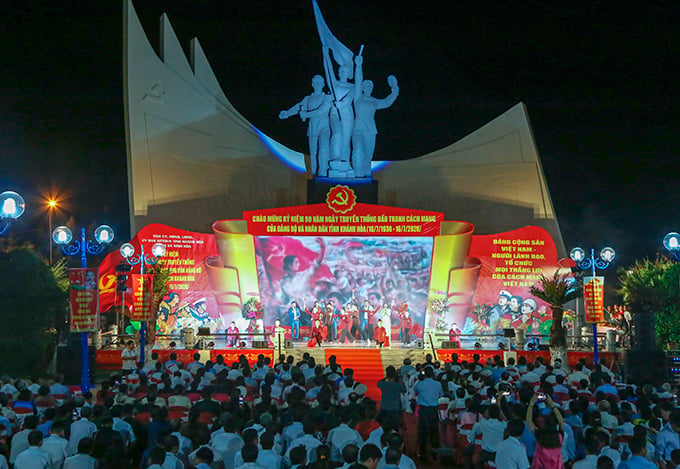 Commemorating the Traditional Day of Revolutionary Struggle of the Party Committee and People of Khanh Hoa Province at the July 16th monument (Ninh Hoa town). |
Before the joy of being citizens of an independent country had even subsided, the French invaders returned to occupy our country. In that difficult time, the courage and will of the people of Khanh Hoa, as well as the entire Vietnamese nation, "spoke out." To halt the enemy's advance northward, on October 23, 1945, our troops opened fire on key enemy positions in Nha Trang, officially beginning the resistance war to defend the fledgling independence of the Democratic Republic of Vietnam. The army and people of Khanh Hoa, with the support of the Southern advance troops, fought tenaciously for 101 days and nights, besieging the French forces at the Nha Trang - Khanh Hoa front. President Ho Chi Minh sent a telegram praising them, saying they "set a heroic example for the whole nation." Throughout two consecutive wars of resistance for national independence and reunification (1946-1975), the Party Committee and people of Khanh Hoa united as one, creating a combined strength, and together with the people of the whole country, continued to write glorious and heroic chapters of history, first fighting the French, then expelling the Americans. On April 2, 1975, Khanh Hoa province was liberated, and from the coastal city, the liberation army marched towards Saigon, leading to the historic victory on April 30, 1975.
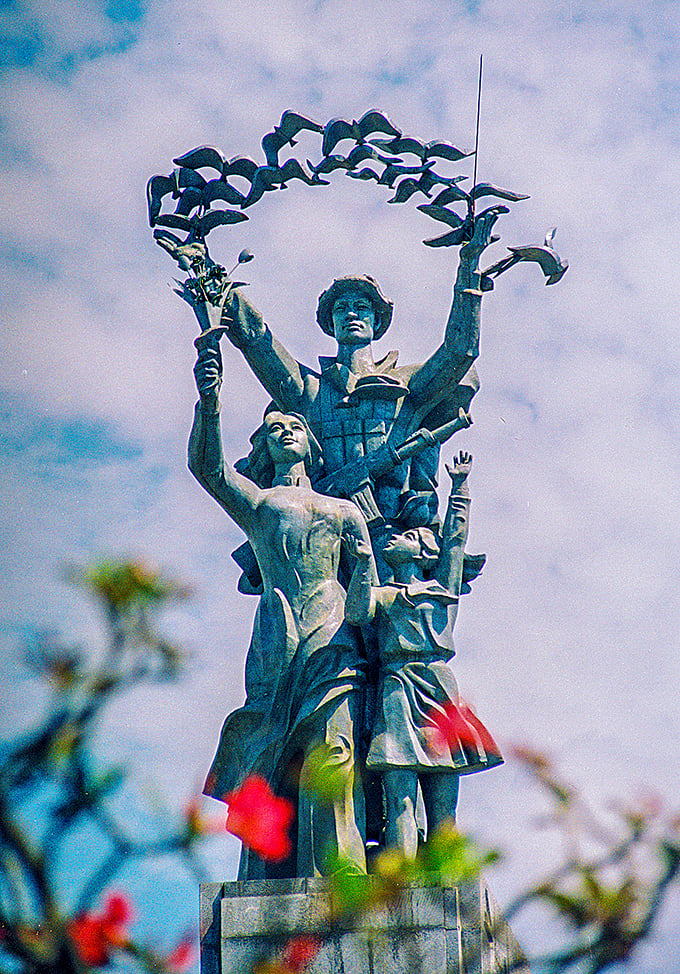 The 2-4 Victory Monument in Nha Trang City. |
Maximizing potential and strengths
Over the past 48 years, since the reunification of the country, the Party Committee and people of Khanh Hoa have overcome all difficulties and challenges, developing the potential and strengths of the locality in the fields of economic development, industry, tourism, services, etc., achieving important and comprehensive socio-economic achievements. In particular, in 2022, despite being heavily affected by the Covid-19 pandemic, domestic difficulties, and the complex developments in the world situation, the province's socio-economic development continued to recover and grow with an estimated GRDP of VND 54,505.2 billion; state budget revenue reached VND 16,418 billion, exceeding the forecast by 36.6%; 20 out of 22 important socio-economic indicators met or exceeded the set plan; social welfare was prioritized, and political security and social order and safety were ensured.
 |
“Turning the pages of the past, searching for old traces, we are grateful to those who opened up the southern lands…” (lyrics from a song by musician Hinh Phuoc Long). The 370th anniversary of the founding and development of Khanh Hoa province is an opportunity for every citizen of this land of agarwood to reflect on the glorious past, remember the contributions of previous generations, and thereby rekindle the aspiration to build an increasingly prosperous and beautiful homeland, first and foremost to achieve the goal of making Khanh Hoa province a centrally-governed city by 2030.
According to the book Dai Nam Nhat Thong Chi, in 1653, the Cham king Ba Tam sent troops to harass the border, killing people in Phu Yen. Lord Nguyen Phuc Tan sent Cai Co Hung Loc to defend the area. Under cover of darkness, they crossed Thach Bi mountain, set fire to the citadel, and advanced to the Phan Rang River. The Cham king sent his son with a letter of surrender and offered to cede land to the lord from the east of the Phan Rang River to Phu Yen. The lord agreed, established the Thai Khang garrison, divided it into two prefectures, Thai Khang and Dien Ninh, and entrusted Hung Loc with its defense.
XUAN THANH
Source































































Comment (0)