

The Islamic Republic of Iran announced that its forces fired on three ships leaving port on April 22 and seized two, describing this as retaliation for the US blockade of Iranian ports and Washington's continued seizure of a ship linked to Iran despite being ordered to do so, according to AP.
Attacks on ships resumed after a period of calm.
Iranian semi-official news agencies reported that the Islamic Revolutionary Guard Corps (IRGC) attacked a third ship in the Strait of Hormuz on April 22.
Nour News, Fars, and Mehr all reported on the IRGC attack on the ship named Euphoria. They stated that the ship was "stranded" off the Iranian coast, but provided no further details. Iranian state television reported that the IRGC had seized two other ships, the Liberian-flagged Epaminondas and the Panamanian-flagged MSC Francesca, both container ships.
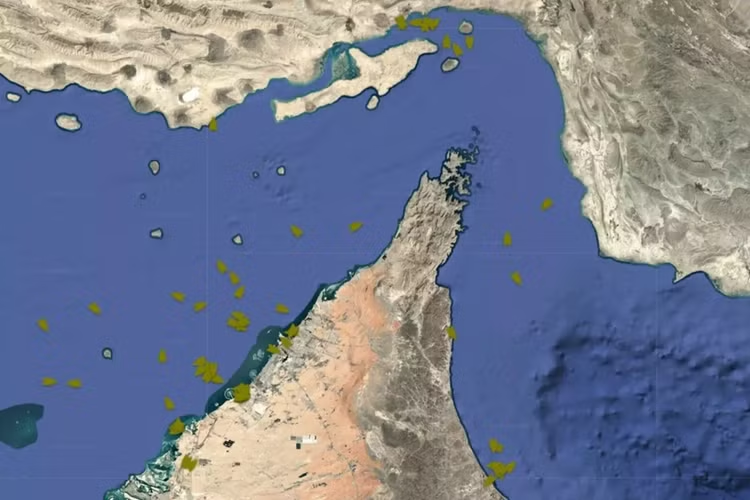
The incident followed two attacks on ships on April 19, ending a period of "calm" that began in mid-March 2026 when Iran established control over the Strait of Hormuz. Iran has demanded that ships provide details about their cargo, ownership, and crew, and in some cases, imposed a $1 per barrel tariff on oil and petroleum products – or $2 million for a large oil tanker.
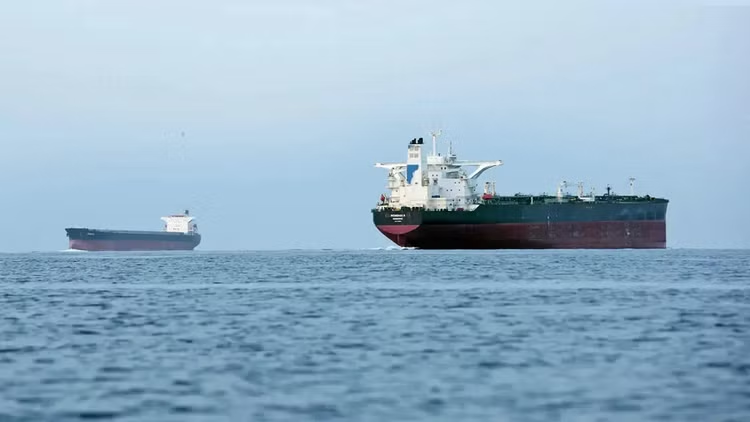
The attacks followed a sudden shift in Iran's stance over the weekend. Iranian Foreign Minister Abbas Araghchi declared on April 17 that the strait was open to ships, but the IRGC reversed its decision the following day. Six cruise ships stranded in the Persian Gulf since late February took advantage of this brief period and passed through the strait. But since then, traffic through the strait has plummeted.
According to Torbjorn Soltvedt, principal Middle East analyst at risk intelligence firm Verisk Maplecroft, maintaining a high premium through sporadic attacks benefits Iran.
"Their main leverage in negotiations with the US is the ability to restrict maritime shipping through the Strait of Hormuz, and insurance is a crucial part of that," commented expert Soltvedt.
Some ships have passed Iran's inspection system, but hundreds of vessels and thousands of crew members remain stranded.
Did the Iranian oil tanker break through the US blockade?
The U.S. Navy boarded and seized an Iranian oil tanker south of the Bay of Bengal in the Indian Ocean, about 2,000 miles from the Strait of Hormuz. This underscores the U.S. power to seize vessels violating the blockade even after they have left the area near the Strait of Hormuz.
However, maritime intelligence firms say some Iranian oil tankers have breached the blockade. According to Lloyd's List Intelligence, a "steady undersea traffic flow" has been moving in and out of the Gulf, including 11 Iranian oil tankers that have left the Gulf outside the strait since April 13.
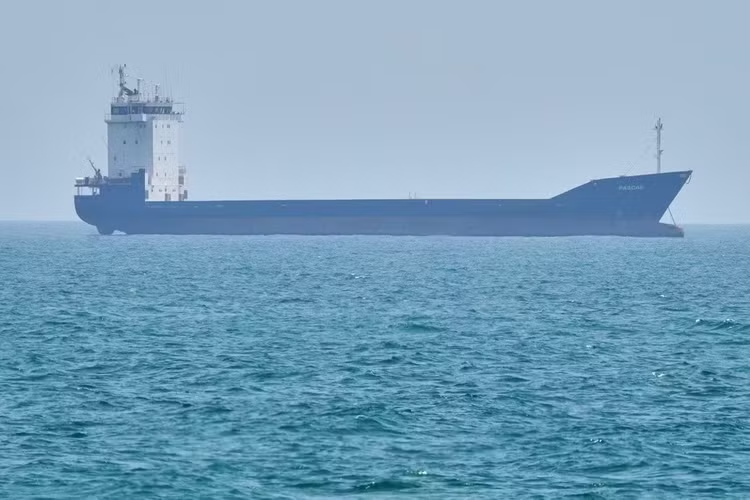
"The U.S. faces a dilemma: the tighter the blockade, the more damage it will inflict on the global oil market, so there are conflicting priorities here, and it seems their policy is not to intercept all Iranian oil shipments," Soltvedt commented.
Captain Tim Hawkins, spokesman for the U.S. Central Command, confirmed on April 22 that the military blockade targets all ships entering and leaving Iranian ports. However, he said that humanitarian shipments, including food, medical supplies, and other essential goods for civilians, are still permitted to pass through, subject to inspection.
Captain Hawkins also dismissed outside reports of some vessels having slipped through the American cordon.
When will the Strait of Hormuz be reopened?
According to AP, data and analytics firm Rystad Energy said that even if the US-Iran conflict ends, restructuring the global oil tanker network alone will take six to eight weeks. Shipowners and insurance companies will need two to five weeks to adjust to the new operating environment and return to normal operations.
"The shipowners will want something more concrete than what we have now. What is needed is something more comprehensive than an informal ceasefire agreement when the two sides are so far apart on key issues such as Iran's nuclear and ballistic missile programs," Soltvedt said.
"Even so, shipping companies will still face a long-term threat from Iranian missiles and drones. They could use this tactic again in the future," the expert noted.
>>> Readers are invited to watch more videos about the Strait of Hormuz.
Source: https://khoahocdoisong.vn/khi-nao-eo-bien-hormuz-duoc-mo-lai-post2149097877.html

![[Image] Hanoi's urban life under the challenge of a "scorching hot" environment](https://vphoto.vietnam.vn/thumb/1200x675/vietnam/resource/IMAGE/2026/05/25/1779706979265_nang-nong-t5-2026-minh-duy-7-4636-jpg.webp)


![[Image] Close-up view of the interchange connecting the two expressways and Long Thanh Airport.](https://vphoto.vietnam.vn/thumb/1200x675/vietnam/resource/IMAGE/2026/05/25/1779703378210_ndo_br_z7863716673926-224453a31600126cce10622af6290afd-4549-jpg.webp)
![[GALLERY] How it works reveals why operating Patriot is extremely expensive.](https://vphoto.vietnam.vn/thumb/402x226/vietnam/resource/IMAGE/2026/05/25/1779713284469_61-patriot-missile-system-how-it-works-air-defence-missiles-5.gif)


![[GALLERY] Shocking: Vietnamese youth spend 7 hours online every day](https://vphoto.vietnam.vn/thumb/402x226/vietnam/resource/IMAGE/2026/05/25/1779712983331_dien-1-png.webp)













































































Comment (0)