

From the "problem" of water hyacinths on the river
The problem of water hyacinth obstructing water flow is a common issue in many riverside areas. Canals and rivers covered in water hyacinth not only affect the aesthetics and environment but also hinder waterway transportation. This makes transporting goods and agricultural products more expensive, directly impacting the profits of local people.
Born and raised in the Dong Thap Muoi region, witnessing the difficulties caused by water hyacinth, Mr. Ngo Nguyen Hong - Director of Nguyen Hong Barge Construction Company Limited, My Thanh commune, Tay Ninh province - dedicated much time to researching and manufacturing a water hyacinth rolling machine. With his experience in the mechanical field, he wanted to create a device that could more effectively process water hyacinth, reduce costs, and utilize this resource for production. The idea of water hyacinth collection devices had existed before.
However, the unique feature of the machine invented by Mr. Hong lies in the fact that after being removed from the water, the water hyacinths are rolled into bundles. This makes transportation more convenient, significantly reduces labor costs, and facilitates the reuse of the water hyacinths. According to Mr. Hong, the device can handle both floating and stationary water hyacinths and operates in many small, shallow rivers or narrow areas. In particular, the rolled water hyacinths can be used by gardeners to cover tree roots, retain moisture, and mitigate the effects of heat and saltwater intrusion.
"Currently, many orchards in the Central Highlands need to buy water hyacinth to cover the base of durian and jackfruit trees. When tightly rolled, transportation is much easier and more efficient," Mr. Hong shared.
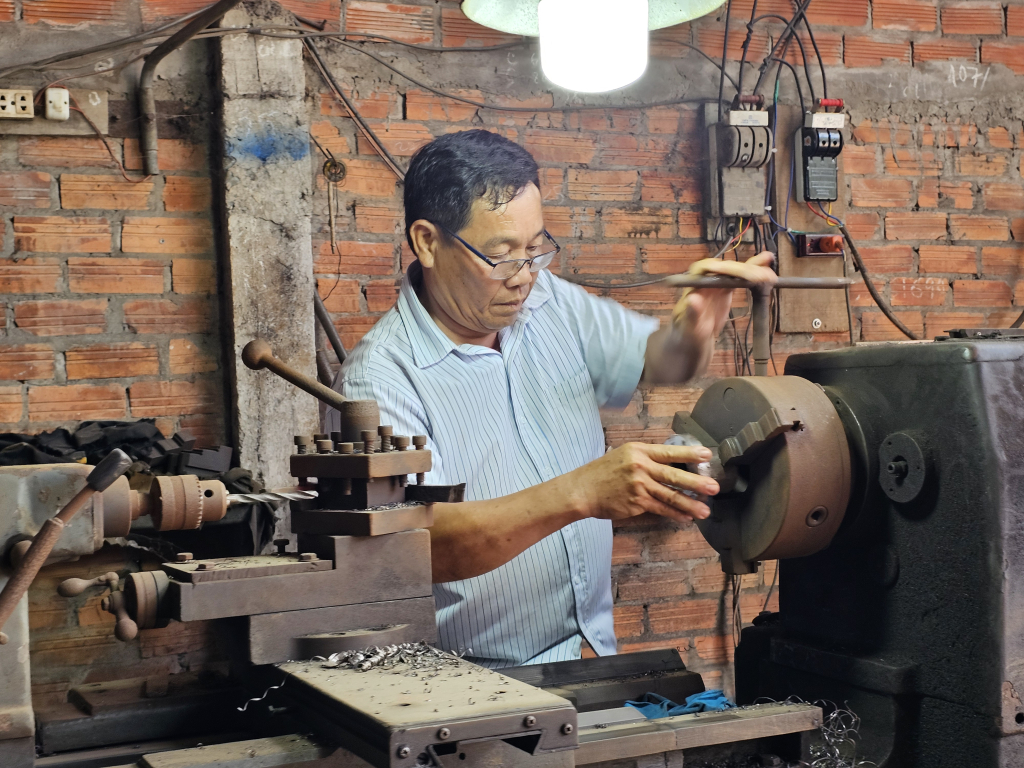
After winning an award at the Science and Technology Innovation Competition, his product was further refined with the support of technical consultants. Based on practical experience, Hong and his colleagues continued to research a water hyacinth removal machine to handle dense patches of water hyacinth, helping the winding machine operate more efficiently. Not stopping there, the research team also aimed to apply digital transformation in the management and operation of the equipment.
According to consultants, using a system for observing, warning, and coordinating treatment equipment to the correct location will help save costs, improve management efficiency, and monitor the water hyacinth treatment process in practice.
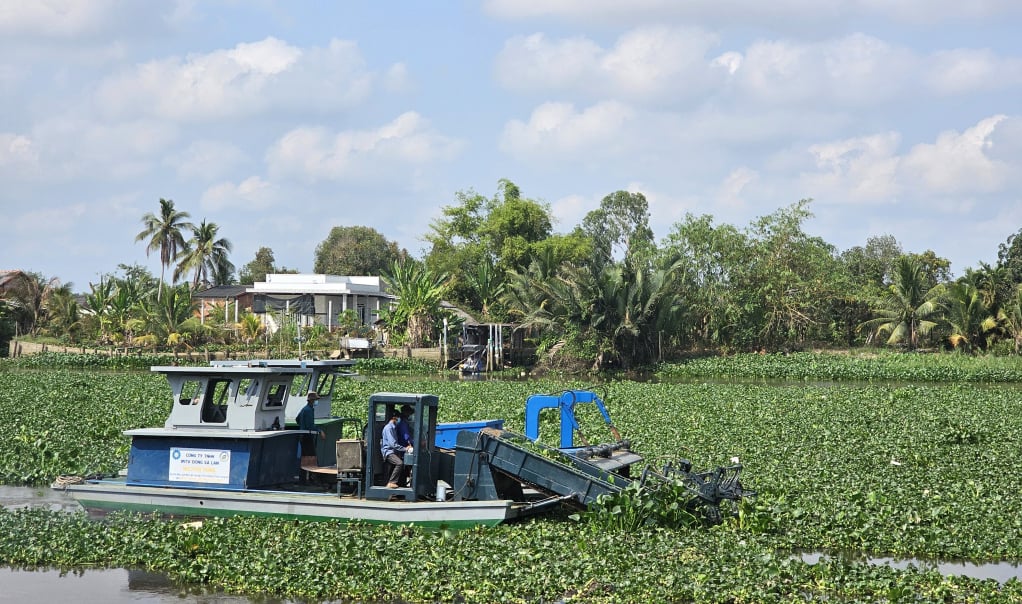
Water hyacinth is a familiar plant in the Mekong Delta. Although its dense growth can hinder waterway traffic, it actually offers many benefits such as natural water filtration, animal feed, tree mulch, or composting to improve soil quality. Collecting and rolling water hyacinth not only helps address environmental issues but also opens up avenues for utilizing this readily available resource in agricultural production.
Moving towards a green agricultural model.
Driven by the desire to create a source of clean food for his family, Mr. Vo Thanh Liem, residing in Hung Thuan commune, has built a green farm model following a nearly closed-loop circular system.
Having started his catfish farm in 2016, Mr. Liem has always been concerned about creating an agricultural model that is both economically efficient and environmentally friendly. After many years of research, in 2023, he began piloting a circular economy model on an area of over 1.3 hectares and quickly saw clear results.
In this model, waste from the fish pond is treated in a recirculating process. Fish waste is automatically siphoned through a worm farming area, where the worms directly process the organic waste. The water is then pumped through a vegetable growing area where microorganisms convert excess nutrients, which the plants absorb. After treatment, the clean water is recirculated back to the fish pond. Thanks to this method, the water quality in the pond is significantly improved, reducing environmental treatment costs and limiting emissions.

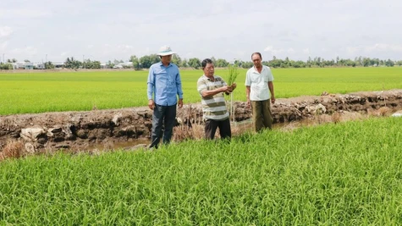
After winning an award at the Science and Technology Innovation Competition, Mr. Liem continued to expand the model to his entire farm of over 7 hectares. Besides raising catfish, the main product that brings high economic value, the farm also develops various fruit trees, raises wild pigs, and supplies fish fry and commercial fish to the market. A special feature of the farm is its organic production approach, minimizing the use of chemicals and pesticides.
According to Mr. Liem, the main source of fertilizer comes from bat guano and wild boar manure. Fruit from the orchard also serves as food for the livestock. In farming, he prioritizes the use of natural predators to control pests and diseases instead of chemicals. "I want to practice clean agriculture, making the most of the available resources on the farm to reduce costs and minimize environmental impact while still producing safe products," Mr. Liem said.
Currently, the model generates revenue of approximately 5-6 billion VND per year and creates stable jobs for many local workers. Not stopping at agricultural production, Mr. Liem also harbors plans to develop experiential tourism linked to ecological agriculture in the future. According to the Chairman of the Union of Science and Technology Associations of the province, Hoang Dinh Can, in recent years, the projects participating in the Science and Technology Innovation Competition have become increasingly diverse, focusing more on practical applications. Many innovations have been implemented in practice and have yielded clear results in livestock farming, education, environmental protection, etc.
It is evident that when the challenges in labor and production are fueled by creativity and the application of science and technology, ideas not only remain on paper but truly come to life, bringing positive values to the community and society.
Source: https://baotayninh.vn/khi-y-tuong-buoc-ra-doi-song-147693.html
![[Photo] Standing Committee member of the Party Central Committee Tran Cam Tu working with the Central Inspection Committee](https://vphoto.vietnam.vn/thumb/1200x675/vietnam/resource/IMAGE/2026/05/28/1779969579668_ndo_br_bnd-2495-jpg.webp)

























































Comment (0)