

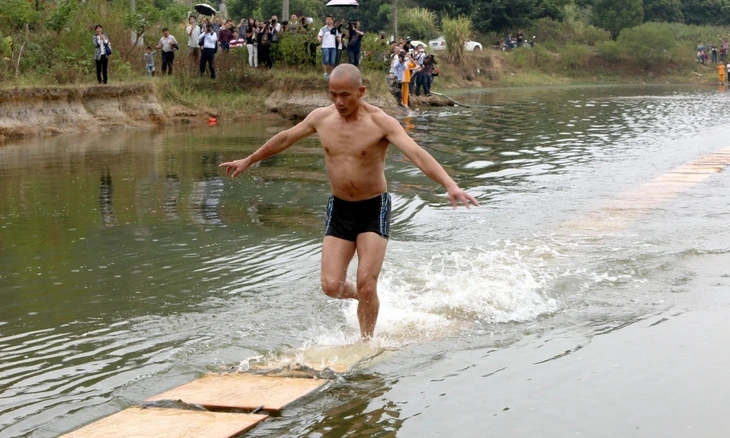
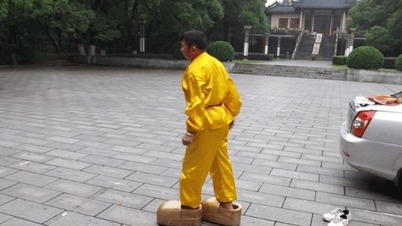
Shaolin monk Shi Liliang performs the water-floating martial art - Photo: XN
How real is this martial arts skill?
Of course, no matter how much one admires Jin Yong's novels, today's readers are discerning enough to realize that such a description of martial arts as light-footedness is completely impossible in real life.
But in reality, lightness skill (or "flying") is still a familiar technique in Chinese kung fu. So, in real life, how much of the lightness skill is there that Jin Yong describes?
Although no martial arts school has officially confirmed "flying and jumping without touching the ground," many traditional Chinese martial arts schools still maintain exercises for body movements, jumping, and balance that people have given the name "lightfooting."
Shaolin is a pioneer in the recorded art of lightness-of-the-foot martial arts. Shaolin monks practice exercises such as pole jumping, walking on narrow wooden planks, climbing steep walls, and carrying sandbags to increase weight while practicing jumping.
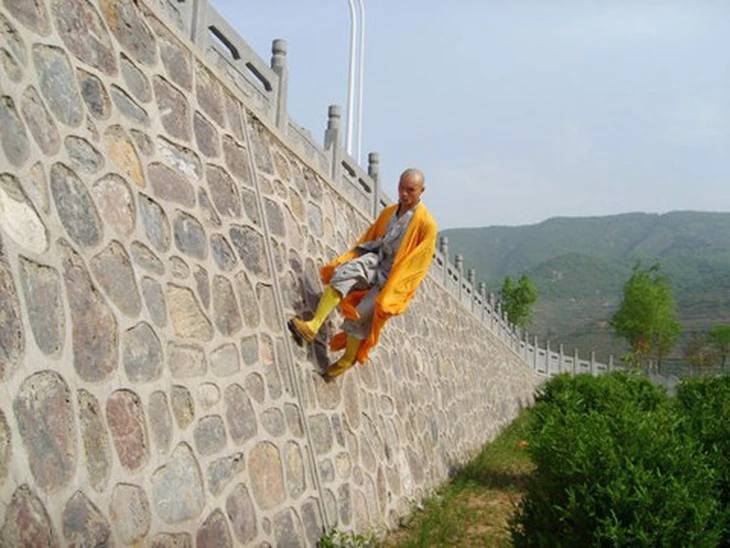
Many Shaolin monks practice martial arts, including lightness skill - Photo: CN
The goal is that when they remove heavy objects, they feel the weight is lighter and their steps are more agile.
Furthermore, Shaolin is also known for its "light kung fu" training method as a sub-branch of external martial arts, which are methods of training in regular hand-to-hand combat.
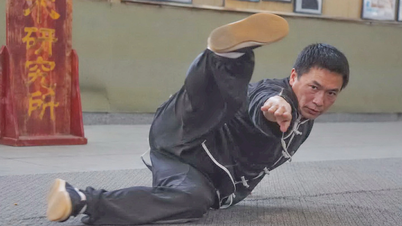
A noteworthy real-life example is the Shaolin monk Shi Liliang from the Southern Shaolin Temple (Fujian). This monk demonstrated running on water for about 125 meters by lightly stepping on floating wooden planks.
He used nearly 200 interconnected floating planks to create a path, then ran lightly, maintaining his balance.
In an interview, Master Shi Liliang stated that it took him nine years to practice this form of lightness-of-the-foot martial arts, known as "Waterwalking."
In *The Legend of the Condor Heroes*, Jin Yong created a martial arts master named Qiu Qianren, nicknamed "Iron Palm Floating on Water," who is considered to have the highest level of lightness skill in the story.
However, Jin Yong also clarified that "floating on water" does not exist in real life, and that such a nickname is merely an exaggeration.
From a physics perspective, the buoyancy of water is insufficient to support the entire body weight. To move on the water's surface (like a basilisk lizard), humans need very high leg speeds—according to some calculations, around 30 m/s (equivalent to ~108 km/h).
This is a speed that exceeds the limits of the human body, equivalent to running three times faster than Usain Bolt - the fastest person on the planet.
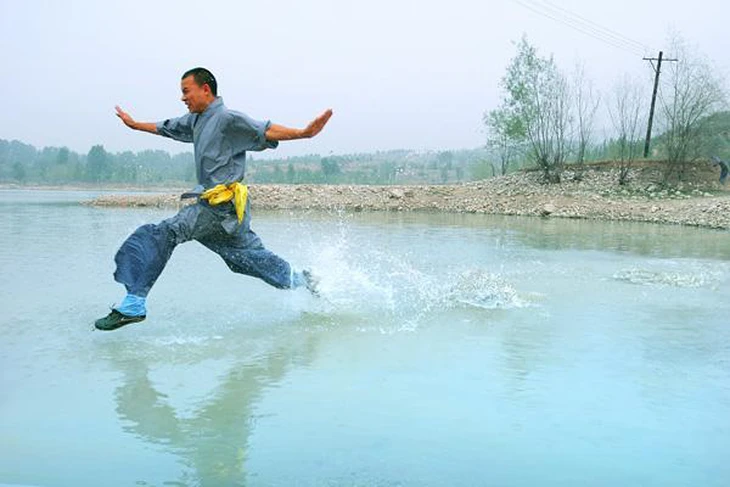
These images only exist in movies or as part of a camouflage performance - Photo: CN
Scientists once calculated that if a person tried to run on water like in the story, they would sink on the very first step because gravity would outweigh buoyancy.
Today, the martial arts community in China acknowledges that lightness skill is essentially just the ability to glide effortlessly and gracefully across thin, light surfaces.
In other traditional martial arts schools such as Wudang and Emei, there are exercises involving pole jumping, leaping, moving across low walls, and maintaining balance on small surfaces. All of these aim to train one's agility, or more practically, "light body technique."
Body control and parkour
While Eastern martial arts practitioners were still diligently exploring the limits of agility, Westerners had developed a nearly identical discipline called parkour.
Parkour is a street movement sport – jumping, climbing, overcoming obstacles – considered the "urban version of acrobatics".
In East Asian countries, many in the parkour community say they are influenced by Chinese martial arts films, where characters jump over walls, leap across rooftops, and move as fast as the wind.
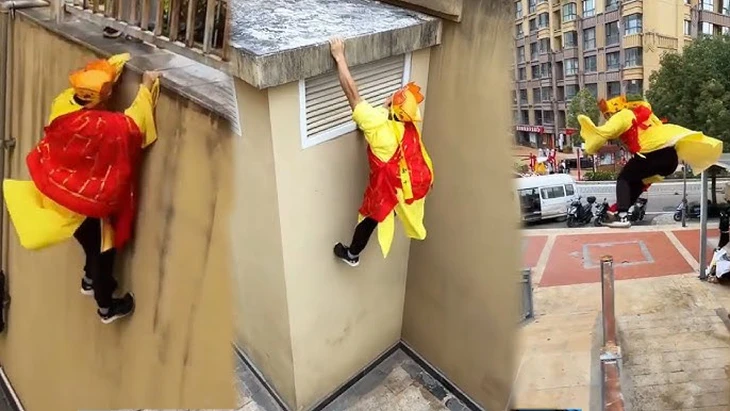
Many parkour artists have previously studied acrobatics - Anh3L PP
In China, many parkour practitioners have gone to traditional martial arts schools to learn "light footwork" or wall jumping techniques, and conversely, martial arts schools also invite parkour instructors to teach their students how to move over obstacles.
Parkour relies primarily on knowledge of physics, landing techniques, and muscle power – it doesn't emphasize internal strength or qi (energy) cultivation. While not entirely "traditional parkour," it is a practical embodiment of parkour in the modern world .
Compared to leaping over walls and performing agile acrobatic jumps in Chinese martial arts films, parkour truly brings the legend of "lightfoot" to life in a more accessible way.
While not quite a leap over a wall with just a single push of the foot, practitioners of traditional Chinese lightness-of-the-body techniques, or modern parkour, can climb a 3-meter-high wall with only two touches of the foot.
Source: https://tuoitre.vn/khinh-cong-ngoai-doi-that-duoc-may-phan-cua-truyen-kim-dung-20250930100824634.htm

![[Photo] First session of the 14th Congress of the Vietnam Trade Union](https://vphoto.vietnam.vn/thumb/1200x675/vietnam/resource/IMAGE/2026/06/03/1780465947883_ndo_br_img-3852-jpg.webp)
![[Photo] Secretary of the National Assembly Party Committee, Chairman of the National Assembly presides over the meeting of the Standing Committee and Executive Committee of the National Assembly Party Committee.](https://vphoto.vietnam.vn/thumb/1200x675/vietnam/resource/IMAGE/2026/06/03/1780480353201_ndo_br_bnd-2585-jpg.webp)
![[Photo] General Secretary and President To Lam presides over a meeting with the Central Organizing Committee.](https://vphoto.vietnam.vn/thumb/1200x675/vietnam/resource/IMAGE/2026/06/03/1780482764658_a1-bnd-4741-3342-jpg.webp)











































![[Video] Sunset at Lap An Lagoon – Where the sun sets over the fishing nets](https://vphoto.vietnam.vn/thumb/1200x675/vietnam/resource/IMAGE/2026/05/31/1780192137701_beach-landscape-sea-water-nature-grass-745871-pxhere-com.jpeg)


































Comment (0)