

According to data from GLOBOCAN, in 2022 Vietnam recorded approximately 1,500 new cases and about 1,000 deaths due to ovarian cancer.
These are the findings presented by experts at the scientific conference "Strengthening the evidence of survival in the treatment of advanced ovarian cancer: The role of PARP inhibitors from data to practice," organized by K Hospital in collaboration with AstraZeneca Vietnam to commemorate World Ovarian Cancer Day - May 8th annually .
The workshop brought together leading oncology experts from across the country, participating directly at key locations such as K Hospital, Nghe An Oncology Hospital, Bac Ninh Oncology Hospital, and online via video link.
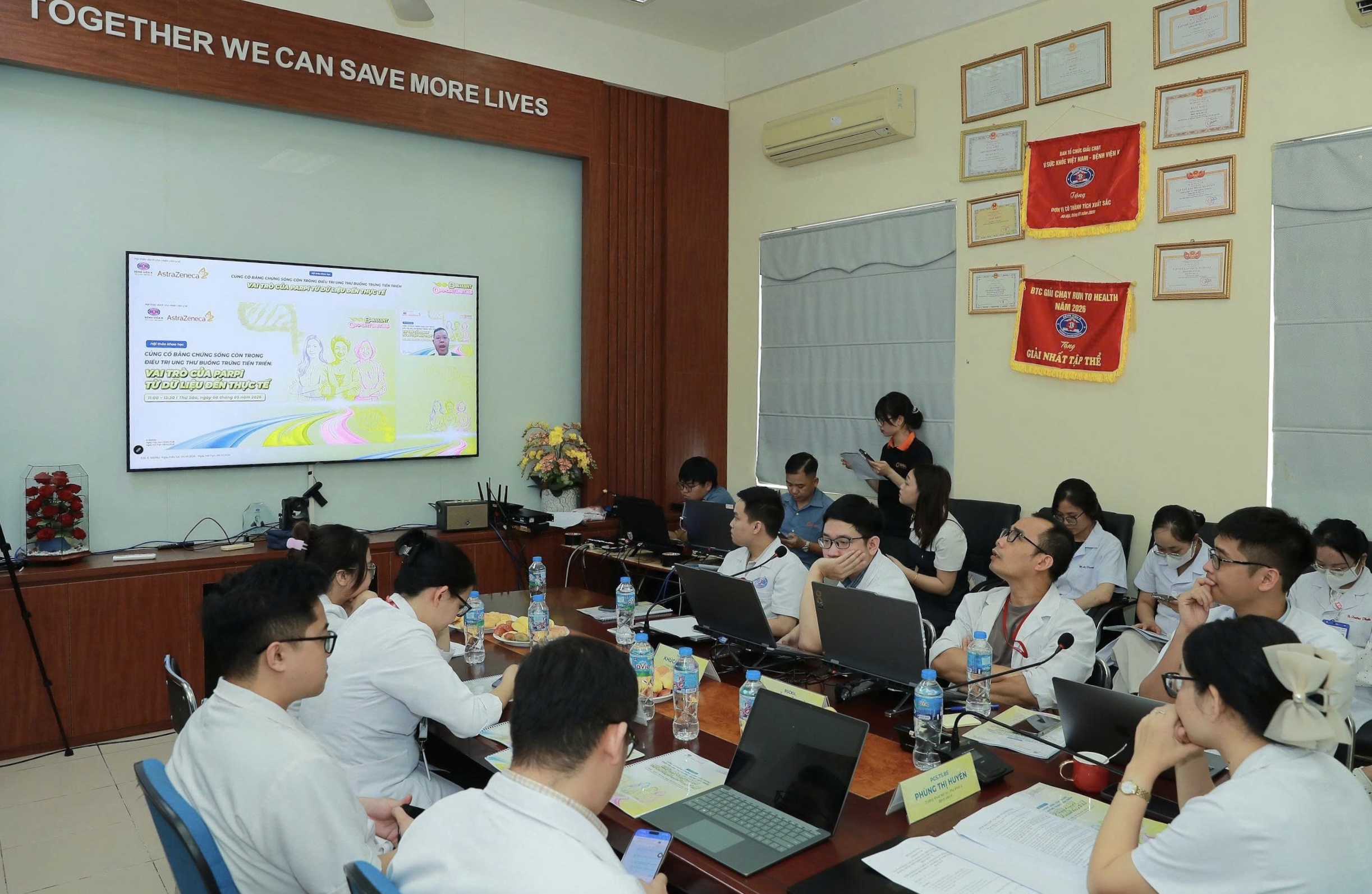
The workshop brought together leading oncology experts from across the country through both in-person and online formats.
The workshop focused on updates in the diagnosis and treatment of ovarian cancer, particularly individualized treatment strategies and maintenance therapy to improve long-term outcomes for patients. In addition, through case study sessions, experts discussed real-world treatment scenarios and best practices in patient management in Vietnam.
Women whose mothers and sisters have had ovarian cancer have a 20 times higher risk of developing the disease than the general population.
Information presented at the conference indicated that the exact cause of the disease remains unclear. Numerous studies have investigated the link between the disease and environmental factors, diet, reproduction, endocrine system, viruses, and genetics, with family history being confirmed; approximately 7% of ovarian cancers have a familial component. Women whose mothers and sisters have had the disease have a 20 times higher risk of developing it compared to the general population.
Family history (primarily in patients with two or more direct relatives with ovarian cancer) is associated with the BRCA1 and BRCA2 genes (hereditary breast and ovarian cancer syndrome [HBOC]). Patients with BRCA1/2 mutations account for approximately 15% (ranging from 7%–21%) of all ovarian cancer patients.
Older age is also a risk factor because the incidence of ovarian carcinoma increases progressively with the number of ovulations. Those who become pregnant before age 25 and experience early menopause are also associated with a reduced incidence of ovarian cancer.
Dr. Vo Thanh Nhan, Head of the Gynecological Oncology Department at Tu Du Hospital, shared that one of the biggest challenges of ovarian cancer is that it often progresses silently with initial nonspecific symptoms that are easily confused with common digestive disorders. This means that many patients are only diagnosed when the disease has already progressed to an advanced stage.
"Therefore, raising awareness of warning signs and proactively seeking early medical attention plays a crucial role in improving the prognosis for patients," said Dr. Nhan.
The 5-year survival rate for ovarian cancer patients detected early is as high as 90%, while that of patients detected late drops to only 30.2%.
According to epidemiological data, the 5-year survival rate for ovarian cancer patients depends heavily on the stage of detection, with approximately 90.5% in early stages but decreasing to 30.2% in late stages.
Without maintenance therapy, more than 50% of patients with advanced ovarian cancer exhibiting positive HRD (homologous recombination deficiency) characteristics may experience recurrence within one year, with a median recurrence time of approximately 10.2 months.

Associate Professor, Doctor Phung Thi Huyen – Head of the Breast and Gynecology Department 2, K Hospital, shared about the challenges in diagnosing ovarian cancer at the conference.
However, currently less than 40% of patients undergo comprehensive HRD testing (according to real-world studies in the US), while identifying tumor biomarkers plays a crucial role in selecting appropriate treatment strategies and optimizing long-term outcomes.
Against this backdrop, advances over the past two decades, from establishing the foundation of standard chemotherapy to the development of targeted molecular biological therapies with maintenance strategies following initial response, are progressively reshaping the new standard of treatment. These advances help extend progression-free survival for many years, aiming for long-term disease control rather than just short-term treatment.
At the workshop, Assoc. Prof. Dr. Phung Thi Huyen – Head of the Breast and Gynecology Department 2, K Hospital, shared: "The majority of ovarian cancer patients are diagnosed at an advanced stage, which poses a major challenge in improving long-term treatment outcomes. Therefore, in addition to initial treatment, developing sustainable disease control strategies is increasingly important in clinical practice."
According to K Hospital: Ovarian cancer symptoms are nonspecific; most women (with ovarian cancer) see a doctor with symptoms 6 or 9 months before diagnosis. The most common symptoms of ovarian cancer include:
- Bloating;
- Pain in the abdomen, back, or pelvis;
- Swelling in the abdomen or pelvis;
- Feeling unusually full right at the beginning of a meal;
- Indigestion;
- Diarrhea or constipation;
- Frequent urination or the urge to urinate;
- Loss of energy or increased appetite;
Source: https://suckhoedoisong.vn/khoang-7-ung-thu-buong-trung-co-tinh-chat-gia-dinh-169260509195126991.htm
![[Image] Hanoi's urban life under the challenge of a "scorching hot" environment](https://vphoto.vietnam.vn/thumb/1200x675/vietnam/resource/IMAGE/2026/05/25/1779706979265_nang-nong-t5-2026-minh-duy-7-4636-jpg.webp)




![[Image] Close-up view of the interchange connecting the two expressways and Long Thanh Airport.](https://vphoto.vietnam.vn/thumb/1200x675/vietnam/resource/IMAGE/2026/05/25/1779703378210_ndo_br_z7863716673926-224453a31600126cce10622af6290afd-4549-jpg.webp)











![[Video] Preventing and avoiding sunstroke and heat exhaustion during hot weather](https://vphoto.vietnam.vn/thumb/402x226/vietnam/resource/IMAGE/2026/05/26/1779753818307_hinh00-01-19-09still001-png.webp)




















































































Comment (0)