

The program attracted around 70 participants, including many students, parents, and tourists who love exploring the ocean. The highlight of the activity was a tour of the Nemo clownfish breeding process and the coral reef cultivation area.
 |
| Many children enjoyed exploring the Nemo fish enclosure at the Oceanographic Museum. |
Research on the breeding of clownfish Nemo has been conducted by the Oceanographic Museum since 2010. Since the beginning of 2026, the unit has successfully bred approximately 7,000 individuals at all stages of development, including broodstock, eggs, and juveniles from 25 days old to several months old.
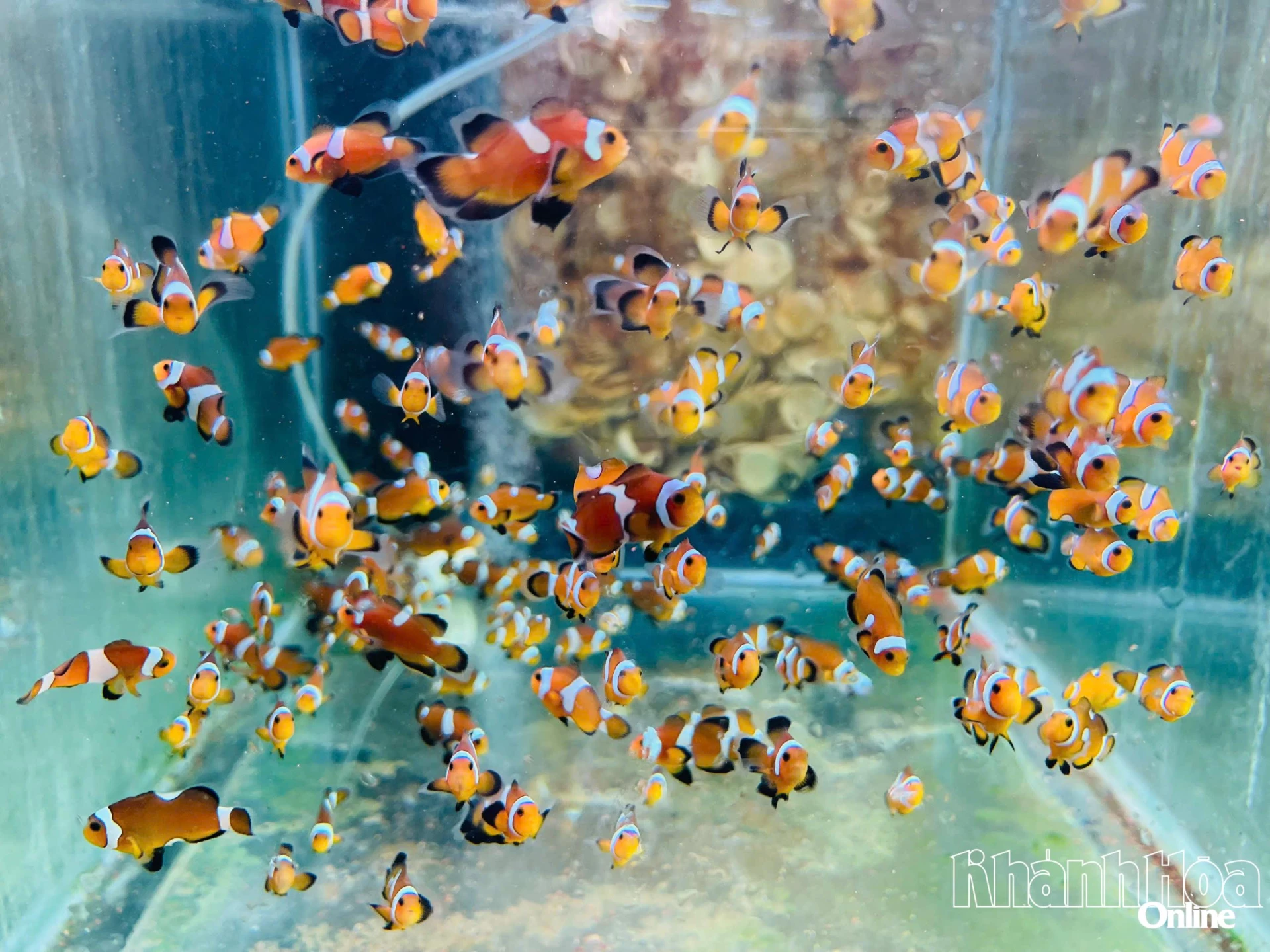 |
| Nemo the fish is studied and bred at the Oceanographic Museum. |
The research team collected the broodstock from the Truong Sa (Spratly) Islands in Vietnam. After research and domestication, the scientists successfully bred Nemo clownfish in artificial conditions, with various developmental stages, from eggs and juveniles to adult fish.
 |
| The Nemo fish breed is a mutation. |
Dr. Truong Si Hai Trinh, Deputy Head of the Information and Communication Department of the Institute of Oceanography, said that the "Museum Open Day" program was organized to help the public better understand the scientific research activities, technological applications, and techniques for domesticating and breeding marine life behind the museum's exhibitions. According to Dr. Trinh, the successful breeding of Nemo fish not only serves as a tourist attraction and exhibition but also contributes to supplying fish to the domestic and export markets. This reduces pressure on natural fishing and supports the conservation of rare marine species.
 |
| Visitors can observe various marine creatures during the "Museum Open Day" program. |
Besides Nemo the fish, the coral breeding area also receives much attention from visitors. Since 2021, the Oceanographic Museum has begun experimenting with breeding hard and soft corals using samples collected from Nha Trang Bay to study their adaptability, growth rate, and conservation of the marine ecosystem. Dr. Truong Si Hai Trinh said: "Although coral only occupies about 1% of the ocean's surface area, it is home to about 25% of marine life. Therefore, researching and protecting coral ecosystems plays a particularly important role in the marine environment."
 |
| Coral is being successfully cultivated at the Oceanographic Museum. |
Not only did the children get to observe the laboratory and the technical process of raising marine life firsthand, but many were also excited to access scientific knowledge through hands-on experiences. Vu Hoang Mat Thuong, a third-grade student from Tan Lap 1 Primary School (Nha Trang ward), said that thanks to the visit, she understood more about the world of marine life. "If we protect the marine environment, fish and marine life will reproduce and thrive more," Thuong shared.
 |
| Little Vu Hoang Mat Thuong was taken by her mother to visit the Oceanographic Museum. |
Meanwhile, young Huynh Nguyen Hoang Phuc (from Dien Khanh commune) said that this was his first time visiting the coral and Nemo fish breeding area at the museum. The practical knowledge helped him better understand the importance of protecting the marine ecosystem. “After today, I will share this with my friends and family so that everyone understands and appreciates the marine life in Nha Trang more. I think young people should work together to protect the marine environment through small things like collecting trash on the beach,” Hoang Phuc said.
 |
| Many visitors were excited to participate in the "Museum Open Day" program. |
Through the "Museum Open Day" program, the Oceanographic Museum not only spreads scientific, technological, and innovative knowledge to the community, but also contributes to igniting a passion for exploring marine science, raising awareness of environmental protection, and preserving marine ecosystems among the younger generation.
According to a research team at the Oceanographic Museum, in order to reduce pressure on natural fishing, besides research and conservation of genetic resources, Nemo fish are also being bred and supplied to domestic and international markets. Currently, Nemo fish typically cost around 45,000 VND per fish; while mutated varieties can cost from 200,000 VND to several million VND per fish. It is expected that the unit will breed approximately 10,000 Nemo fish this year.
THAI NGOC HUY
Source: https://baokhanhhoa.vn/khoa-hoc-cong-nghe/202605/khoi-day-niem-dam-me-kham-pha-khoa-hoc-bien-0c966f9/
![[Photo] The heat at the fireworks display site on the opening night of the Da Nang International Fireworks Festival 2026](https://vphoto.vietnam.vn/thumb/1200x675/vietnam/resource/IMAGE/2026/05/27/1779889741485_ndo_br_z7872039145157-fecaba5112f39e8352544099d7ef4738-5140-jpg.webp)


![[Photo] The courage of new recruits of Brigade 144 on the training ground.](https://vphoto.vietnam.vn/thumb/1200x675/vietnam/resource/IMAGE/2026/05/27/1779881651341_anh-man-hinh-2026-05-27-luc-18-32-52.png)















































![[Photo] The courage of new recruits of Brigade 144 on the training ground.](https://vphoto.vietnam.vn/thumb/402x226/vietnam/resource/IMAGE/2026/05/27/1779881651341_anh-man-hinh-2026-05-27-luc-18-32-52.png)

























Comment (0)