

To realize this historically significant aspiration, building a balanced financial system, in which the capital market—with the stock market at its core—operates robustly and transparently, is a prerequisite.
In this context, the wave of securities companies simultaneously implementing strategies to significantly increase their charter capital is not purely an intrinsic solution for the businesses themselves. This has become a key action, closely aligned with the innovative thinking and decisive direction of the Prime Minister, aimed at unlocking long-term resources for the economy .
Change your management approach to accelerate your progress.
For decades, Vietnam's economic system has operated heavily reliant on credit from commercial banks. The inadequacy of this historical structure lies in the paradox of "using short-term funds to finance long-term projects"—using short-term capital mobilized from the banking system to finance businesses and strategic national infrastructure mega-projects. This not only places significant maturity and liquidity risks on the national financial safety net but also narrows the potential for breakthrough development in the real economy.
Recognizing this macroeconomic bottleneck, the Resolution of the 14th National Congress of the Party clearly outlined the direction for transforming the growth model and restructuring the financial market towards balance, modernization, and sustainability.
To concretize that strategic spirit, at a meeting with the Ministry of Finance at the end of April, Prime Minister Le Minh Hung posed the question: To achieve double-digit growth in the 2026-2030 period, total social investment must increase by approximately 1.7-2 times compared to before. In the context of the state budget being limited to only 20-22%, the head of government clearly outlined the solution to this problem by unlocking the "three pillars" of non-budgetary resources: the fiscal market, institutions, and technology.
Of these three core solution groups, restructuring market resources is considered the leading priority. The Prime Minister emphasized the strong message of reforming management thinking, decisively removing technical barriers so that the stock market and capital market truly become the main channels for medium and long-term capital mobilization; and promoting privatization to enhance transparency and strengthen investor confidence. Alongside this, fiscal resources, institutions, and technology are also identified as inseparable pillars, through tightening budgetary discipline, optimizing public investment, and promoting comprehensive digital transformation in data management.

Faced with this historic requirement, the accelerated increase in charter capital by securities companies in 2026 is no longer a passive step to cope with technical barriers or stringent standards from the State Securities Commission. This is a proactive strategic move by intermediary financial institutions to build a robust hard and soft infrastructure: synchronously integrating into the new information technology system (KRX and its upgrades), establishing a central clearing and settlement mechanism, and implementing account data "cleaning" according to the Government's Project 06. Superior financial capacity is a necessary condition for the market to be ready for the upcoming macroeconomic upgrade.
The race to raise capital: Scale is the "passport" to the big playing field.
Over more than two decades of formation and development, the Vietnamese stock market has witnessed a strong transformation in both scale and the internal capacity of intermediary financial institutions. To date, the market has over 70 securities companies in operation, creating a dynamic and healthy competitive ecosystem. The industry's top structure has been clearly defined, with over 30 large enterprises listing their shares or registering for centralized trading on the HOSE, HNX, and UPCoM exchanges. The transparency of information according to the strict standards of the listing exchange not only enhances credibility but also acts as a magnet attracting both domestic capital and foreign indirect investment (FII).
In particular, the financial capacity and total assets of the entire industry have continuously set new historical milestones in the recent period. The race to increase charter capital has developed extensively, pushing the potential of many entities beyond 10,000 billion VND, with some leading enterprises even reaching 15,000 to over 20,000 billion VND. The emergence of these "super institutions" with equity capital and capital supply capacity equivalent to, or even superior to, some small and medium-sized commercial banks, has completely changed the structure of the capital market. No longer purely playing the role of small-scale brokers, securities companies have now risen to become multi-functional financial institutions, possessing a modern digital ecosystem.
The market from the beginning of 2026 to the present has witnessed a series of significant milestones, transforming the capital raising race into a widespread strategy to secure a "passport" to the international arena. These companies include:
SSI Securities: Continuing to affirm its leading position by implementing a plan to issue bonus shares and a large-scale offering to existing shareholders. This decisive move helps SSI solidify its position as the leading company in terms of charter capital in the entire industry, aiming to break through the margin lending limit for foreign investors and having sufficient capacity to underwrite issuance transactions worth billions of USD.
Vietcap Securities (VCI): By continuously increasing its internal financial strength, Vietcap is focusing its efforts on anticipating large-scale cross-border M&A (mergers and acquisitions) projects, while simultaneously enhancing its competitive position in the financial advisory sector for multinational corporations entering Vietnam.
MB Securities (MBS): Is actively pursuing capital increase plans. This additional capital of trillions of dong will be the core resource for the company to reinvest in its core technology infrastructure, comprehensively implement data cleaning and biometric security campaigns in accordance with the directives of Project 06.

Strengthening the foundation of digital finance and shaping a new position.
The trend of strengthening internal capabilities, expanding operations, and adopting technology is spreading strongly among both companies affiliated with large banking institutions and publicly traded joint-stock companies.
A clear example of this is Vietcombank Securities Company Limited (VCBS), a securities institution backed by state-owned commercial banks. This company recently announced the completion of its first capital increase to VND 8,500 billion in May 2026.
This is a strategic step in the overall plan approved by the Vietnam Foreign Trade Bank (Vietcombank) to increase VCBS's charter capital to VND 12,500 billion (an additional VND 6,000 billion in 2026 and VND 4,000 billion in 2027).

Among joint-stock companies, representing the wave of breakthroughs in financial potential is An Binh Securities Joint Stock Company (ABS). According to the report presented at the 2026 Annual General Meeting of Shareholders, in 2025, ABS recorded exceptional growth with operating revenue reaching VND 537 billion and pre-tax profit exceeding VND 219.5 billion (growth of 42% and 67% respectively compared to 2024), thanks to effective control of operating costs.
Entering 2026, to realize its strategic goals with a revenue target of VND 1,175 billion and a pre-tax profit target of VND 600 billion, ABS has approved a comprehensive plan to expand its capital base by more than VND 3,000 billion.
The core of this plan is to increase charter capital beyond VND 3,000 billion through a private placement of 200 million shares combined with the issuance of ESOP shares, while also issuing up to VND 1,000 billion in public bonds and implementing a roadmap to transfer listing to the HOSE exchange to support proprietary trading and margin lending activities.
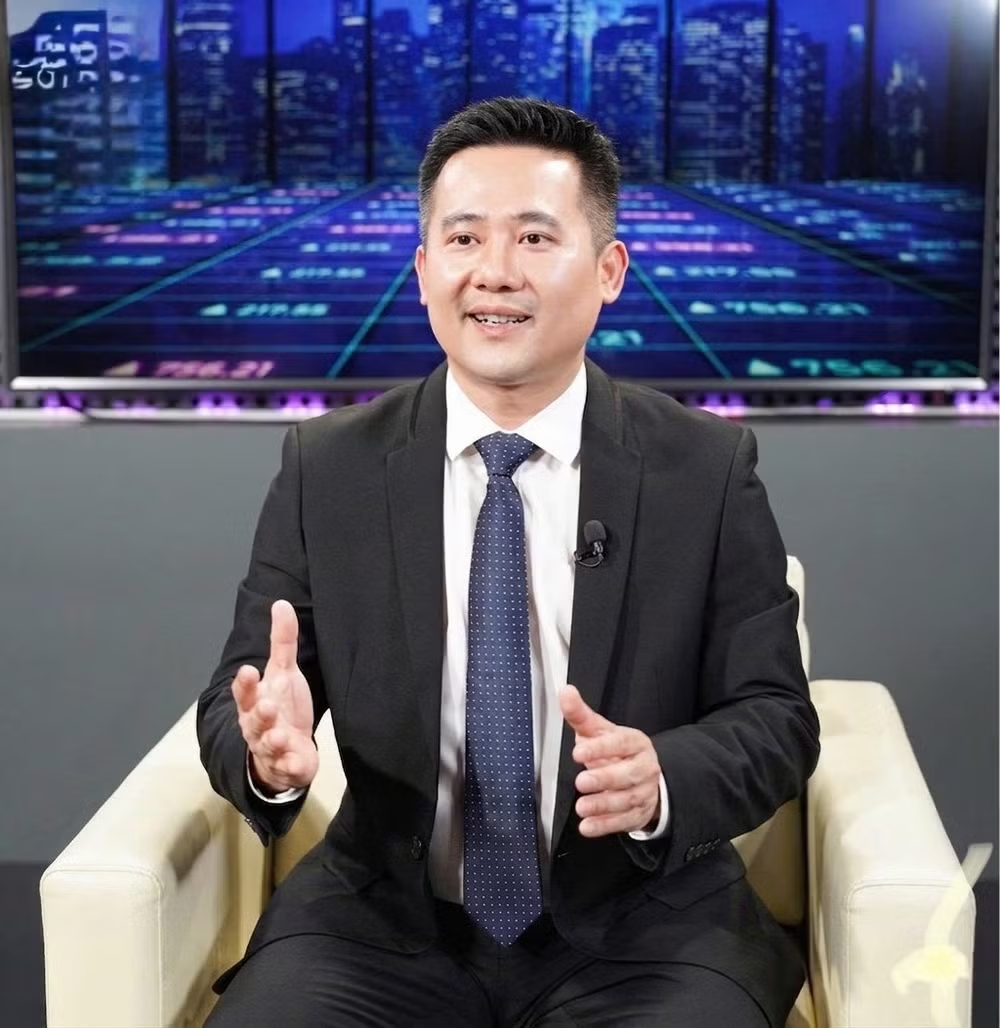
The proactive and coordinated preparations of leading institutions such as SSI, Vietcap, MBS, and the decisive steps taken by VCBS and ABS are not just about the growth of individual units. These are representative pieces that reflect the sustainable, transparent, and disciplined development mindset of the entire securities industry, creating a solid foundation for future upgrades.
From "brokerage street" to modern investment banking model
The growing scale of the national economy in the new era demands that businesses' long-term capital needs be met exponentially. Increasing capital scale helps securities companies move beyond the limitations of traditional activities dependent on small brokerage fees, shifting comprehensively towards a true "Investment Banking" (IB) model in accordance with international standards.
According to Dr. Le Xuan Nghia, a member of the National Financial and Monetary Policy Advisory Council, the current large influx of capital is likened to a new lifeline, unlocking and creating a comprehensive surge in three core competency areas.
First and foremost, this capital flow is the key to enhancing the underwriting capacity and financial structure of businesses. With a capital base of thousands, even tens of thousands of billions of dong, securities companies now have the strength and resources to proactively arrange and underwrite large-scale bond and stock issuances for national mega-projects - from key transportation infrastructure and renewable energy to cutting-edge semiconductor industries.
Simultaneously, this also serves as a strategic leverage to optimize margin lending. The strong surge in equity capital has expanded lending margins legally and safely, while establishing a solid liquidity foundation. The inevitable consequence is that we will be perfectly prepared to anticipate the anticipated surge in trading demand from both domestic and foreign investors as the market enters a boom phase.
Furthermore, this abundant financial resource also carries the mission of creating and promoting green financial products (ESG). This can be considered a groundbreaking step, directly serving the commitment to a circular economy and a comprehensive green transformation strategy strongly affirmed in the Party's 14th National Congress documents. Through this, social capital will be directed and integrated into sustainable financial instruments for the future.
Risk management through technology, ensuring safety according to international standards.
A crucial question arises: After undertaking a rapid wave of capital increases, how will securities companies manage risk to safeguard macroeconomic capital flows?
The actions of the new government have clearly outlined the direction: Growth in scale must go hand in hand with sustainability in quality; safety should not be sacrificed for speed. In response to this challenge, securities companies are adopting proactive risk management strategies based on digital technology and approaching international standards such as Basel III in the financial sector, maintaining capital adequacy ratios far exceeding the minimum required levels.
From the perspective of a company undergoing a significant restructuring of its technical infrastructure, Mr. Nguyen Quang Dat, General Director of An Binh Securities Joint Stock Company (ABS), analyzed:
For a financial institution, business expansion must always go hand in hand with sustainability and rigorous risk management. To safely manage a capital flow that has more than tripled, ABS has been implementing a comprehensive management strategy encompassing both technology and human resources. We are strengthening our services and upgrading our core technology systems to ensure smooth and secure transactions, supporting more efficient investment management. The ABS Invest application platform is considered the "heart" of our smart investment ecosystem, enabling optimal portfolio management and risk control.
Simultaneously, the organizational structure has been standardized, and the capabilities of key personnel have been enhanced through an ESOP program to retain talented employees and leverage the internal strengths of the staff. Besides establishing a specialized proprietary trading department to optimize resources, a core risk hedging advantage of ABS is the effective utilization of its comprehensive cooperation platform with ABBANK and ABF Fund Management. This collaboration creates a synchronized financial solution chain, helping to control cash flow and conduct multi-faceted assessments, ensuring that every expansion step is geared towards efficient and sustainable development.
Expectations for the macroeconomic picture over the next 3-5 years.
Looking at the broader picture over the next 3 to 5 years, as the financial capacity of securities companies aligns with the government's stable macroeconomic direction, the Vietnamese capital market has the opportunity to enter a golden age of significant development.
The strong financial capacity of intermediary institutions is a prerequisite for reputable international rating agencies such as MSCI and FTSE to upgrade Vietnam to "Emerging Markets". Once the upgrade hurdle is overcome, foreign capital from major investment funds around the world will automatically flow into Vietnam, estimated to reach billions of USD annually.
The market structure will undergo a fundamental qualitative change: The proportion of institutional investors, open-ended funds, and voluntary pension funds will increase significantly, playing a leading and regulating role in the market, replacing the herd mentality and erratic fluctuations of the previous period, which relied primarily on small individual investors. The synergy between the capital size of securities companies and the maturity of investors will create a capital market with depth and resilience against global macroeconomic shocks.
The growth of the capital market will create a perfect "communicating vessel" mechanism with the banking system. Bank credit will return to its core area of expertise, which is providing short-term and working capital to the economy; meanwhile, the entire demand for long-term capital, seed capital for investment and development of businesses and the nation, will be shared and thoroughly addressed through the capital market.
In light of the Resolution of the 14th National Congress of the Party and the close, decisive, and forward-thinking guidance of the Government, the modernization and upgrading of intermediary financial institutions is creating a historical impetus. Unlocking long-term capital is the key to opening up new growth opportunities, steering the Vietnamese economy steadily into an era of national progress.
Source: https://nhandan.vn/khoi-thong-mach-mau-von-dai-han-cho-nen-kinh-te-post964835.html



![[Photo] Standing Committee member of the Party Central Committee Tran Cam Tu working with the Central Inspection Committee](https://vphoto.vietnam.vn/thumb/1200x675/vietnam/resource/IMAGE/2026/05/28/1779969579668_ndo_br_bnd-2495-jpg.webp)
















![[Video] Heavy rain in Hanoi, many streets partially flooded.](https://vphoto.vietnam.vn/thumb/402x226/vietnam/resource/IMAGE/2026/05/28/1779982477251_2-3360-png.webp)










































































Comment (0)