

Representatives from the Ministry of Education stated that teachers currently face a great deal of pressure, and therefore urged local authorities and management levels not to make "happy schools" a criterion for emulation campaigns.
At the seminar on happy schools held on October 25th by the Vietnam Institute of Educational Sciences and the Happy Schools Support and Development Fund, Mr. Vu Minh Duc, Director of the Department of Teachers and Management Staff, Ministry of Education and Training , acknowledged that happiness is an abstract concept, understood differently by each person and at different stages of life. In short, happiness is a feeling of excitement and positive emotion experienced by individuals in specific circumstances. Using his own experience as an example, Mr. Duc told his generation that going to school is happiness.
Regarding the reasons for building happy schools, Louise Aukland, a neuroscience researcher at the University of Oxford, UK, argues that the education sector has a responsibility to create a better learning environment for students.
Citing figures from the United Nations Educational, Scientific and Cultural Organization (UNESCO) and UNICEF, Louise stated that one in three students experiences bullying at school every month and that 20% of young people globally are experiencing mental health problems.
"We shouldn't just make students laugh, but help them enjoy coming to school, develop positive feelings, thoughts, and mindsets. Happy young people will achieve better results," she said.
Since 2018, when the Ministry of Education and Training began implementing the "happy school" model, some provinces, cities, and schools have turned this activity into a competitive movement, with summaries and awards. However, Mr. Vu Minh Duc said that this must stem from the inherent needs of the schools and teachers, aiming to bring positivity and enthusiasm to students.
"Don't turn 'happy schools' into a movement or a competition criterion that schools are forced to implement. That would only create more pressure on the schools," Mr. Duc expressed.
Furthermore, according to Mr. Duc, many schools have implemented these models effectively, helping to reduce academic pressure for both students and teachers, making both teachers and students enjoy attending classes. However, some models are unsuitable and are being exploited for economic purposes. Therefore, he suggested that schools must ensure the preservation of core values.
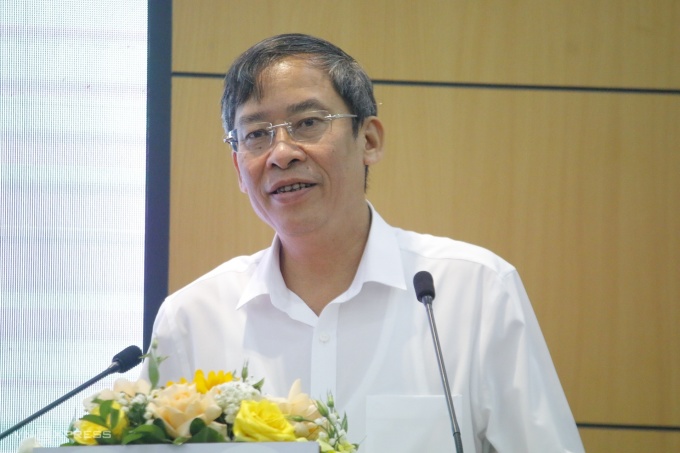
Mr. Vu Minh Duc, Director of the Department of Teachers and Management Staff, Ministry of Education and Training, at the seminar on the morning of October 25. Photo: Thanh Hang
Dr. Le Thi Quynh Nga, from the Vietnam Institute of Educational Sciences, suggests a model of a happy school with two main elements: internal and external.
Ms. Nga explained that "external" refers to factors such as a friendly and safe environment, solid facilities, and suitability for children's age and development. Furthermore, this criterion also encompasses interpersonal relationships, ensuring students feel respected, trusted, and supported.
"For example, if the school gate is about to collapse, or the ceiling fan is in danger of falling, how can students be happy? Similarly, the way teachers treat each other, and how staff treat students, also needs to be emphasized, ensuring civility and respect," she said.
Regarding internal factors, Ms. Nga believes that since happiness is a personal emotional state, for students to experience happiness, they need to be healthy both physically and mentally.
"Schools should actively organize sports activities to help students improve their health. As for their mental well-being, they should focus on supporting positive thinking, which will lead to positive emotions and ultimately happiness," Ms. Nga said.
Sharing her practical experience, Ms. Le Thi Mai Huong, Deputy Principal in charge of the Experimental Primary, Secondary, and High School of Educational Science, said that instead of creating a common set of regulations for the entire school, students in each class develop their own rules. This makes them more responsible and committed to following them effectively.
"If students violate school rules, we focus on psychological counseling to understand why the child reacted that way. We can't just criticize whenever something is out of place," Ms. Huong said, arguing that school is a place for people to develop their potential.
Nearly a week ago, a workshop on happy schools, organized by the Ministry of Education and Training and the Nguyen Binh Khiem - Cau Giay Education System, attracted over 500 teachers from across the country. At this workshop, educators discussed and sought solutions to reduce pressure in schools, explore positive educational approaches, and address school violence, among other topics.
Thanh Hang
Source link



![[Image] Nearly 125,000 Hanoi students completed the Literature exam for the 10th grade entrance exam.](https://vphoto.vietnam.vn/thumb/1200x675/vietnam/resource/IMAGE/2026/05/30/1780117233041_ndo_br_thiet-ke-chua-co-ten-2-png.webp)










![[Video] 2 candidates violate exam regulations on the first day of the 10th grade entrance exam in Hanoi.](https://vphoto.vietnam.vn/thumb/402x226/vietnam/resource/IMAGE/2026/05/30/1780156540244_dung01-11-24-36099still011-png.webp)




















































































Comment (0)