


Imagine this: you're soaking in a hinoki wood bathtub surrounded by fragrant steam, soft lighting changing with your breath, while in the other corner, a plush, curved sofa awaits. This is the vision of the future home that leading designers from around the world have outlined at Milan Design Week 2026.
The home – a “private sanctuary”
The most prominent trend this year revolves around two seemingly purely functional spaces: the kitchen and the bathroom – both are being radically redefined, becoming "personal sanctuaries" in each home.
According to Channel News Asia (CNA), the "soft kitchen" trend is clearly evident at EuroCucina. The Cesar brand introduced the Tangram kitchen set with five flexible, curved modules, creating a "flowing" layout instead of the rigid, traditional right-angled design.
Poliform takes this idea further with the Harp kitchen island – which looks more like a spacious work surface than a conventional countertop, incorporating light wood, soft curves, marble tops, and polished steel details. This design “reflects the increasing role of the kitchen as the heart of the home, serving as both a workspace and an aesthetic statement.”
Bathroom designs tell a different story. The global healthcare economy reached $6.8 trillion in 2024 and is projected to hit $9.8 trillion by 2029 – that wave is heading straight into every family's bathroom, according to CNA.
The Gessi brand has launched the Rituale del Vapore prototype, which allows users to adjust the intensity of steam from the showerhead, incorporating color and aromatherapy.
Grohe takes it a step further with the Spa Private Collection Vanity – integrating facial steam, essential oil capsules, customizable colored lighting, and a dedicated cooling compartment for cosmetics. Interior designer Molina Hun, co-founder of Sojonohun in Singapore, commented to CNA that this trend reflects a desire to “bring the spa experience closer to everyday life.”
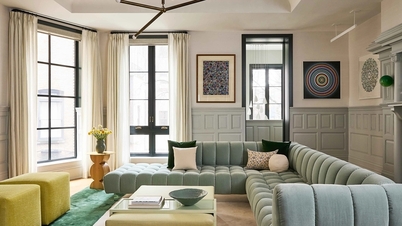
The Xtra brand (Singapore) told CNA that the market is witnessing “a shift away from rigid minimalism towards tactile hedonism with soft curves inspired by nature and oversized upholstery, meeting the growing need for refuge and psychological comfort in living spaces.”
When the hand challenges the algorithm
The remainder of Milan Design Week 2026 poses a question: in an age where AI can generate images, drawings, and even design ideas in seconds, what role does the human hand still play? It seems the answer will be revealed in the design philosophies at Milan this year.
Missoni transformed its production line into a stage, placing a giant industrial loom at the center of the exhibition, continuously weaving fabric right before the eyes of visitors.
According to Architectural Digest , instead of concealing the process as is customary in the luxury industry, the brand “brings the act of weaving to the foreground – the machine is both the object and the actor, continuously producing fabric in real time, emphasizing the rhythm, repetition, and choreography of the craft.”
Loro Piana chose a more understated approach: displaying dozens of plaid fabric samples as independent technical studies, each piece a separate investigation into material and structure.
Prada Home – with an exhibition curated by American artist and curator Theaster Gates – showcases a collection of handcrafted Japanese ceramics not to flaunt luxury, but to celebrate “the tactile and cultural significance of ceramics, their ability to preserve memory, gestures, and time.”
This year, recycled materials have truly become the standard for the first time, no longer just a marketing gimmick. Designer Carlo Colombo at Lema introduced the Traverso table with legs made from Re-Glassing – a recycled glass material extracted from solar panels that have reached the end of their lifespan.
Jean-Marie Massaud's Aom collection for Arper combines a lightweight polypropylene frame and recycled Breathair polyester fibers, completely replacing traditional polyurethane foam. According to CNA, this streamlined structure also makes the product "easier to assemble."
Marble – the oldest material in architectural history – has also been reinvented: “it has movement, it has presence, it becomes a stronger focal point in the space,” according to interior designer Molina Hun.
The Traverso table by Colombo and the Stadium d'Hermès table set by the design duo Barber and Osgerby – made entirely from Carrara Venato and Verde Alpi mosaic stone – are two of the most outstanding examples.
First impressions at Milan 2026
The Fuorisalone Award 2026 – the highest honor for outdoor exhibitions – went to the project Ooooh, that's EpiQ! designed by Ricardo Orts Ulises for Škoda Auto. Located in the courtyard of Palazzo del Senato, the project impresses with its soft forms combined with an interactive digital dome, according to ArchDaily . The Aesop brand launched its first Aposē lamp collection, consisting of three models – table lamps, pendant lamps, and floor lamps – handcrafted in Italy and Germany in collaboration with the Flos lighting brand, limited to 500 sets, according to Who What Wear . Notably, Villa Pestarini – an architectural masterpiece designed by architect Franco Albini in 1938-1939 – opened to the public for the first time with all its original details intact.
Source: https://baodanang.vn/milan-design-week-2026-ve-ngoi-nha-tuong-lai-3338759.html





![[Photo] The General Secretary, President and his wife lay flowers at the Ho Chi Minh Monument in Manila.](https://vphoto.vietnam.vn/thumb/1200x675/vietnam/resource/IMAGE/2026/05/31/1780219759477_anh-man-hinh-2026-05-31-luc-16-29-07.png)



















![[Video] Sunset at Lap An Lagoon – Where the sun sets over the fishing nets](https://vphoto.vietnam.vn/thumb/340x192/vietnam/resource/IMAGE/2026/05/31/1780192137701_beach-landscape-sea-water-nature-grass-745871-pxhere-com.jpeg)









































































Comment (0)