

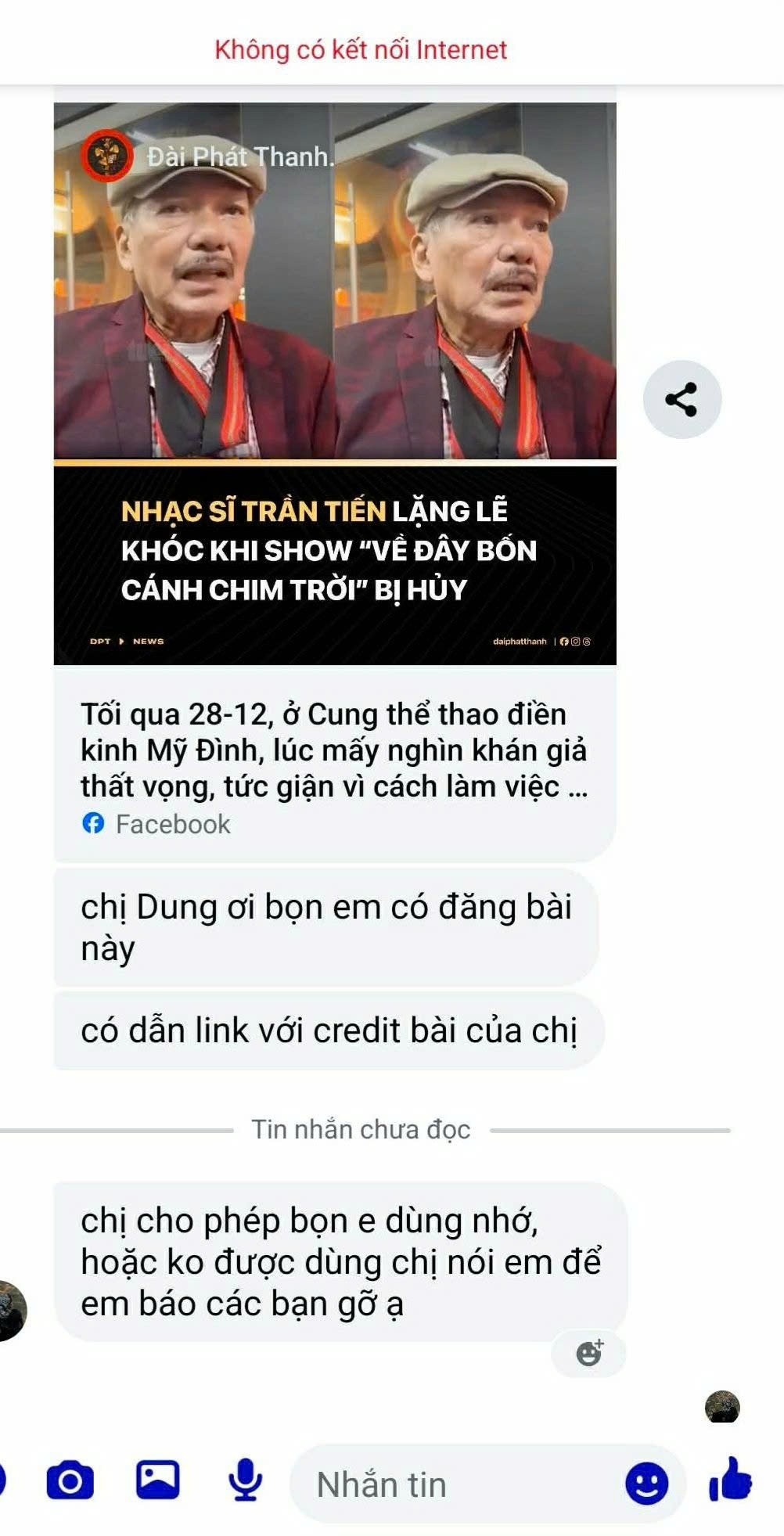
A video of musician Tran Tien sharing his thoughts after the cancellation of his show "Ve Day Bon Canh Troi," posted on Tuoi Tre Online, was quickly "stolen" by the Radio Station's Facebook page. A representative from this page then sent a message to the reporter who wrote the article with the content shown in the image - Screenshot.
Copyright infringement in journalism is a very serious and increasingly sophisticated problem. It's not just about copying verbatim; many accounts, fan pages, and websites use techniques like "rewriting" news, employing automated tools, and even artificial intelligence to rewrite articles in a different way, obscuring the original source.
But no matter how the wording is altered, the essence remains the appropriation of other people's intellectual labor. It's a form of "brainstorming" in the digital environment.
This situation is even more dangerous because it not only steals an innovative product but also distorts the information ecosystem.
When social media platforms "examine" content, they optimize advertising.
When a journalistic work is stolen, abridged, its headlines are altered, its context changed, and it is posted on "parasitic" websites, it not only causes economic damage to the news organization and journalist, but can also create information chaos, erode social trust, and even contribute to the spread of fake news and misinformation.
Genuine journalism requires significant investment, while many online platforms simply wait for mainstream media to complete the most difficult part, then "steal" the content, optimize advertising, boost views, and profit from the intellectual labor of others. Journalists are held accountable, while those who steal information reap the benefits.
The root cause of this situation lies not only in the lack of legal regulations, but also in the gap between regulations and enforcement. The online world is evolving rapidly, while the processes of detection, proof, removal requests, penalties, and lawsuits are often slow, complex, and costly. This delay fosters a disregard for the law.
The second reason is economic gain. When the profit from violating the law outweighs the risk of being penalized, people will continue to violate it.
The third reason is the low level of public awareness regarding journalistic copyright. Many people still think that online news is "public property"; taking a few excerpts, changing a few sentences, and adding "source" is enough. But copyright is not just about whether or not to cite the source.
The fourth reason is that the responsibility of digital platforms is not commensurate. If platforms only focus on traffic without controlling the source of content, they will inadvertently create conditions for the spread of intellectual property theft.
The solution first requires a change in perspective. Social media platforms reposting news from newspapers shouldn't be considered a minor issue. Stealing, modifying, abridging, commercially exploiting, and misrepresenting the source are acts of intellectual property infringement and must be punished.
We need an alliance to protect journalistic copyright.
Directive 38 has set forth the requirement to focus on combating, preventing, and handling acts of intellectual property infringement. This spirit needs to be concretized in the field of journalism through reviews and handling of websites, fan pages, and social media channels that specialize in copying, plagiarizing, and profiting from news articles. It's not just about punishing the uploaders, but also addressing the entire chain of interests behind them – namely, advertising, affiliate marketing, payment intermediaries, and technical operating units – if they intentionally abet such activities.
At the same time, digital platforms need to be held more accountable. Platforms cannot simply claim that content is uploaded by users. When they have distribution algorithms, monetization mechanisms, and advertising policies, they also have a responsibility to detect, remove, limit the spread of, and prevent the recurrence of copyright infringement in journalism. A faster, more transparent "notification and removal" mechanism with clearer responses for news organizations is needed.
Media organizations need to cooperate to protect their rights. There is a need for a common database of journalistic works, copyright marking tools, an automated plagiarism detection system, a common legal focal point, and even a media copyright protection alliance to represent them in negotiations, issuing warnings, requesting removals, initiating lawsuits, or advocating for action.
Furthermore, it is necessary to cultivate a culture of respect for copyright among the public. Readers also play a very important role. When readers choose to read reputable news, share original links, and do not support websites that "recycle news," "clickbait," or "copy and paste," they are contributing to protecting a healthy information environment. A decent press cannot exist if society is indifferent to the theft of journalistic information.
It is also necessary to promote economic models for journalism that are suitable for the digital age. Copyright protection should not only be about "banning" and "punishing," but also about creating mechanisms so that quality journalistic content is distributed legally, licensed flexibly, compensated fairly, and receives a fair share of revenue when appearing on major platforms. When rights are clearly defined, legal use will be easier, and theft will have less room to thrive…
Mr. Nguyen Quang Dong (Director of the Institute for Policy Research and Media Development):
Vietnamese journalism is currently facing intellectual property infringement in two main forms.
One type of content is obtained by parties, including KOLs and KOCs, who take free content from the press, edit it into their own content, and profit from it without sharing the revenue with the news organizations.

Mr. Nguyen Quang Dong
Secondly, and more sophisticatedly, technology companies are taking data from news outlets to train large-scale language models like Chat GPT...
This form of intellectual property infringement is even more difficult to identify and complex.
Vietnam's legal framework in general, and in the field of intellectual property and copyright in particular, is generally not outdated compared to the rest of the world . However, Vietnam lacks the capacity to enforce the law effectively.
Two preferred short-term solutions are for media organizations to form a joint paywall and charge a fee for reading certain high-quality, exclusive articles.
The Press Department or the Vietnam Journalists Association could help promote the formation of this alliance so that newspapers would simultaneously erect a wall of subscription fees to protect their rights. Implementing subscription fees would not only increase revenue for newspapers but also provide a better safeguard for copyright protection.
That wall would provide additional evidence to prove copyright infringement when news organizations sue in court over copyright violations.
Mr. Nguyen Duc Loi (Permanent Vice President of the Vietnam Journalists Association):
With the emergence of new forms of journalism, copyright infringement also appears in new forms that are more difficult to detect and address.
Many media outlets have made efforts to combat this problem, but the results have not been as expected due to various reasons.

Mr. Nguyen Duc Loi
Firstly, public awareness of intellectual property rights is limited. Many people do not consider the unauthorized and uncredited use of journalistic content as a violation of the law.
There are social media sites that repost content produced by news organizations without attribution, and even remove the logos and images of the news organizations that produced the content. And of course, they don't share the revenue from this content with the news organizations.
Secondly, while government agencies have issued numerous relevant legal documents to combat this problem, some provisions have not kept pace with the new situation and have little effect in regulating infringing behavior. Furthermore, the penalties for violations are not strong enough, being very low compared to the profits obtained from copyright infringement, thus failing to provide sufficient deterrence.
Furthermore, many media organizations have not paid sufficient attention to the issue of copyright infringement and lack the determination to handle copyright violations within their own organizations. It is very rare for media organizations to file lawsuits in court when their copyrights are violated.
In my opinion, the solution is for legal documents to be updated more effectively, with stricter penalties. Press agencies need to be more determined in their enforcement. The Vietnam Journalists Association is also considering establishing a copyright protection center, similar to what the Vietnam Writers Association and some other associations have done. This is necessary but difficult to implement given the limited human resources of these associations.
Furthermore, there needs to be ethical standards for those creating digital content, requiring them to respect copyright and uphold integrity. It is unacceptable that a journalistic work, which requires significant investment of time, effort, intellect, and even blood, is stolen in a matter of seconds the moment it is published.
Regarding the solution of charging for newspaper subscriptions, which some countries have implemented, this is a necessary step, but it must be done gradually. Currently, some Vietnamese media outlets have adopted this approach, but the results have not been as expected.
Source: https://tuoitre.vn/khong-the-bao-chi-lam-ke-lay-cap-huong-loi-20260519095001361.htm
![[Photo] The General Secretary, President and his wife begin their state visit to the Philippines.](https://vphoto.vietnam.vn/thumb/1200x675/vietnam/resource/IMAGE/2026/05/31/1780230559452_anh-man-hinh-2026-05-31-luc-19-28-11.png)

![[Photo] Admire the coral "masterpiece" amidst the million-year-old heritage of Dak Lak province.](https://vphoto.vietnam.vn/thumb/1200x675/vietnam/resource/IMAGE/2026/05/31/1780221235105_anh-man-hinh-2026-05-31-luc-16-53-27.png)
![[Photo] Solemn bathing ceremony and Buddha procession in Hue](https://vphoto.vietnam.vn/thumb/1200x675/vietnam/resource/IMAGE/2026/05/31/1780228263543_1-jpg.webp)


























![[Video] Sunset at Lap An Lagoon – Where the sun sets over the fishing nets](https://vphoto.vietnam.vn/thumb/340x192/vietnam/resource/IMAGE/2026/05/31/1780192137701_beach-landscape-sea-water-nature-grass-745871-pxhere-com.jpeg)







































![[Photo] Admire the coral "masterpiece" amidst the million-year-old heritage of Dak Lak province.](https://vphoto.vietnam.vn/thumb/402x226/vietnam/resource/IMAGE/2026/05/31/1780221235105_anh-man-hinh-2026-05-31-luc-16-53-27.png)
































Comment (0)